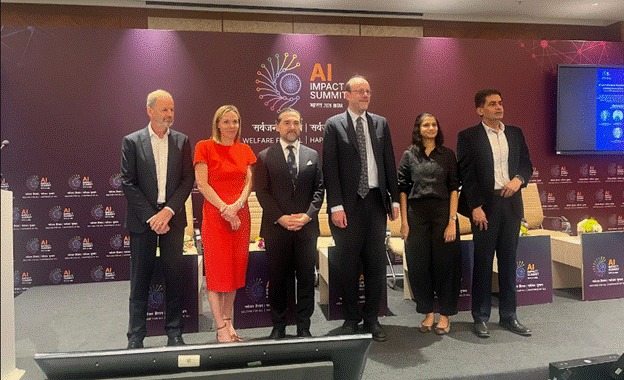
Inclusive AI Growth Depends on Public Systems, Open Innovation, and Balanced Global Governance, says Panel

AI Could Be a Game Changer for Emerging Markets & Developing Economies: Johannes Zutt, Vice President, South Asia Region, World Bank Group
The session “AI and the New Frontier for Economic Progress: Linking Innovation to Inclusive Growth” at the India AI Impact Summit 2026 brought together leading economists, development practitioners and global policy thinkers to examine a defining question for the next decade: whether artificial intelligence will widen economic divides or become a catalyst for broad-based prosperity. The discussion contemplated the structural conditions required for AI-led growth: productivity gains, public-sector transformation, open innovation ecosystems and labour-market readiness.
Framing the opportunity for emerging economies, Johannes Zutt, Vice President, South Asia Region, World Bank Group, highlighted AI’s potential to accelerate development through practical, deployable solutions rather than frontier breakthroughs alone. He said, “For emerging markets and developing economies, AI could be a game changer. It offers an opportunity to leapfrog longstanding development challenges and enhance growth and productivity,” adding that the focus must be on “‘small AI’ – practical, affordable, locally relevant AI that addresses specific problems and works even where connectivity, data, skills and infrastructure are limited.”
Ufuk Akcigit, Co-Director, Growth and Economy, University of Chicago, drew attention to a structural imbalance in the innovation ecosystem. While the application layer lowers barriers for startups and new entrants, he cautioned that the compute-, data- and talent-intensive foundational layer risks concentrating power and slowing long-term dynamism. “At the application layer, entry barriers are low and that is friendly for creative destruction. But at the foundational layer, entry barriers are very high and that creates a concentration problem,” he noted, adding that the central question for the future is what happens to “creative destruction,” a key driver of sustained economic growth.
Focusing on development outcomes, Michael Kremer, Director, Development Innovation Lab, University of Chicago, underscored the importance of public investment in high-impact use cases that markets alone may not support. He said, “If policymakers take appropriate actions and make appropriate investments, AI has the potential to substantially narrow some of the gaps,” emphasising that applications delivering public goods will require active support from governments and multilateral institutions because they “will not attract commercial investment commensurate with their needs.”
Iqbal Singh Dhaliwal, Global Executive Director, J-PAL, MIT, placed frontline service delivery at the centre of the AI productivity story. Stressing the value of measurable impact over adoption metrics, he said, “Very few things free up frontline workers’ time. If your AI application frees up time for teachers or health workers, that’s a winner,” while cautioning that the pace of technological diffusion must remain aligned with labour-market absorption to avoid widening inequality.
Bringing a global governance perspective, Anu Bradford, Professor of Law and International Organization, Columbia University, noted that sovereignty in the AI era is multidimensional and shared across supply chains, standards and regulatory frameworks. She observed that “the Global South has the same incentive for AI sovereignty: to design rules that better serve their economies and societies,” calling for cooperative approaches that balance competitiveness with responsible regulation rather than treating them as opposing goals.
Across the discussion, panellists converged on a clear economic message: AI’s most transformative impact may lie in raising the productivity of teachers, health workers, administrators and small enterprises, strengthening public systems and enabling more precise targeting of development programmes. At the same time, risks around labour displacement, market concentration, closed innovation models and uneven diffusion require early policy attention.
The session concluded that inclusive growth in the AI era will depend on deliberate choices: investing in public-interest applications, preserving open knowledge flows, enabling entrepreneurship at the application layer and building regulatory frameworks that support both innovation and equity.








Naresh Pal Gangwar Appointed Higher Education Secretary Amid Push for Exam Reforms
Jaipur, July 2026 : In a major bureaucratic reshuffle at a time when the Centre is under p…

Naresh Pal Gangwar Appointed Higher Education Secretary Amid Push for Exam Reforms
Jaipur, July 2026 : In a major bureaucratic reshuffle at a time when the …