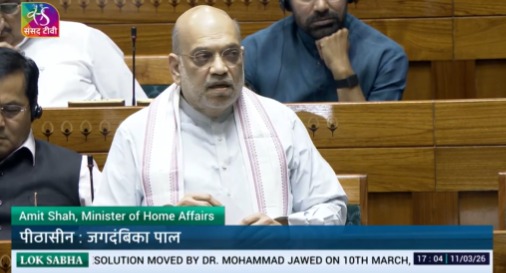
Amit Shah Defends Speaker Om Birla, Cites Parliamentary Precedents in Lok Sabha Debate

New Delhi, March 2026 : Union Home Minister Amit Shah on Wednesday addressed the Lok Sabha during a debate on a no-confidence motion moved against Speaker Om Birla, asserting that historical parliamentary precedents contradict the Opposition’s claims regarding the appointment of a Deputy Speaker.
Participating in the discussion, Shah said that in all three previous instances in parliamentary history when a motion seeking the removal of a Lok Sabha Speaker was brought before the House, the proceedings were presided over by the Deputy Speaker. Responding to Opposition criticism that the current government has not appointed a Deputy Speaker, he argued that earlier governments had followed a different practice and often appointed members of their own party to the position.
According to Shah, the Indian National Congress now claims that the post of Deputy Speaker should be reserved for the Opposition. However, he said historical records show that when the Congress was in power, the party itself filled the post with its own members.
“The Congress today claims the Deputy Speaker’s position as its right, but history shows that when it had the opportunity, it appointed members from its own party,” Shah said, adding that this weakens the Opposition’s argument about the current vacancy.
The Home Minister cited several examples from parliamentary history to support his argument. He pointed out that in 1954, M. A. Ayyangar held the post of Deputy Speaker and was a member of the Congress party. Similarly, in 1966, Krishnamoorthy Rao served in the position, again representing the Congress.
Shah argued that earlier governments had filled the post even when the Opposition believed it should be held by a non-ruling party member. In contrast, he said, the current government has left the position vacant, which he suggested reflects an openness to allowing the Opposition to occupy the post.
The Home Minister also drew a contrast between the conduct of past Speakers and that of Om Birla during the current controversy. According to him, in previous instances under Congress governments, Speakers had continued to preside over the House even after a motion seeking their removal had been submitted.
He said that in some cases, Speakers remained in the Chair for as long as 14 days after the notice of a no-confidence motion had been filed.
“In contrast, the present Speaker stepped down from presiding over the House immediately after the notice was received and has not occupied the Chair while the motion is under consideration,” Shah said.
He described this move as an example of respecting parliamentary traditions and maintaining the dignity of the Speaker’s office. “Unlike earlier instances, the present Speaker left the Chair immediately after the notice and will return only after the House decides on the motion,” Shah added.
Shah also sought to draw a broader distinction between the parliamentary approach of the Bharatiya Janata Party and that of the Congress. He noted that in the seven decades since Independence, three attempts have been made to move a no-confidence motion against a Lok Sabha Speaker, and none of those involved the BJP.
“In none of those motions was the BJP involved because we believe in upholding parliamentary principles and maintaining the sanctity of the Chair,” Shah said.
He further remarked that during earlier Congress-led governments, notices against the Speaker were brought by parties such as the Samajwadi Party and the Communist Party of India (Marxist).
The current no-confidence motion against Om Birla was submitted by Opposition members in February and is reported to have received the support of more than 100 MPs. Opposition parties have accused the Speaker of partisan conduct, citing the suspension of several Opposition MPs and alleged denial of speaking opportunities to certain members, including Leader of the Opposition Rahul Gandhi.
The motion has been moved under Article 94 of the Constitution of India, which outlines the procedures for the resignation, removal, or vacation of office by the Speaker and Deputy Speaker of the Lok Sabha.
Under the Constitution, a Speaker can be removed through a resolution passed by a majority of the House. However, since India’s Independence, no Lok Sabha Speaker has ever been removed through such a motion.
Historically, three attempts have been made to remove a Speaker, but none succeeded. In 1954, J. B. Kripalani moved a resolution against the first Lok Sabha Speaker G. V. Mavalankar, but the House rejected it after debate.
Another attempt occurred in 1966 when members of the Samajwadi Party submitted a notice against Speaker Sardar Hukam Singh, though it failed to proceed due to lack of sufficient support.
In 1987, Somnath Chatterjee moved a resolution against Speaker Balram Jakhar, but the motion was ultimately defeated following discussion in the House.
As the debate continues, the outcome of the motion will depend on the majority view of the Lok Sabha members, though past precedents suggest that such resolutions have historically failed to secure the numbers required for removal.
(The content of this article is sourced from a news agency and has not been edited by the Mavericknews30 team.)


US Blockade Costs Iran Billions in Oil Revenue, Tankers Stranded Amid Gulf Tensions
Washington, May 2026 : Iran has incurred an estimated $4.8 billion in lost oil revenue due…

US Blockade Costs Iran Billions in Oil Revenue, Tankers Stranded Amid Gulf Tensions
Washington, May 2026 : Iran has incurred an estimated $4.8 billion in lost oil …