CM Nitish Kumar Participates in Public Dialogue Programme in Saharsa During Samriddhi Yatra

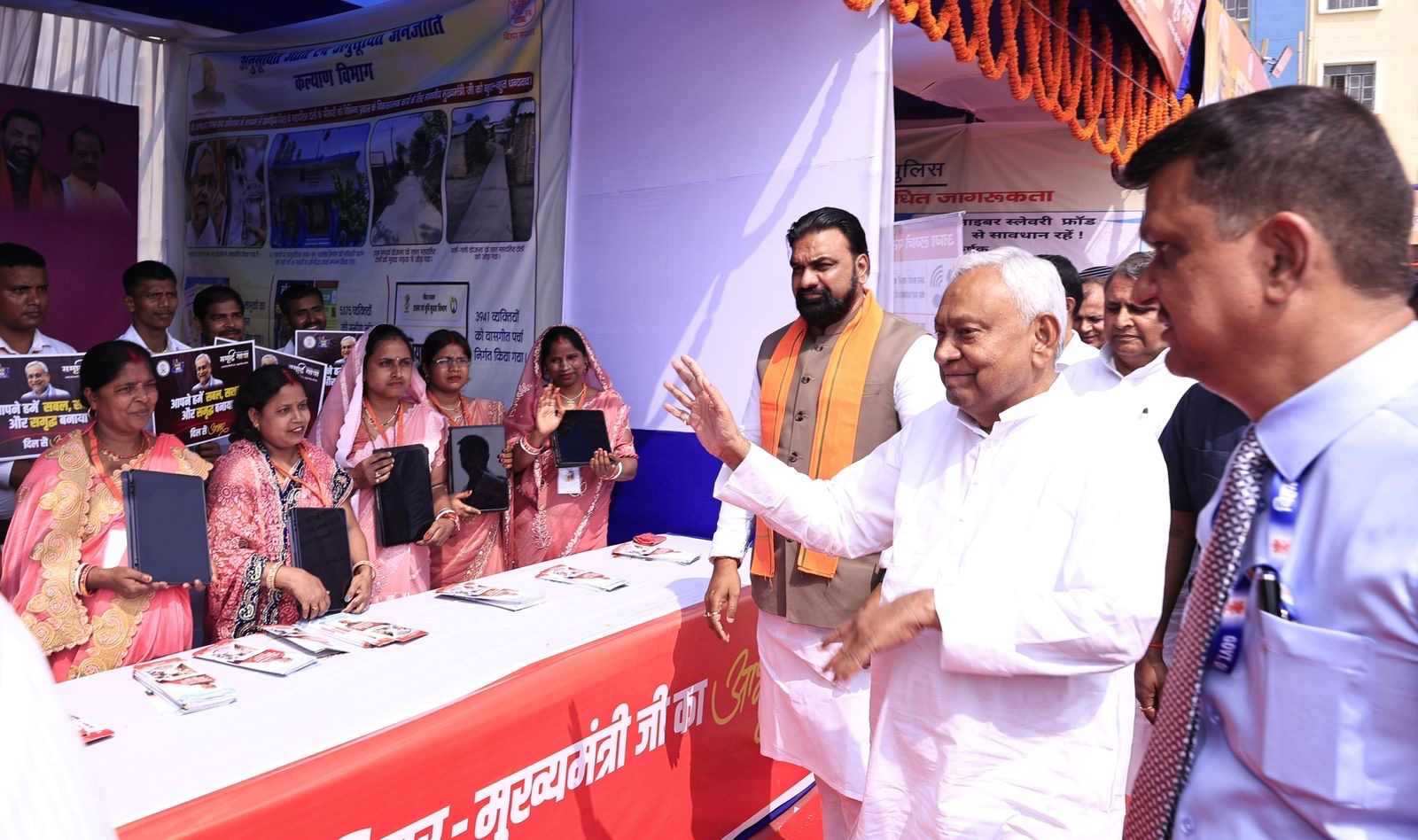
Patna, March 2026: Nitish Kumar today participated in a public dialogue programme organized at the Saharsa Stadium in Saharsa district under the Samriddhi Yatra.
Addressing the public dialogue programme, the Chief Minister said that everyone knows that on 24 November 2005, when the government led by the National Democratic Alliance was formed for the first time in the state, the rule of law was established in Bihar, and since then continuous work has been carried out for development.
He said people remember what the situation was earlier. Earlier the condition was very bad. People did not come out of their homes after evening. There were many disputes in society. There used to be many Hindu–Muslim conflicts. The condition of education was poor and very few children used to study.
He said that earlier there was no proper arrangement for medical treatment. There were very few roads and the condition of the existing roads was also poor. Electricity was available in very few places. Now there is no atmosphere of fear or panic. At present there is an environment of love, brotherhood and peace in the state.
The Chief Minister said that earlier many Hindu–Muslim conflicts used to occur, therefore from 2006 the fencing of graveyards (Kabristans) was started. Fencing work of graveyards has been completed on a large scale. Now such disputes do not occur.
He said that since 2016, fencing work has also been carried out for Hindu temples older than 60 years, which has prevented incidents of theft.
Focus on Education
The Chief Minister said that special attention was first given to the education sector. A large number of teachers were appointed and many new schools were opened. Schemes such as school uniforms and bicycles for boys and girls were launched.
He said that from 2023, through the Bihar Public Service Commission, 2.58 lakh government teachers were recruited. Since 2006, 3.68 lakh contract teachers had been appointed, out of which 28,976 teachers have now become government teachers through BPSC recruitment.
Later the government decided that contract teachers would not be required to appear for the full BPSC examination. Instead, they would be made government teachers after a simple examination. They were given five opportunities for this. So far four examinations have been conducted and 2.66 lakh teachers have passed. Only 73,000 teachers remain, who will get one more chance.
At present, the total number of government teachers has reached 5.24 lakh. Apart from this, recruitment for 45,000 new teaching posts is also being started through BPSC.
Improvements in Health Services
Nitish Kumar said that earlier the healthcare system was very poor. Primary Health Centres used to receive only 39 patients per month, which means only one or two patients per day.
Since 2006, arrangements for free medicines and treatment have been made in hospitals. Now on average 11,600 patients visit Primary Health Centres every month.
Earlier there were only six medical colleges, which have now increased to twelve. Six more medical colleges will be built this year and construction of medical colleges in the remaining 21 districts will also be completed soon.
He added that the Patna Medical College and Hospital is being expanded to 5,400 beds, while five other old medical colleges are being upgraded to 2,500 beds each. The Indira Gandhi Institute of Medical Sciences is being expanded to 3,000 beds.
Development of Roads and Agriculture
The Chief Minister said that large-scale construction of roads, bridges and culverts has taken place in the state. The target of reaching Patna from distant areas within six hours was achieved in 2016. With the construction of more roads, railway overbridges, bypasses and elevated roads, the travel time from distant areas to Patna has now been reduced to about five hours.
He said that work has been done under the Agriculture Road Map since 2008, which has brought significant progress in agriculture. Food grain production has increased considerably, while the production of fruits, vegetables, milk, eggs, meat and fish has more than doubled. As a result, Bihar has become self-reliant in fish production, and farmers’ income has increased.
Currently, work is progressing rapidly under the Fourth Agriculture Road Map (2024–2029).
Seven Resolves Programme
The Chief Minister said that in 2015, the government implemented the Seven Resolves Programme, which included economic support for youth, reservation in government jobs for women, electricity to every household, tap water in every home, toilets in every house, connecting villages with paved roads, and creating opportunities for development.
Electricity was provided to every household by 2018, and power is being supplied at very low rates. Now electricity is almost free for most domestic consumers.
He said the government has also started installing solar panels on rooftops of households. Approval has been given for installing solar panels on 50 lakh homes, and the work will be completed soon.
Employment and Welfare Measures
Under the Seven Resolves-2 programme launched in 2020, several initiatives have been implemented for youth empowerment, women’s empowerment, irrigation facilities, clean villages, clean cities and healthcare.
The Chief Minister said the government had set a target to provide 10 lakh government jobs and 10 lakh employment opportunities for youth. So far 10 lakh government jobs and 40 lakh employment opportunities have been provided, benefiting 50 lakh youth in total.
The target is to provide jobs and employment to one crore youth in the next five years.
Social Welfare and Inclusion
Nitish Kumar said that development work has been carried out for all sections of society, including Hindus, Muslims, upper castes, backward classes, extremely backward classes, Dalits and Mahadalits.
Madrasas have been granted government recognition, and their teachers are receiving salaries equal to other government teachers.
The pension amount for elderly people, persons with disabilities and widows has been increased from ₹400 to ₹1,100, benefiting 1.14 crore people.
He said that a caste-based survey conducted in 2023 revealed about 94 lakh poor families in the state. Each of these families is being given ₹2 lakh financial assistance for employment, and assistance has already been started for 83.20 lakh families.
Development Plans for Saharsa
The Chief Minister said several development works have been carried out in Saharsa since 2005. Engineering and polytechnic colleges have been established, along with ITI institutes in all subdivisions, nursing and paramedical institutes, and the construction of a medical college and hospital.
Several bridges and roads have been built in the district, including the Balwaha Ghat Bridge, while roads are being widened and drainage systems are being constructed in Saharsa city.
He said the Kosi flood of 2008 had severely affected Saharsa, Supaul and Madhepura districts, but relief and reconstruction work was carried out.
During the Samriddhi Yatra, six development schemes have been approved for Saharsa, including storm-water drainage systems, development of Ugratara Temple, sports complex development, railway overbridge construction and block office buildings.
The Chief Minister said that under the Seven Resolves-3 programme (2025–2030), many new projects will be implemented in Saharsa to boost development, employment and infrastructure.
Several senior leaders, including Deputy Chief Minister Samrat Choudhary, Water Resources Minister Vijay Kumar Chaudhary, Member of Parliament Dinesh Chandra Yadav, and other public representatives were present at the programme along with a large number of citizens.


Top 10 Monsoon Destinations in India That Come Alive During the Rainy Season
Hyderabad, July 2026 : The arrival of the southwest monsoon transforms India into a specta…
Top 10 Monsoon Destinations in India That Come Alive During the Rainy Season
Hyderabad, July 2026 : The arrival of the southwest monsoon transforms India into a …