Uttar Pradesh to Launch Major Anti-Water Scarcity Campaign; “Wastewater” to Be Reclaimed as a Resource

Policy on safe reuse of treated water in final stage of notification; set to transform water management from industry to agriculture
Lucknow, March, 2026: At a time of growing global water stress, Uttar Pradesh has begun to take a decisive lead on an issue that found space in policy discussions for years, but rarely received priority on the ground. Amid rapidly expanding urban populations, declining groundwater levels, rising pollution pressure on rivers, and uncontrolled dependence on freshwater sources, the state is now positioning the safe reuse of treated wastewater as a major structural shift. Uttar Pradesh’s policy on the safe reuse of treated water has reached the final stage before notification.
This move is especially significant because the state is no longer treating treated water as a disposal compulsion, but as an essential development resource. Until now, large volumes of water, even after sewage treatment, were being discharged into rivers, despite the fact that the same water could be used on a large scale for non-potable purposes such as industry, power generation, irrigation, construction, urban greening, and flushing. The new policy is set to provide an institutional framework to this thinking.
This entire process has also received strong support at the central level. Union Jal Shakti Minister Shri C.R. Paatil, through regular reviews in empowered task force meetings, has placed the reuse of treated water at the center of the national water security agenda. His continued emphasis on policy reform, city-level strategies, and increasing the use of treated water in the industrial, agricultural, and energy sectors has provided Uttar Pradesh with momentum, direction, and institutional clarity. Once notified, this policy will provide a clear regulatory framework for the reuse of treated wastewater in Uttar Pradesh. Along with promoting non-potable uses, it will clearly define the roles of urban local bodies, government departments, industries, and other concerned institutions.
The state government has not confined this policy to paperwork. By preparing city-level reuse action plans, Uttar Pradesh has made it clear that treated water reuse is no longer a slogan, but a real implementation agenda backed by micro-level planning. Prayagraj and Agra have already prepared their city-level reuse action plans, Varanasi is in the final stage, and the process has begun in Kanpur. This progress shows that Uttar Pradesh now aims to establish treated water reuse in major urban centres as a structured, measurable, and results-oriented program. The rapid policy movement in Uttar Pradesh, city-level preparedness, and strong examples of industrial use all point toward a major transformation. This transformation is not limited to reducing pressure on freshwater sources or lowering the burden of polluted water on rivers. The real shift is that the state has now begun to view water not as a resource for linear consumption, but as a recyclable asset.
It is clear that Uttar Pradesh has now moved beyond the traditional framework of water management. Where wastewater was once seen as a burden, it is now being prepared to serve as an engine of development. The policy on the safe reuse of treated water reaching the final stage of notification is not merely an administrative milestone; it is a declaration that Uttar Pradesh is no longer fighting the water crisis defensively, but is entering the field with an assertive strategy.
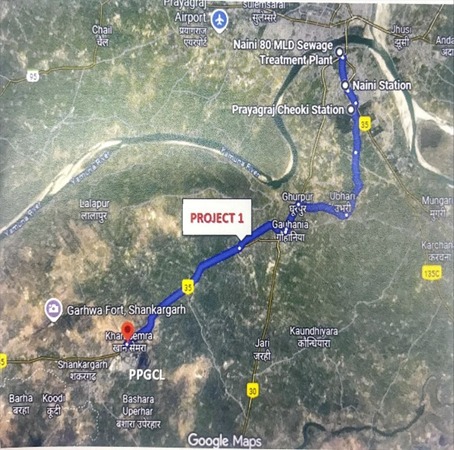
Prayagraj is emerging as a major example of this transformation. Around 10 sewage treatment plants with a combined capacity of 340 MLD are operational here, but the reuse of treated water has so far remained limited. Now, through plans to supply water from the Naini, Rajapur, and Kodara STPs to industries and the Railways, a treated water reuse capacity of over 126 MLD is being developed, which could make Prayagraj a strong model of recycled water-based urban management.
Agra , too, is emerging as an important center of this transition. In Agra, which generates around 286 MLD of sewage, treatment capacity is being increased from 221 MLD to nearly 398 MLD. Plans to reuse around 28 MLD of treated water from the Dhandhupura, Jaganpur, and Bichhpuri STPs for the Railways, the Metro corridor, and Keetham Lake indicate that Agra is now seeking solutions to water scarcity not in new sources, but in reusing the water already available.
Kanpur has presented a solid and practical model in the field of treated water reuse. Developed under the Namami Gange Mission, the 30 MLD STP at Bingawan is the city’s first advanced plant based on the Hybrid Annuity Model and operates on Sequential Batch Reactor technology. Operational since June 2023, this plant has been functioning continuously at full capacity and is effectively treating wastewater through a modern, automated system. The treated water is being discharged into the Pandu River in accordance with prescribed standards, reducing the pollution load on the Ganga. At the same time, this water is also supporting downstream agricultural use, highlighting its economic utility. Going a step further, the Panki Thermal Power Plant is using around 40 MLD of treated water.

Kavitha Detained During Protest Over Farmers’ Paddy Procurement Issues in Hyderabad
Hyderabad, May 2026: Telangana Rakshana Sena (TRS) leader Kalvakuntla Kavitha and several …
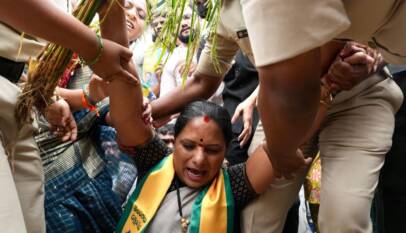
Kavitha Detained During Protest Over Farmers’ Paddy Procurement Issues in Hyderabad
Hyderabad, May 2026: Telangana Rakshana Sena (TRS) leader Kalvakuntla Kavitha and several party workers …