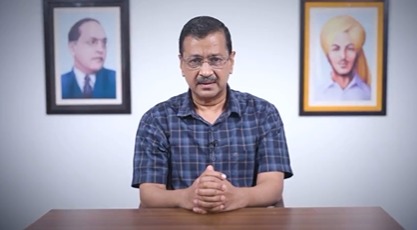
Delhi High Court Issues Fresh Notice to Arvind Kejriwal in ED Appeal Over Excise Policy Case

New Delhi, April 2026 : The Delhi High Court on Wednesday directed the issuance of a fresh notice to Arvind Kejriwal in connection with a plea filed by the Enforcement Directorate (ED), which has challenged his acquittal in cases linked to alleged non-compliance with summons in the Delhi excise policy money laundering matter.
The direction came from a single-judge Bench of Justice Swarana Kanta Sharma, who observed that the earlier notice issued on April 1 had not been served on Kejriwal. Taking note of the registry’s report, the court ordered that a fresh notice be issued and scheduled the next hearing for July 22. “The respondent has not been served. A fresh notice will be issued,” the court noted during proceedings.
The ED’s appeal arises from the acquittal granted by the Rouse Avenue Court in complaint cases accusing Kejriwal of deliberately ignoring multiple summons issued under Section 50 of the Prevention of Money Laundering Act (PMLA). The agency had alleged that despite receiving five separate summons, Kejriwal failed to appear before it, prompting prosecution.
However, Additional Chief Judicial Magistrate Paras Dalal had earlier ruled in favour of Kejriwal, stating that the material on record was insufficient to justify prosecution for non-compliance. The ED, contesting this decision, has argued that failure by a public functionary to comply with summons could set a problematic precedent.
The matter has gained further attention following Kejriwal’s recent communication to the court. In his letter addressed to Justice Sharma, he stated that he would neither appear in person nor through legal representation in cases related to the now-scrapped excise policy. Expressing a lack of confidence in receiving justice, he said he intended to follow the path of “Satyagraha,” inspired by Mahatma Gandhi. He also indicated that he reserves the right to challenge any adverse order before the Supreme Court.
A similar stance was taken by Manish Sisodia, who also informed the court of his decision to abstain from participating in the proceedings, citing reasons of conscience rather than opposition to the judiciary.
The developments come shortly after Justice Sharma rejected Kejriwal’s plea seeking her recusal from hearing related matters. In her April 20 order, the judge emphasised the importance of institutional integrity, stating that recusal cannot be sought merely on perception. She remarked that allowing such requests could undermine the judicial process.
Highlighting the broader implications, the court observed that the issue extends beyond a legal dispute to the credibility of judicial institutions. “A courtroom cannot be a theatre of perception,” the judge noted, adding that justice must not only be done but must also be seen to be administered fairly and independently.
With the next hearing scheduled for July, the case continues to draw significant legal and political attention, as it unfolds at the intersection of governance, accountability, and judicial propriety.







Israel, Lebanon Agree on Ceasefire Framework Amid Continued Cross-Border Hostilities
Washington/Beirut, June 2026 : Israel and Lebanon on Wednesday agreed to move forward with…

Israel, Lebanon Agree on Ceasefire Framework Amid Continued Cross-Border Hostilities
Washington/Beirut, June 2026 : Israel and Lebanon on Wednesday agreed to move forward with …