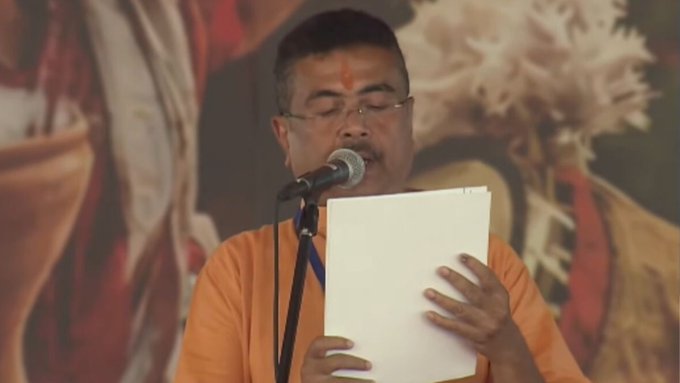
Suvendu Adhikari Sworn In as Bengal’s First BJP Chief Minister, Ushering in a New Political Era

Kolkata, May 2026 : West Bengal witnessed one of the most dramatic political transitions in its post-Independence history on Saturday as senior Bharatiya Janata Party (BJP) leader Suvendu Adhikari took oath as the state’s first BJP Chief Minister, bringing an end to the 15-year rule of the Trinamool Congress (TMC) led by Mamata Banerjee.
The grand swearing-in ceremony, held at Kolkata’s iconic Brigade Parade Ground, marked the beginning of what BJP leaders described as a “new dawn” and the start of a “double-engine government” in the eastern state. The event was attended by Prime Minister Narendra Modi, Union Home Minister Amit Shah, Defence Minister Rajnath Singh, BJP national president Nitin Nabin, Union ministers, chief ministers from BJP-ruled states, senior party leaders, diplomats, industrialists, religious figures and thousands of BJP workers and supporters.
Governor R.N. Ravi administered the oath of office and secrecy to Suvendu Adhikari amid loud cheers, chants of “Bharat Mata Ki Jai” and “Jai Shri Ram”, and the waving of saffron flags across the sprawling Brigade Parade Ground, which had been transformed into a massive celebration venue decorated with BJP colours and Bengali cultural motifs.
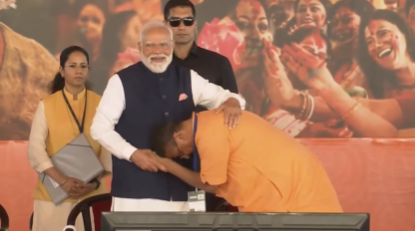
Moments after taking the oath, Suvendu Adhikari walked toward Prime Minister Narendra Modi, touched his feet and sought his blessings. Modi embraced him warmly in a symbolic gesture that drew loud applause from the crowd. Adhikari then greeted senior BJP leaders one by one and exchanged warm handshakes with them. When he approached Uttar Pradesh Chief Minister Yogi Adityanath, he greeted him with a traditional Bengali gamchha, reflecting the BJP’s attempt to blend Bengali identity with its larger national narrative.
The BJP had deliberately selected May 9 for the swearing-in ceremony because the day coincided with Rabindranath Tagore’s birth anniversary according to the Bengali calendar. BJP leaders said the move was intended to counter the Trinamool Congress’ long-standing campaign that portrayed the BJP as “anti-Bengali” and disconnected from Bengal’s culture and traditions.
The oath ceremony featured performances by traditional drummers, folk artists and cultural groups celebrating Bengal’s heritage. The stage backdrop prominently displayed images of Swami Vivekananda, Syama Prasad Mookerjee, Rabindranath Tagore and Netaji Subhas Chandra Bose, underlining the BJP’s effort to connect itself with Bengal’s intellectual and nationalist legacy.
Before the ceremony began, Prime Minister Modi, accompanied by Chief Minister-designate Suvendu Adhikari and BJP state president Samik Bhattacharya, took a ride around the venue in an open jeep, waving at supporters gathered in huge numbers. BJP workers from across the state had arrived overnight in buses and trains to witness the historic moment.
The significance of the event was not lost on the BJP leadership. For decades, West Bengal had remained one of the most difficult political territories for the BJP. The state had first been ruled by the Congress after Independence, followed by the Left Front’s uninterrupted 34-year rule and then the Trinamool Congress government led by Mamata Banerjee from 2011 onward. Saturday’s ceremony therefore marked not just a change of government, but the BJP’s arrival as the dominant political force in Bengal.
In a message posted on social media before taking oath, Suvendu Adhikari described the occasion as “a historic dawn for West Bengal.”
“A historic dawn for West Bengal indeed. Today marks the end of decades of misrule and the beginning of a double-engine era of development, peace and prosperity. The dream of Sonar Bangla begins today,” he said.
Adhikari also stressed that his government would operate on the basis of “collective leadership” rather than centralized decision-making.
“It will not be ‘I’ who governs the state. It will be ‘we’ who govern the state. West Bengal will move forward with strong coordination between the Centre and the state government,” he said.
One of the first major administrative decisions expected under the new government is the shifting of the state secretariat back to the historic Writers’ Buildings in central Kolkata. During Mamata Banerjee’s tenure, the secretariat had been shifted to Nabanna in Howrah district in 2013. BJP leaders said returning to Writers’ Buildings symbolized a restoration of administrative tradition and institutional governance.
The formation of the BJP government has also triggered intense activity within the Union government. According to sources, the Centre has already started reviewing centrally sponsored schemes and infrastructure projects that had remained stalled in West Bengal over the past decade due to political disputes, land issues, administrative delays or disagreements between the Centre and the Mamata Banerjee government.
Sources said Defence Minister Rajnath Singh has been entrusted with coordinating the review process. Several Union ministries have been asked to submit detailed reports on projects that faced delays or opposition during the previous regime.
The Centre’s objective, according to officials, is to accelerate the implementation of welfare schemes and infrastructure projects under the new “double-engine” arrangement in West Bengal.
One of the most significant programmes expected to be implemented immediately is Ayushman Bharat, the Centre’s flagship health insurance scheme that provides coverage of up to Rs 5 lakh per eligible family annually. The Mamata Banerjee government had consistently refused to adopt the scheme, arguing that its own “Swasthya Sathi” programme was superior.
Prime Minister Modi had repeatedly criticised the previous state government for denying the benefits of Ayushman Bharat to the people of West Bengal. BJP sources indicated that approval for implementing the scheme could come in the new Cabinet’s very first meeting.
Similarly, the Pradhan Mantri Kisan Samman Nidhi scheme, which provides direct income support to farmers, is expected to be expanded significantly in the state. Earlier, disputes had arisen over beneficiary verification and the Trinamool Congress government had prioritised its own Krishak Bandhu scheme.
The Centre is also preparing to revive projects under the Pradhan Mantri Awas Yojana (PMAY), which had been stalled amid allegations of irregularities and disputes over the scheme’s renaming as “Bangla Awas Yojana.”
Funds under the Mahatma Gandhi National Rural Employment Guarantee Act (MGNREGA), which were frozen earlier over allegations of financial irregularities, may also be restored under a revised monitoring framework.
Apart from welfare schemes, several major infrastructure projects are expected to move faster under the new administration. These include border fencing projects along sensitive stretches of the India-Bangladesh border, road projects under the Pradhan Mantri Gram Sadak Yojana, water supply initiatives under the Jal Jeevan Mission, fisheries development under the PM Matsya Sampada Yojana and Ganga-cleaning projects under the Namami Gange programme.
The Centre had repeatedly alleged in Parliament that several projects in West Bengal faced delays because land was not made available by the state government. Officials now expect smoother coordination under the BJP government.
In education, the new administration is expected to implement the National Education Policy, PM Shri Schools and literacy initiatives like ULLAAS more aggressively.
The political journey of Suvendu Adhikari himself has been one of the most fascinating stories in Bengal politics. Born into the influential Adhikari family of East Midnapore district, he was drawn toward public life at an early age. People close to the family often recall that he showed strong spiritual inclinations as a child and regularly visited the Ramakrishna Mission.
Adhikari entered politics through student activism at Prabhat Kumar College in Contai, initially joining the Congress student wing, Chhatra Parishad. He later became associated with the faction led by veteran Congress leader Somen Mitra, where he learned the fundamentals of grassroots politics.
In 1995, he won his first election as a councillor in the Contai Municipality on a Congress ticket. When Mamata Banerjee broke away from the Congress and formed the Trinamool Congress in 1998, the Adhikari family eventually joined her movement and became one of her strongest pillars in East Midnapore.
Suvendu initially faced setbacks, losing Assembly and Lok Sabha elections in the early 2000s. However, his political fortunes changed dramatically during the Nandigram movement of 2007.
The Left Front government’s attempt to acquire land for industrial projects triggered massive protests in Nandigram, and Suvendu Adhikari emerged as one of the movement’s principal leaders. The agitation transformed him into a statewide political figure and played a major role in weakening the Left Front government.
The movement eventually paved the way for Mamata Banerjee’s rise to power in 2011, ending 34 years of Left rule in West Bengal.
Over the next few years, the Adhikari family became one of the most influential political families within the Trinamool Congress. Suvendu served as MP, MLA and minister in the Mamata Banerjee government.
However, tensions gradually emerged within the Trinamool Congress leadership, particularly after the growing prominence of Abhishek Banerjee within the party organisation. Over time, several of Suvendu’s organisational responsibilities were reduced.
In December 2020, Suvendu Adhikari quit the Trinamool Congress and joined the BJP in a dramatic political move that transformed Bengal politics.
The 2021 Assembly elections turned into a direct political battle between Mamata Banerjee and Suvendu Adhikari in Nandigram. In one of the most closely watched contests in India, Adhikari defeated Mamata Banerjee by a narrow margin, earning the title of Bengal’s “giant killer.”
He subsequently became Leader of the Opposition in the West Bengal Assembly and emerged as the BJP’s most aggressive face against the Trinamool Congress.
Over the next five years, Adhikari sharpened the BJP’s political strategy in Bengal around issues such as corruption, law and order, religious polarisation, governance and alleged appeasement politics.
Political analysts believe his organisational strength and ability to consolidate anti-Trinamool votes played a decisive role in the BJP’s emphatic victory in the 2026 Assembly elections.
In the latest elections, Adhikari won both Nandigram and Bhabanipur — the latter being Mamata Banerjee’s traditional political stronghold — further strengthening his image as the BJP’s most powerful leader in Bengal.
Saturday’s swearing-in ceremony therefore represented the culmination of a long and dramatic political journey — from being one of Mamata Banerjee’s closest aides to becoming the leader who dethroned her party from power.
As celebrations erupted across BJP offices and party workers burst crackers in several districts, BJP leaders repeatedly used the phrase “Sonar Bangla” to describe their vision for the state.
The new government now faces enormous expectations. Apart from accelerating development projects and implementing central schemes, it will also have to address issues related to employment, industrial investment, law and order, political violence, infrastructure and governance reforms.
At the same time, the BJP leadership is keenly aware that governing West Bengal will require balancing aggressive political messaging with administrative delivery and cultural sensitivity in a state known for its strong regional identity and political consciousness.
For the BJP, the victory in West Bengal is not just an electoral achievement but also a symbolic expansion into one of India’s most politically and culturally influential states.
For Suvendu Adhikari, the oath-taking ceremony marks the beginning of his biggest political challenge yet — transforming from a fierce opposition leader into the Chief Minister of one of India’s most politically complex states.
As the sun set over Brigade Parade Ground on Saturday evening, supporters continued celebrating what the BJP described as the beginning of a “new era” in West Bengal politics — one that could significantly reshape the state’s political and developmental trajectory in the years ahead.





Yamal Unfazed by Goal Drought as Spain March into World Cup Semi-finals
Los Angeles, July 2026 : Spain’s teenage sensation Lamine Yamal has dismissed concerns ove…

Yamal Unfazed by Goal Drought as Spain March into World Cup Semi-finals
Los Angeles, July 2026 : Spain’s teenage sensation Lamine Yamal has dismissed concerns over …