A nation that manufactures its own weaponry writes its own destiny: Raksha Mantri

RM & Maharashtra CM inaugurate a private sector Defence Manufacturing Complex in Shirdi
India’s first 300 KM Universal Rocket Launching System flagged-off
“Need to transform India into a global hub for munitions & automation, Govt ready to take every necessary step”
“Aatmanirbharta in defence is not merely a requirement for war, it’s a necessity for peace, development & economic resilience”
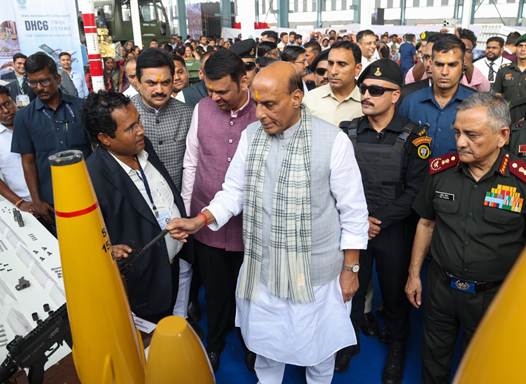
“A nation that manufactures its own weaponry writes its own destiny,” said Raksha Mantri Shri Rajnath Singh as he, along with Maharashtra Chief Minister Shri Devendra Fadnavis, inaugurated a Defence Manufacturing Complex of a private sector company, NIBE Group’ at Shirdi on May 23, 2026. The complex intends to manufacture advanced artillery systems, missile & space technologies, rocket systems, energetic materials, and autonomous defence platforms.
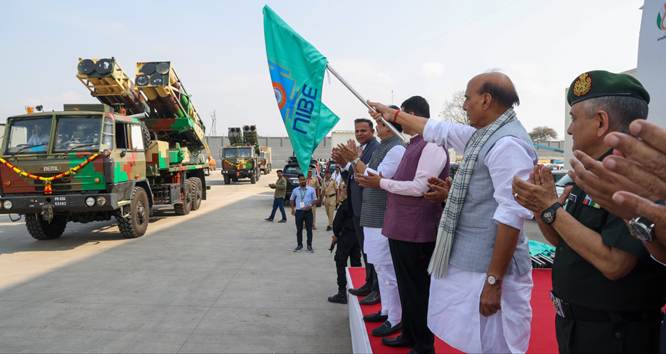
India’s first 300 KM Universal Rocket Launching System ‘Suryastra’ was flagged-off as part of the event. The foundation stone was also laid for a missile complex for the system. Furthermore, the unveiling of indigenous TNT Plant Technology, RDX Plant Technology and Renewable Bio-Energy Compressed Biogas Plant took place during the ceremony. An MoU was also exchanged between NIBE Group and Black Sky in the field of satellite assembly.
Raksha Mantri stressed the importance of self-reliance in ammunition production, and exuded confidence that the complex would help in fulfilling the operational requirements of the defence forces & bolster the industrial ecosystem of the country. He stated that defence production, which was earlier largely confined to the Public Sector Units & Ordnance factories, was opened to the private sector by Prime Minister Shri Narendra Modi-led Government. “We recognised the capabilities of the private sector as it can transform India into a global manufacturing hub,” he said.
Shri Rajnath Singh emphasised that the outcome of future wars will be determined by the nation’s advancements & capabilities in munitions and automation, and not by the size of its forces. “Glimpses of this reality can be witnessed in the ongoing Russia-Ukraine conflict and the West Asia situation. India demonstrated this capability during Operation Sindoor,” he said.
Raksha Mantri pointed out that India’s private industries possess a deep understanding of the dynamics of future warfare and are working relentlessly to equip the country with state-of-the-art systems. He called for concerted efforts of all stakeholders to transform India into a global hub for munitions and automation, adding that the Government is consistently promoting Make-in-India in critical technologies and advanced systems. “We stand ready to take every necessary step to ensure that India emerges as a frontrunner in munitions and automated systems,” he stated.
Shri Rajnath Singh underlined that the fundamental objective of technology is not to diminish the capabilities of soldiers, but to augment them, and the final decision must always remain in human hands. He said modern weaponry and automated systems are playing an increasingly significant role in future warfare, and it is imperative for India to advance in this direction. “Let us collectively pledge to make India completely self-reliant in defence and space technology,” he said, urging the defence companies to enhance India’s capabilities for the wars of the future.
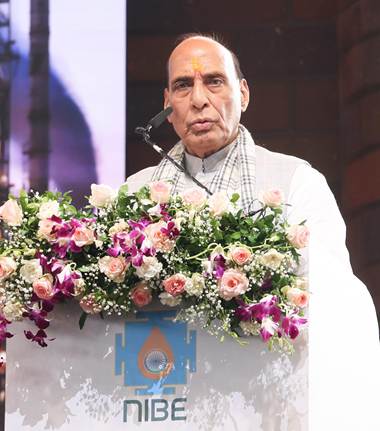
Highlighting the measures undertaken by the Ministry of Defence over the last decade, Raksha Mantri said that bold policy reforms, liberalised FDI norms, introduction of Strategic Partnership Model, notification of Positive Indigenisation Lists, and launch of schemes such as Innovations for Defence Excellence (iDEX), Acing Development of Innovative Technologies with iDEX (ADITI) and Technology Development Fund (TDF) are providing impetus to young innovators. He underlined that the private sector is playing a crucial role in realising the vision of Aatmanirbhar Bharat and Make-in-India, as the brave soldiers are protecting national interests on the back of the strength being provided by the domestic industry.
“There was a time when private sector contribution in defence production was negligible. It has now reached approx. 25-30 per cent. Our objective is to take this figure to 50 per cent in the coming years. This is the New India where the private industry is not merely a supplier of nuts & bolts, but is emerging as the innovator and manufacturer of state-of-the-art weapon systems. The nation touches greater heights when the vision of the Government converges with the innovation of the private sector,” said Shri Rajnath Singh.
Raksha Mantri asserted that, in today’s world, ‘security’ and ‘economy’ can no longer be viewed in isolation, as a robust economy serves as the bedrock for a strong military and modern defence capabilities. “National security creates a stable environment conducive to investment, industrial growth, and overall development. However, we are currently witnessing the weaponisation of almost everything – from trade and supply chains to even rare earth minerals. In such times, we cannot remain dependent on others for our defence manufacturing needs. Aatmanirbharta in defence production is not merely a requirement for war, but also a necessity for peace, development, and economic resilience,” he added.
Shri Rajnath Singh added that the plants being inaugurated today are poised to become research-oriented hubs, which would further bolster India’s defence capabilities. He hoped that the missile complex for the Universal Rocket Launching System will provide a new direction to India’s future warfare capabilities. “Powered by indigenous technology, this rocket system will multiply our strike capability manifold and prove to be a strategic game-changer,” he said.
Raksha Mantri appreciated the fact that the complex will create a vast ecosystem not just for high-technology industries, but also for MSMEs, small-scale industries, and the local economy. “The production of ammunition, missiles, rocket systems, and satellite components will engage ancillary units, suppliers, and vendors. It will generate employment, and empower the youth of this region with cutting-edge technological skill sets, enabling them to contribute to nation-building,” he hoped.
In his address, the Chief Minister of Maharashtra commended the efforts of the Central Government towards enhancing the defence preparedness of the country through Aatmanirbhar Bharat and Make-in-India initiatives. He described Operation Sindoor as a shining example of the unmatched bravery of the Indian soldiers as well as the growing indigenous defence capabilities of the nation. He highlighted that India’s defence ecosystem has transformed due to the active and equal participation of the public & private sectors, and it will continue to provide continued strength to the defence forces for safeguarding national interests. He added that as India continues to enhance its strategic might, it is playing a constructive role in promoting global peace and stability.
The event also featured technology demonstrations, MSME defence capability displays, and interactions with industry leaders and defence stakeholders. Chief of Defence Staff General Anil Chauhan; Maharashtra Government’s Minister of Industries Shri Uday Samant; Minister of Water Resources Shri Radhakrishna E. Vikhepatil; Secretary (Defence Production) Shri Sanjeev Kumar; Secretary, Department of Defence R&D and Chairman DRDO Dr Samir V Kamat; other senior civil & military officials, strategic partners, and industry stakeholders were present on the occasion.







Museums will be named after India’s National Heroes, not invaders: Chief Minister
Grand museum named after Chhatrapati Shivaji Maharaj being constructed at a rapid pace: CM…
Museums will be named after India’s National Heroes, not invaders: Chief Minister
Grand museum named after Chhatrapati Shivaji Maharaj being constructed at a rapid pace: CM …