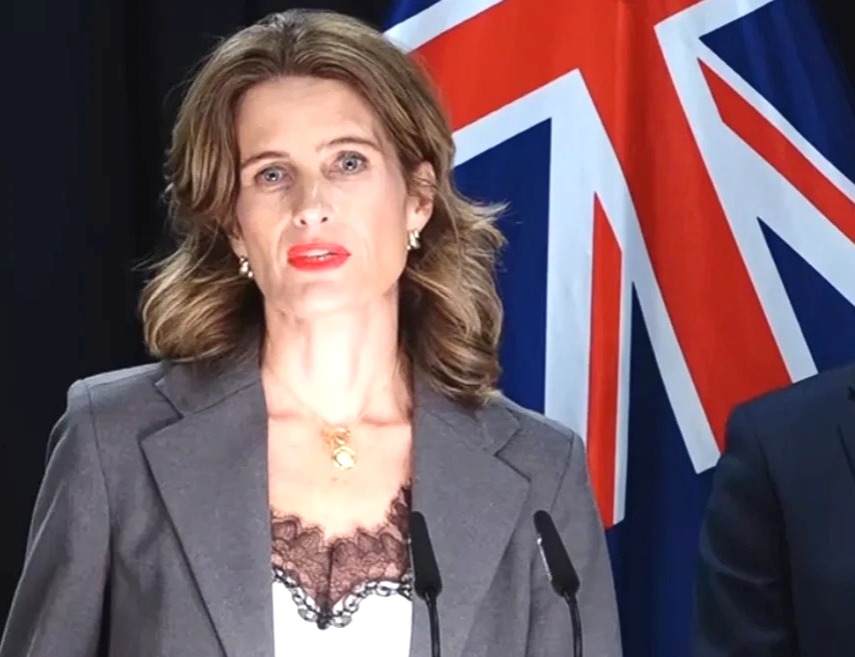
New Zealand: Pre-Budget Announcement At Post-Cabinet Briefing.

Wellington; May 2026: This Thursday (28th May 2026), Government Of New Zealand is going to table its Fiscal Budget for the FY:2026-2027.
Earlier, the New Zealand’s budget got branded like:
- the Black budget of 1958,
- the Mother of All Budgets in 1991,
- the Wellbeing Budget of 2019.
Finance Minister Nicola Willis has yet to draft a catchy title for this year’s forthcoming budget, but senior economist Mark Smith of ASB Bank, New Zealand has suggested: “Budget 2026 is likely to be more about fiscal repair, spending prioritisation and bolstering New Zealand’s economic security against a highly fluid global backdrop. Willis has to tackle the realities of a slowing economy hit by the Middle East conflict, denting the tax take, inflating expenses, producing deficits until the end of the decade, and higher borrowing. The Middle East conflict is expected to delay but not derail the foreshadowed economic recovery and eventual path back to surplus”.
At the most basic level households and governments face similar challenges: balancing income against expenses, and prioritising needs against resources. The government has forecast to have a deficit of $13.9 billion for the current financial year ending in June 2026, with the deficit reducing over the following three years to a surplus of $2.3 billion in 2030.
Over the past 02 years Finance Minister Willis has been criticising the state of the government finances inherited from the previous Labour government, with large deficits and increased debt incurred during the Covid pandemic.
“We’re still carrying a deficit from the Covid spend-up and international credit rating agencies are watching us closely”, she said in a recent speech to an Auckland business group. “Now, more than ever, you need your government to hold a steady hand on the tiller, ensuring the country’s finances are in fit condition to withstand whatever comes our way”.
But that was before the Middle East conflict, which Westpac senior economist Darren Gibbs says has changed everything. “The conflict in the Middle East will negatively affect the government’s finances through a variety of channels that sit outside of its immediate control”.
He said that included the inflation surge caused by higher fuel and other prices, which will cost such as inflation-indexed benefits, while the conflict will likely dampen tax revenue because of possibly higher unemployment and reduced consumer spending. “There is significant uncertainty about the key economic assumptions, most notably about the path of the conflict from here and the implications for energy prices, global growth and the impact on New Zealand’s economic outlook”, Gibbs said.
Budget deficits are expected to be bigger in the near term touching more than $13 billion in the coming financial year, but then reducing steadily to an eventual surplus about a billion dollars in 2030, the first in a decade.
Willis has been vocal about the repair job needed on government finances and said there will be no tempting but illusory budget day goodies.
The operational allowance, the money available for new day to day initiatives, has been trimmed by $300m to $2.1 billion and much of that is already committed to pre-announced moves.
The saving has been transferred to long term capital spending which has been increased to $5.7b for major projects such as schools, highways, hospitals, and defence projects, which Willis said will be “job-rich”.
The government may have something of boost from the $2 billion of underspending in the current year which has meant a smaller deficit than forecast for the nine months ended March.
ANZ senior economist Miles Workman said the government was between a rock and a hard place – needing to support the economy, but not stoke inflation, at a time its finances were pressured. “The best fiscal response for the long-run health of the New Zealand economy would also be the most politically difficult in the here and now, even without the oil shock hitting the economy: reducing discretionary spending or increasing taxes”.
Economists were generally agreed that the government will borrow more, as much as $10bn extra over the next four years, which would lift the net debt level to around 48 percent of the value of the economy.
Senior Economist Darren Gibbs said uncertainty caused by the Middle East conflict might result in this budget having a short shelf life. “Given the impending General Election, the Treasury will need to publish a fiscal update (PREFU) by early October. Depending on the path of the conflict, this could lead to marked changes to the budget forecasts”.
Furthermore, as asserted, Businesses will be able to access cheaper loans to help reduce their dependence on gas as part of a new scheme in Thursday’s Budget. The move was announced by ministers today (Monday – 25th May 2026) along with a promise of a law change forcing the gas industry to provide better information on supply and demand.
Under the lending initiative, the government would guarantee 80% of eligible bank loans, allowing banks to offer lower interest rates, as much as 1.5 percentage points, to companies switching to alternative energy sources, such as electricity or bio energy.
Finance Minister Nicola Willis said the Budget would put aside a ‘provisional $48 million’ to cover potential losses, unlocking an estimated $1.2 billion in bank loans. “A factor in some recent business closures has been the high price of energy to power industrial processes, with tight gas supplies causing some businesses to shrink or even shut”, she said.
“Dwindling gas reserves are affecting gas users directly, and they are affecting all New Zealanders indirectly through the reduction in job and income opportunities that arise when employers are struggling”. The Budget would also set aside another $5.9 million dollars for the Energy Efficiency and Conservation Authority (EEC) to support businesses exploring alternatives.
Manufacturers, hotels, cultivators, and aged care facilities would be among those which could draw new lending, up to a maximum of $50 million each. Refinancing would not be included. Businesses using more than 1000 gigajoules [277,778 Kilowatt-hours (kWh) of electricity or 26,137 cubic metres (m3}] of gas a year would be eligible and would have to cut that use by at least 15% while maintaining or increasing production.
The scheme would be available for 03 years with loans to be repaid within a decade, subject to bank terms.
National has previously criticised the Labour’s grant scheme to help businesses switch from fossil fuels to cleaner sources, with Willis labelling it as a corporate welfare. Willis said the two initiatives were not comparable because the coalition was remaining at arms-length: “We’re not pretending to be bankers and we’re not picking winners”.
Associate Energy Minister Shane Jones said the government would also pass legislation, as part of Budget changes, requiring greater disclosure of gas supply and demand information to regulators and others. “Yes, I know, I hear a number of you saying, isn’t this extraordinarily intrusive? But we are facing a very challenging set of circumstances with the loss of the availability of gas. The most recent figures show a 23% decline in New Zealand’s gas reserves in the past year and production this year is now expected to be 15% lower than expected at the beginning of the year”, Jones said.
Jones said fragmented and incomplete information was weakening market confidence and helping drive up prices. Official would seek feedback on the new disclosure requirements after the Gas Transparency Bill was passed, with regulations to be in place by the end of the year. “Good information supports good policymaking. Improved transparency will support the government and market participants to consider their options and make smart investments”, Jones said.
Energy Minister Simeon Brown said 12 of the 17 currently operational gas fields in New Zealand were expected to stop producing within 10 years. “That’s why this government is working hard to shore up domestic gas supply and fast-track clean energy generation projects, while undertaking a procurement process for an LNG importation facility”.
Team Maverick.







India Aims to Build a World-Class Drone Ecosystem as Defence Reforms Accelerate Innovation
New Delhi, July 2026 : Defence Secretary Rajesh Kumar Singh has said that building a globa…

India Aims to Build a World-Class Drone Ecosystem as Defence Reforms Accelerate Innovation
New Delhi, July 2026 : Defence Secretary Rajesh Kumar Singh has said that building …