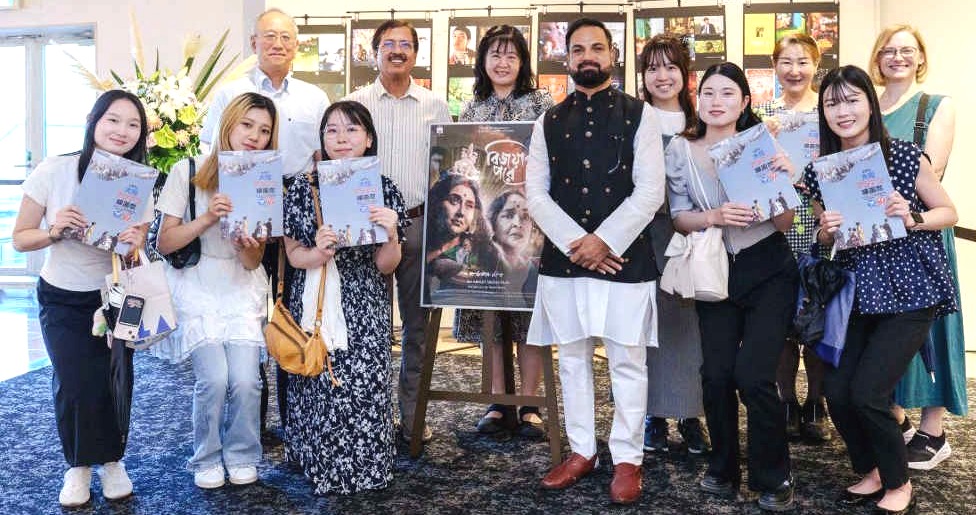
Filmmaker Abhijit SriDas’s Transcending Global Journey.

Guwahati; May 2026: The relationship between Assam and Bengal has always run deeper than geography. It is woven through language, literature, music, theatre, cinema and centuries of shared cultural exchange. A time when both states are finding themselves aligned in new political realities and regional conversations are increasingly focused on identity, heritage and development, some believe this may also be an opportunity to renew cultural partnerships that have historically enriched both societies.
Cinema, after all, has often succeeded where politics and policy alone cannot. It creates emotional bridges. It helps people see themselves in one another’s stories. The question therefore is not merely whether filmmakers from Bengal would visit North East; or, vice versa – that North Eastern filmmakers should camp in Bengal. The larger question is whether the next chapter of eastern India’s storytelling can emerge from a deeper dialogue between regions that have influenced one another for generations.
For Bengali filmmaker Abhijit SriDas, this attraction is not merely geographical. He sees a region where rivers carry memory, forests shape identity and cultures possess a richness that Indian cinema is only beginning to appreciate. His fascination with Assam comes amid a quiet reawakening across eastern India. While Bengal and Assam have long shared literary, artistic and historical ties, many believe the cinematic possibilities between the two regions remain largely unexplored.
Abhijit SriDas is from Siliguri whose debut feature film became the first Indian Bengali film to be officially screened at the prestigious Osaka Asian Film Festival now finds himself deeply fascinated to Assam and the wider picturesque Northeast, which he believes may hold some of the most powerful untold stories in contemporary Indian cinema.
For many years, Indian cinema has often viewed the North East region from a distance, capturing its scenery, terrain and visual beauty. Far less attention has been paid to the emotional lives of its people, its indigenous narratives, historical complexities and the silences that define existence there. SriDas believes that is beginning to change.
He has frequently spoken about his fascination with the relationship between wildlife, landscape and human emotion. To him, Assam, with its rivers, elephant corridors, tea gardens, forests, floodplains, indigenous communities and living traditions, represents a cinematic universe that remains astonishingly underexplored despite possessing immense narrative depth.
Most importantly, he believes these stories need not be confined to documentaries. They can thrive within mainstream feature films while retaining their cultural authenticity and commercial appeal. The significance of this perspective lies in the fact that SriDas brings it to the conversation with growing international recognition behind him.
His debut film “Bijoyar Pore” is among the most talked-about Bengali films on the international festival circuit in recent years, gradually earning recognition well beyond eastern India. The psychological family drama, starring Padma Shri awardee Mamata Shankar alongside Swastika Mukherjee, Deepankar De, Mir Afsar Ali and Rwitobroto Mukherjee, explores grief, reconciliation, memory and the fragile emotional architecture of relationships.
It is an extraordinary achievement for a debut filmmaker. Its journey took it from Dhaka and Jaffna to Boston and Montreal, from Dallas to Atlanta and beyond. Bijoyar Pore collected major honours along the way, including the Audience Choice Award at the Dhaka International Film Festival and multiple accolades for SriDas, most notably the Best Director Award at the Telangana Bengali Film Festival, while continuing to attract attention across Asia and North America.
The defining milestone came at the Osaka Asian Film Festival, one of Asia’s most respected platforms for contemporary cinema, where Bijoyar Pore became the first Indian Bengali film to receive an official screening.
Mamata Shankar’s performance drew particular acclaim, with many viewers describing it as among her most affecting performances in recent years. The emotional sensitivity and restraint of the film enabled it to connect deeply with audiences across cultures and backgrounds. What made the journey especially meaningful was its direction: eternally eastward, not westward.
A story deeply rooted in Bengali culture found resonance with audiences in another corner of Asia. Discussions surrounding the screening extended beyond the film itself into conversations about the larger legacy of Bengali cinema, invoking masters such as Satyajit Ray, Ritwik Ghatak and Mrinal Sen. Amid those conversations stood a contemporary voice from eastern India, carrying a story shaped by a new generation.
Following the screening, SriDas described the experience as a historic moment for Bengali cinema and reflected on how themes such as silence, memory and reconciliation possess an emotional power that transcends borders. A filmmaker from Siliguri carried a deeply Bengali story from Nandan to Osaka and into the wider conversation of Asian cinema. Today, his attention is turning east once again, towards Assam and the Northeast, not as destinations to be filmed, but as living stories waiting to be heard.
Perhaps that is why his gaze is now turning further east, towards the rising sun and beyond, towards Assam and the Northeast. He speaks of stories where animals are not merely creatures but characters, where a river is not simply a landscape but a keeper of memory, and where entire communities carry histories, traditions and emotional worlds that have rarely occupied centre stage in mainstream Indian cinema.
Several filmmakers from the Northeast have already demonstrated the extraordinary power of storytelling emerging from the region. Yet many continue to feel that these voices deserve far greater visibility than they currently receive.
The late Zubeen Garg often spoke about the need to build a stronger cinematic ecosystem rooted in Assam while creating stories capable of travelling far beyond the region’s borders. It was a vision that viewed local narratives not as limitations, but as bridges connecting Assam to larger audiences across India and the world.
That aspiration continues to resonate. SriDas has not announced any formal project in Assam yet. What exists today is a growing curiosity, a series of conversations and the possibility of creative collaborations that may take shape in the years ahead. Meaningful cinema often begins in exactly that manner.
Team Maverick.




Pakistan Deploys Chinese SH-15 Howitzers Along Eastern Border Amid Military Modernisation
New Delhi, Aug 2026 : Pakistan has reportedly stepped up the deployment of Chinese-made ar…

Pakistan Deploys Chinese SH-15 Howitzers Along Eastern Border Amid Military Modernisation
New Delhi, Aug 2026 : Pakistan has reportedly stepped up the deployment of Chinese-made …