Government Schemes Must Reach Every Eligible Family; Administration Must Work with Sensitivity and Accountability: Chief Minister Vishnu Deo Sai

High-Level Review Meeting in Sukma Assesses Development, Law and Order, Health, Education, Agriculture and Welfare Programmes Across Three Districts
CM Directs Officials to Ensure Benefits Reach the Last Person in Bastar and Resolve Public Grievances Within Fixed Timelines
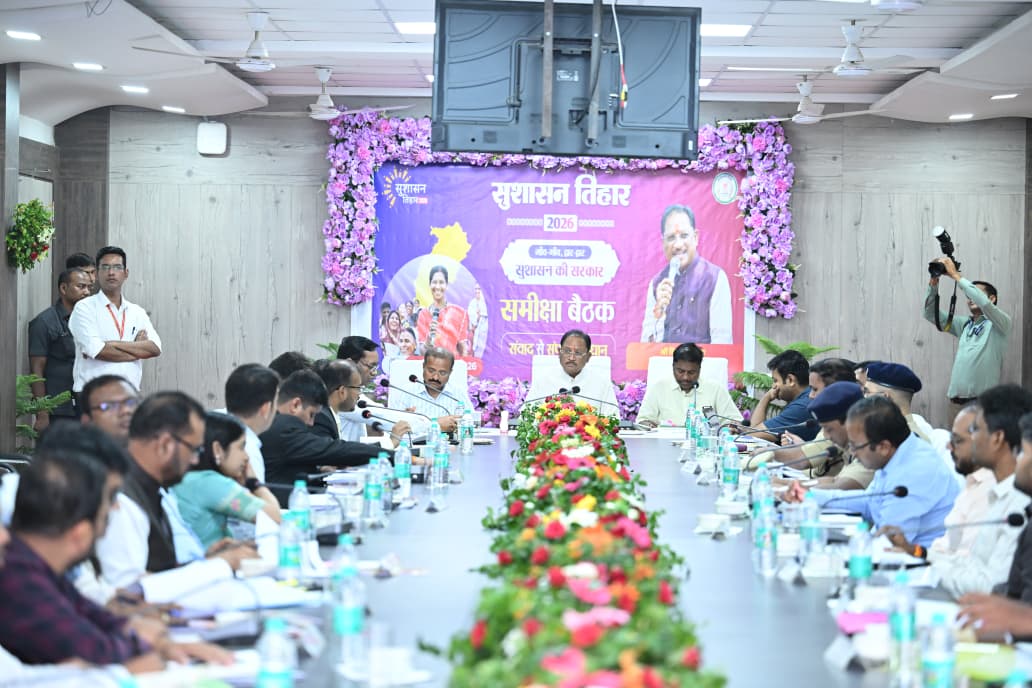
Raipur, June 2026 : Chhattisgarh Chief Minister Vishnu Deo Sai has stressed that the true success of governance lies in ensuring that government benefits reach the last person in society and that citizens do not have to struggle to get their problems resolved.
Chairing a high-level review meeting at the Sukma District Collectorate, the Chief Minister conducted a detailed assessment of development initiatives, law and order, revenue administration, healthcare, education, agriculture, infrastructure, and public welfare programmes in the districts of Sukma, Dantewada, and Bijapur.
He directed district collectors, superintendents of police, and senior officials to ensure 100 per cent coverage of government schemes in every village and among every eligible family, including those living in remote and sensitive areas of the Bastar division.
“The government’s objective is not merely to launch schemes but to bring real and measurable improvements in people’s lives through their effective implementation,” he said.
The meeting was attended by Forest Minister Kedar Kashyap, Principal Secretary to the Chief Minister Subodh Kumar Singh, Special Secretary Rajat Bansal, Bastar Commissioner Doman Singh, Chief Conservator of Forests Alok Kumar Tiwari, and other senior officials, while several officers participated through video conferencing.
Mission-Mode Implementation of Health Initiatives
Reviewing the Bastar Munne Campaign and the Chief Minister Swasth Bastar Campaign, the Chief Minister instructed officials to ensure regular and effective healthcare services in remote forest regions.
He said camp-based healthcare services should be used extensively to address public grievances and provide treatment. Where necessary, camps should continue for two to three consecutive days to ensure complete resolution of issues.
“The objective is not just to achieve targets on paper. Citizens should experience quality treatment and reliable healthcare services,” he emphasized.
Special Drive for Revenue Cases and Rehabilitation
The Chief Minister directed the Revenue Department to prioritize cases related to land mutation, demarcation, partition, and record correction, noting that these matters directly affect citizens’ rights and livelihoods.
He ordered a special campaign to dispose of cases pending beyond prescribed timelines, especially those unresolved for more than a year.
The meeting also reviewed the implementation of the SVAMITVA Scheme, distribution of Forest Rights Act titles, welfare support for rehabilitated families, and measures for the resettlement of families originally from Bastar but currently residing in other states.
New Market Opportunities Through the “Bastar Brand”
The Chief Minister stressed the need to connect women’s self-help groups with forest produce-based enterprises as well as activities such as shrimp farming, goat rearing, and beekeeping.
He directed officials to prepare an action plan for shrimp farming by developing ponds in the Shabari River region and suggested marketing products made by women’s groups under a unified “Bastar Brand.”
“Women’s self-help groups are not merely economic entities; they can become powerful drivers of rural self-reliance and social transformation,” he said.
Boost to Tourism, Agriculture and Tribal Entrepreneurship
The meeting explored opportunities to promote tourism through water sports, adventure activities, and jungle safaris in Sukma, Dantewada, and Bijapur.
The Chief Minister emphasized linking tourism development with local employment generation and economic activity. He also directed officials to encourage tribal entrepreneurship by involving local communities in rice processing and milling activities.
Reviewing preparations for the upcoming Kharif season, he instructed departments to ensure timely availability of seeds and fertilizers. Given the limited availability of DAP fertilizer, he called for awareness campaigns promoting alternatives such as SSP, urea, nano urea, and nano DAP.
Chief Minister’s Helpline to Strengthen Accountability
The Chief Minister said the state government is developing the Chief Minister’s Helpline into a robust and reliable platform where citizens can easily register complaints.
Complaints received through the helpline will be closely monitored at higher levels, ensuring accountability among officials and timely resolution of grievances.
“Sensitive, accountable, and result-oriented administration is the true hallmark of good governance,” he said.
He also urged the prudent use of diesel and petrol, assuring that there is no fuel shortage in the state and warning that strict action would be taken against those spreading rumours.
Focus on Education, Health and New Criminal Laws
The Chief Minister reviewed the implementation of several flagship schemes, including the Pradhan Mantri Awas Yojana, Pradhan Mantri Gram Sadak Yojana, PM Surya Ghar Muft Bijli Yojana, Ayushman Bharat, Jal Jeevan Mission, Bihan Yojana, Tendu Leaf Collection Programme, Mahtari Vandan Yojana, Social Security Pension Schemes, and the Pradhan Mantri Kisan Samman Nidhi.
During the review of Ayushman Bharat, he noted that issuing health cards alone is not sufficient and stressed that beneficiaries must receive quality medical treatment.
In the education sector, he advocated the use of AI-based technologies to address teacher shortages in specific subjects and praised Bijapur district’s “Shiksha Mitan” initiative. He also directed officials to improve learning outcomes through innovation and regular monitoring.
The Chief Minister further reviewed road safety measures, policing, and the implementation of India’s new criminal laws. He called for extensive training programmes, public awareness campaigns, and effective dissemination of information about the new legal framework. He also emphasized strengthening anti-drug initiatives.
Concluding the meeting, Chief Minister Vishnu Deo Sai urged all departments to work with greater coordination, clearly defined goals, and a culture of accountability.
“With dedicated and coordinated efforts from all officials, Chhattisgarh can emerge as one of the country’s leading and most developed states,” he said.

NCC Holds Cyclothon 2026 to Mark 79th Independence Anniversary
The National Cadet Corps (NCC) organised Cyclothon 2026 on August 02, 2026 in New Delhi to…
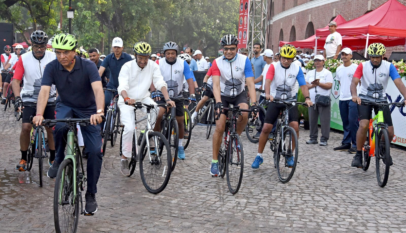
NCC Holds Cyclothon 2026 to Mark 79th Independence Anniversary
The National Cadet Corps (NCC) organised Cyclothon 2026 on August 02, 2026 in New …