Sonia Gandhi Slams Centre’s Gaza Policy, Says India’s Silence Has Weakened Its Global Standing

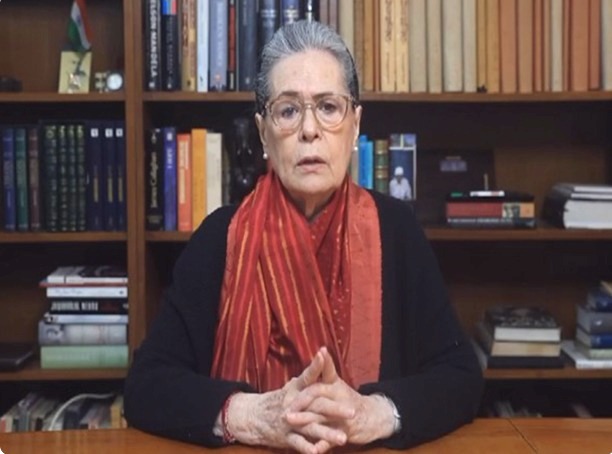
New Delhi, June 2026 : Congress Parliamentary Party (CPP) Chairperson Sonia Gandhi on Saturday launched a scathing attack on the Narendra Modi-led government over its handling of the Gaza conflict, accusing it of maintaining an “unjustifiable silence” in the face of what she described as a humanitarian catastrophe. In a strongly-worded opinion article published in The Indian Express, Gandhi argued that the government’s inaction was not only morally indefensible but also strategically damaging to India’s long-standing foreign policy interests and international credibility.
The Congress veteran contended that India’s traditional diplomatic principles—anchored in support for anti-colonial struggles, national sovereignty, and global peace—have been significantly diluted under the current government. According to her, New Delhi’s reluctance to speak out against the humanitarian crisis in Gaza has alienated several of India’s long-standing partners in West Asia while weakening the country’s moral authority on the global stage.
Gandhi said India has historically enjoyed close relations with Palestine, Iran and several countries across the Middle East. However, she claimed that the Modi government’s present foreign policy has distanced India from these traditional allies while simultaneously allowing countries like Pakistan to project themselves as mediators in regional affairs.
“The spirit of Indian nationhood demands that India speak up for the Palestinian people, particularly for children who have been subjected to unimaginable suffering. Equally, the country’s national interest requires us to respond to the overwhelming global opinion against Israel’s actions in Gaza and the occupied West Bank,” she wrote.
She maintained that the government’s continued silence could neither be justified on ethical grounds nor explained from the perspective of India’s strategic interests.
Referring to reports of the United Nations Independent International Commission of Inquiry on the Occupied Palestinian Territory, Gandhi said the commission had concluded in September 2025 that Israeli authorities were committing acts amounting to genocide against Palestinians in Gaza. She further pointed out that a subsequent report released in June 2026, headed by former Delhi High Court Chief Justice S. Muralidhar, reiterated concerns that Israeli military operations had deliberately targeted Palestinian civilians, particularly children.
Describing the findings as deeply disturbing, Gandhi wrote that the commission’s report documented widespread destruction across Gaza, alleging that over 20,000 children had been killed while another 44,000 had sustained life-altering injuries. She further cited findings that the destruction of hospitals, including specialised children’s healthcare facilities, had led to a sharp rise in miscarriages and childbirth complications.
While acknowledging that the October 7 Hamas attack on Israel was “dastardly, horrific and completely unacceptable,” Gandhi argued that Israel’s military response over the past two-and-a-half years had crossed all limits of proportionality.
She alleged that several senior Israeli leaders, including Prime Minister Benjamin Netanyahu and members of his Cabinet, had publicly advocated policies such as the “complete siege” of Gaza, the “total annihilation” of the territory and the forced displacement of its population.
According to Gandhi, despite what she termed “clear evidence of genocidal intent,” the continued political and military support extended by US President Donald Trump’s administration had enabled Israel to pursue its military campaign. She also criticised the United Nations for being unable to take decisive action because of repeated American intervention, despite UN agencies documenting alleged violations of international humanitarian law.
The Congress leader noted that an increasing number of countries traditionally aligned with the Western bloc—including France, the United Kingdom, Canada and Australia—had moved towards recognising Palestinian statehood. She also referred to South Africa’s proceedings before the International Court of Justice, alleging that Israel had violated the 1948 Genocide Convention.
Gandhi further pointed out that several European countries had imposed restrictions on arms exports to Israel, while a number of Latin American nations had either downgraded or severed diplomatic relations with the country. She also referred to proceedings before the International Criminal Court, stating that arrest warrants had been issued against members of Israel’s political leadership.
Against this backdrop, Gandhi argued that India had emerged as one of the few major democracies that continued to refrain from publicly criticising Israel’s actions.
“Today, India stands almost alone in its silence despite growing global concern over the humanitarian crisis unfolding in Gaza,” she wrote.
Reflecting on India’s diplomatic legacy, Gandhi said the country had traditionally been recognised as a voice for decolonisation, peace and justice among developing nations. She argued that New Delhi’s current position represented a significant departure from those principles.
“India today appears indifferent to the erosion of the international rules-based order, to the suffering of fellow nations in the Global South and to the humanitarian tragedy unfolding before the world’s eyes,” she observed.
She also questioned the strategic rationale behind Prime Minister Narendra Modi’s recent visit to Israel, which she described as taking place shortly before Israel intensified military operations against Iran and following the assassination of senior Iranian leaders.
According to Gandhi, the government’s current foreign policy has produced little tangible benefit while straining India’s ties with key partners across West Asia.
“We have alienated ourselves from our historical friends in Palestine, Iran and much of the Middle East. We have distanced ourselves from prevailing global opinion, while Pakistan has stepped forward to claim a role as a regional mediator—a position that historically could have belonged to India because of our balanced relations with all parties,” she wrote.
Concluding her article, Gandhi asserted that India’s departure from its traditional foreign policy doctrine had yielded little beyond what she described as the personal friendship between Prime Minister Narendra Modi and Israeli Prime Minister Benjamin Netanyahu, arguing that the country’s global standing and strategic interests had suffered as a consequence.
(The content of this article is sourced from a news agency and has not been edited by the Mavericknews30 team.)





PM Modi Begins Landmark Seychelles Visit, Receives Warm Welcome from President Herminie
Victoria, June 2026 : Prime Minister Narendra Modi on Saturday began a three-day State Vis…
PM Modi Begins Landmark Seychelles Visit, Receives Warm Welcome from President Herminie
Victoria, June 2026 : Prime Minister Narendra Modi on Saturday began a three-day State …