UNESCO Unites Global Education Leaders To Accelerate Progress On SDG 4 And Shape The Education Agenda Beyond 2030.

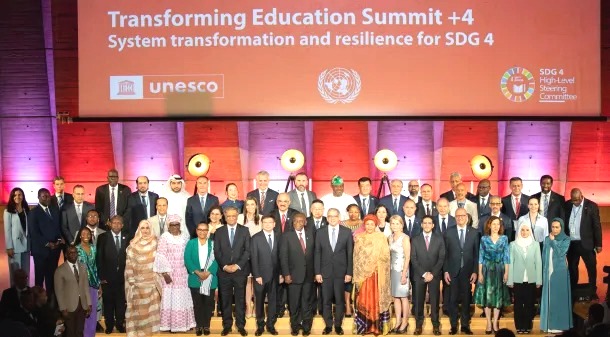
Paris; July 2026: Yesterday (Saturday – 11th July 2026; IST), nearly 40 global leaders gathered at UNESCO for the Transforming Education Summit (TES+4), reaffirming their commitment to SDG 4 as they confront a deepening global education financing crisis and work to shape the education agenda beyond 2030.
The educational summit brought together UNESCO Director-General Khaled El-Enany, South Africa President Cyril Ramaphosa, the United Nations Deputy Secretary-General Amina J. Mohammed, nearly 40 ministers, Grammy-nominated recording artist and songwriter Audrey Nuna, youth representatives, and representatives of UN agencies, international and regional development partners, financial institutions, civil society, academia and the private sector.
“Resilience in education is about people: empowering teachers, supporting learners, and building systems that can evolve to meet the challenges of today and tomorrow”, reiterated Khaled El-Enany
UNESCO Director-General and SDG 4 High-Level Steering Committee Co-Chair
Through the twin lenses of resilience and transformation, the TES+4 reviewed progress in key thematic areas: inclusive digital transformation, greening education, the teaching profession, skills development and education in crisis situations. The Summit also restated that sustainable financing underpins resilient education systems while inclusion, equity and gender equality remain at the heart of educational transformation.
“The Summit builds on the landmark launch in 2022, and its task is twofold”, Amina J. Mohammed
Deputy Secretary-General, United Nations said in her speech while adding further
- The first is acceleration: five years remain to deliver on Sustainable Development Goal 4 – inclusive, equitable, quality education for all – and the pace of the next five years will decide how much of that promise is kept.
- The second is direction: today’s discussions will help define the global education agenda beyond 2030. Because 2030 is a milestone, not a finish line, and education will remain the foundation for every one of the Sustainable Development Goals.
The opening plenary on sustainable financing highlighted that resilient education systems require predictable, equitable and long-term investment, in line with the TES Call to Action on Financing Education and the work of the SDG 4 High-Level Steering Committee.
The speakers mostly have emphasised the need to shift from fragmented, short-term funding to country-led sustainable financing strategies that strengthen domestic resource mobilisation, improve efficiency, and expand fiscal space for education through innovative approaches. In this context, particular attention was given to the challenge of debt sustainability, such as debt swaps for education, to protect and increase investment in education in constrained fiscal contexts. The role of development partners and international financial institutions in aligning external financing with national priorities to reinforce resilience and equity was also underscored.
To help countries navigate these challenges, UNESCO has released a Debt and Education package exploring how the global debt crisis is constraining fiscal space and forcing governments to divert resources away from education.
Cyril Ramaphosa, President of the Republic of South Africa and SDG 4 High-Level Steering Committee Co-Chair has asserted: “Resilience, financing and the post-2030 agenda are not parallel tracks, they converge on one destination: education systems that anticipate disruption, adapt with equity, and transform with purpose, catalysing the skills revolution needed for tomorrow’s economies”.
The session on education in crisis examined how lessons from education in emergencies can help build more resilient education systems:
- South Sudan has underscored the need to better align international support for teachers, data systems and sustainable financing with efforts to promote to contribute to peace and social cohesion.
- Ukraine showed how underground schooling and nationwide distance and flexible learning spaces allowed learning continuity the war, while shifting the focus from emergency response to longer-term resilience, digital education and lifelong learning.
- Libya highlighted how safe schools, strong partnerships and digital transformation can serve as strong pillars to build resilient systems.
The participants has agreed upon three priority actions:
- Learning remains a beacon of stability and crucial to building sustainable resilience in EiE with teachers at the heart of it.
- Resilience can only be achieved through effective and robust partnerships.
- Resilience is built before a crisis, not during it.
In the session on the teaching profession, participants discussed country-level reforms, as well as global-level milestones achieved since the TES, including the 2024 Recommendations of the United Nations Secretary-General’s High-Level Panel on the Teaching Profession and the Santiago Consensus adopted at the 2025 World Summit on Teachers. Cambodia presented reforms aimed at strengthening teacher competence by raising teacher training standards, strengthening pedagogical competence, expanding continuous professional development and developing guidance on the use of AI in teaching. The Arab Bureau of Education for the Gulf States highlighted efforts to advance regional dialogue to make the teaching profession more attractive across the Gulf States.
Furthermore, the participants agreed on three priority actions:
- Developing and implementing comprehensive teacher policies;
- Transforming teacher education from a lifelong perspective;
- Taking decisive and immediate action to make the teaching profession more attractive.
Discussions on inclusion and gender equality highlighted how countries are embedding equity into education policies, planning and system resilience.
- Thailand presented flexible learning pathways and proactive mechanisms to identify and support out-of-school learners.
- Uruguay underlined the importance of dialogue across society, positioning education as a transformative tool for gender equality and social change.
- Mauritania highlighted gender equality as central to building resilient education systems and safeguarding progress during crises.
The session on inclusive digital transformation reaffirmed education as a public good, highlighting the Gateways to Public Digital Learning Initiative’s progress in ensuring that digital and AI technologies advance equity, inclusion and human agency.
- Egypt, as a lead country of the initiative, shared its experience in developing public digital platforms,
- Philippines announced its decision to join the initiative,
- Finland emphasised the importance of co-creating digital solutions with learners, teachers and stakeholders. The United Arab Emirates presented the AI-powered NOVA project, showing how AI can transform institutional practices while strengthening responsible governance.
The session on environmental and climate change education focused on advancing climate-ready systems through the Greening Education Partnership. Leaders from Saint Kitts and Nevis, the Kingdom of Tonga and the Seychelles underscored the urgency of climate and ocean literacy in Small Island Developing States (SIDS), the need for a whole institution approach and the entire ecosystem to become climate ready. For its part, Uzbekistan shared approaches to greening schools and curricula, stressing that education is one of the most effective means to achieve sustainability.
The session on skills, employability, and lifelong learning explored how TVET and higher education systems can better respond to the rapidly changing labour market needs. Discussions highlighted a shared commitment to equipping learners with future-ready skills by strengthening links between education and industry, embedding digital and AI competencies and expanding lifelong learning opportunities. Country examples ranged from South Africa’s whole system approach connecting education, the economy and the labour market, to Armenia’s industry partnerships to strengthen AI skills; Saudi Arabia’s promotion of digital education for global citizenship; and Oman’s integration of TVET, entrepreneurship and lifelong learning through its National Framework for Future Skills.
The Transforming Education Summit +4 (TES+4) marked a pivotal step in building a global momentum for the post-2030 education agenda. The meeting helped forge a shared vision for coordinated action as UNESCO and the SDG 4 High-Level Steering Committee have launched global consultations on the future of education. Young people are at the heart of this process: the consultations include youth and students, ensuring that their aspirations, experiences and ideas help shape the next education agenda and priorities.
Closing the Summit, Prasert Jantararuangtong, Thailand’s Minister of Education, announced that the Kingdom of Thailand will host the 2027 Global Education Meeting in Bangkok from 31st March to 02nd April, 2027. Bringing together governments, youth, educators, experts, development partners and other key stakeholders, this event will offer a strategic platform to take stock of progress and reinforce global commitment to decisive actions in the final stretch to 2030.
Team Maverick.



Alvarez, Lautaro Fire Argentina Past 10-Man Switzerland in Extra Time, Set Up Blockbuster World Cup Semi-final Against England
Score: Argentina 3 (Alexis Mac Allister 10′, Julian Alvarez 112′, Lautaro Mart…

Alvarez, Lautaro Fire Argentina Past 10-Man Switzerland in Extra Time, Set Up Blockbuster World Cup Semi-final Against England
Score: Argentina 3 (Alexis Mac Allister 10′, Julian Alvarez 112′, Lautaro Martinez 120+1′) beat …