Rajya Sabha Passes Bill to Make Insulting ‘Vande Mataram’ a Punishable Offence Amid Opposition Walkout

New Delhi, July 2026 : The Rajya Sabha on Wednesday passed the Prevention of Insults to National Honour (Amendment) Bill, 2026, paving the way for deliberate insults to the National Song “Vande Mataram” to become a punishable offence, bringing it on par with existing legal protections for the National Anthem and other national symbols. The legislation was cleared after a heated debate marked by repeated disruptions, sloganeering and an eventual walkout by Opposition members.
The Bill seeks to amend the Prevention of Insults to National Honour Act, 1971, extending legal protection to “Vande Mataram”, a song that played a pivotal role during India’s freedom struggle. The government argued that the amendment reflects the nation’s commitment to safeguarding symbols that embody India’s unity, cultural identity and patriotic spirit.
The proceedings witnessed repeated interruptions as Opposition members demanded the presence of Union Home Minister Amit Shah during the debate. Members from several Opposition parties raised points of order, but Deputy Chairman Harivansh Narayan Singh declined to entertain them, observing that the House was not functioning in an orderly manner.
As the protests intensified, Opposition MPs continued raising slogans, making it difficult for speakers to continue their speeches. Eventually, they staged a walkout before the Bill was put to vote.
Aam Aadmi Party MP Sanjay Singh opposed the legislation, questioning the government’s intentions and alleging that the party introducing the Bill belonged to an organisation that had not unfurled the National Flag at its headquarters for many years. Other Opposition leaders also criticised the legislation, arguing that national respect cannot be legislated through criminal provisions.
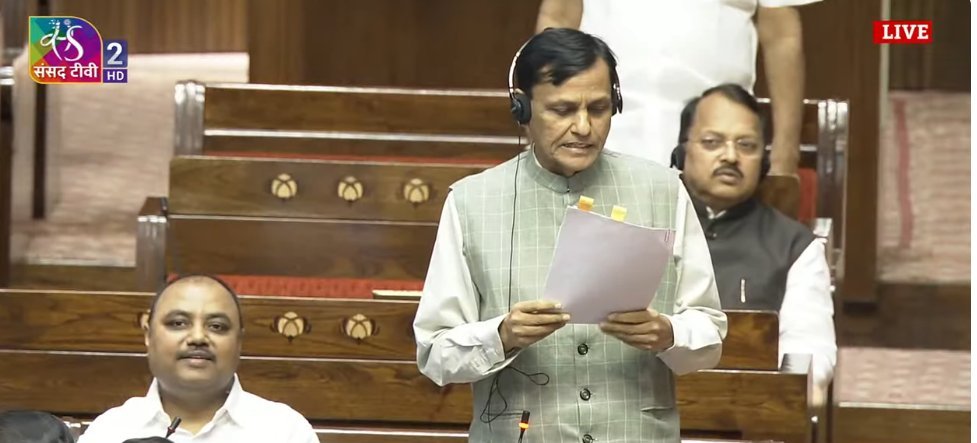
Replying to the debate, Minister of State for Home Affairs Nityanand Rai defended the amendment, describing it as much more than a routine legislative exercise.
“Every amendment is not merely a legal change but a reaffirmation of India’s national consciousness, cultural values and the ideals of our freedom movement,” Rai told the House.
He noted that the original Prevention of Insults to National Honour Act was enacted in 1971 to protect the dignity of the National Flag, National Anthem and Constitution, and said the current amendment simply extends similar protection to “Vande Mataram”.
Highlighting the historical importance of the song, Rai recalled that Bankim Chandra Chatterjee composed “Vande Mataram” in 1875 and that it became one of the most powerful symbols of India’s freedom movement.
He referred to Rabindranath Tagore’s rendition of the song at the 1896 session of the Indian National Congress and noted that Sarala Devi Chaudhurani later performed its complete version during the 1905 Congress session in Varanasi.
The minister also criticised the Congress leadership’s 1937 decision, taken during Jawaharlal Nehru’s presidency of the party, to officially restrict the song to its first two stanzas. In contrast, he praised Netaji Subhas Chandra Bose for initiating efforts in 1938 to create a complete musical arrangement of the song.
Rai further recalled that the complete rendition of “Vande Mataram” was broadcast by All India Radio on Independence Day in 1947 at the initiative of Sardar Vallabhbhai Patel. He also cited Dr Rajendra Prasad’s statement in the Constituent Assembly on January 24, 1950, which accorded “Vande Mataram” a status equal in national importance to the National Anthem.
The Minister asserted that opposing the Bill amounted to disregarding the sentiments of India’s freedom fighters and great national leaders. He said revolutionaries such as Chandrashekhar Azad, Ram Prasad Bismil, Ashfaqulla Khan, and Khudiram Bose had chanted “Vande Mataram” while making the ultimate sacrifice for the country.
According to Rai, disrespecting the National Song only emboldens forces seeking to divide the nation. He argued that protecting “Vande Mataram” is essential to preserving India’s unity and cultural heritage.
The minister linked the legislation to Prime Minister Narendra Modi’s vision of “Ek Bharat, Shreshtha Bharat”, saying the amendment reflects the aspirations of millions of Indians and rises above political considerations.
Before the minister’s reply, members from various political parties, including the BJP, DMK, TDP, YSRCP, BJD, RJD, BRS, AIADMK and Shiv Sena, participated in the discussion, expressing differing views on the proposed amendment.
Following the government’s response and the Opposition’s walkout, the Rajya Sabha passed the Bill, completing another key piece of legislation during the ongoing Monsoon Session of Parliament. The amendment is expected to strengthen legal safeguards for one of India’s most enduring symbols of the freedom movement while further intensifying the political debate over nationalism and the protection of national symbols.




ISRO Successfully Tests Indigenous Ship-Borne Tracking System for Gaganyaan Mission
New Delhi, July 2026 : The Indian Space Research Organisation (ISRO) has successfully vali…

ISRO Successfully Tests Indigenous Ship-Borne Tracking System for Gaganyaan Mission
New Delhi, July 2026 : The Indian Space Research Organisation (ISRO) has successfully validated …