ISRO Successfully Tests Indigenous Ship-Borne Tracking System for Gaganyaan Mission

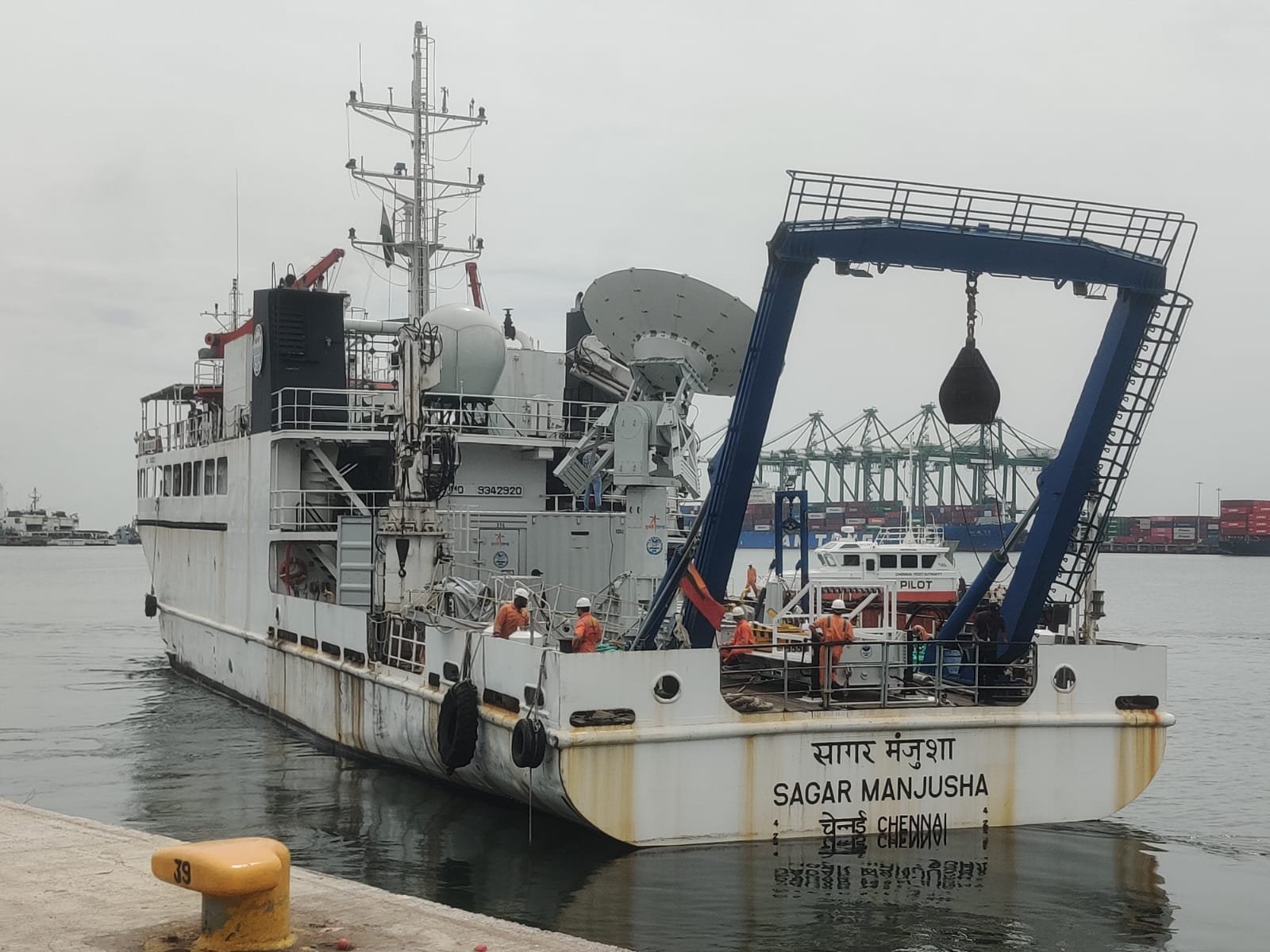
New Delhi, July 2026 : The Indian Space Research Organisation (ISRO) has successfully validated its indigenous ship-borne tracking terminals aboard the National Institute of Ocean Technology’s (NIOT) research vessel Sagar Manusha, marking a significant advancement in India’s space infrastructure. The successful trial strengthens the country’s capability to monitor rockets and satellites over vast oceanic regions and will play a crucial role in supporting the upcoming Gaganyaan human spaceflight mission.
The trial was conducted on July 26, 2026, off the Chennai coast by ISRO’s Telemetry, Tracking and Command Network (ISTRAC). The Ship-Borne Terminal (SBT) was tested under actual maritime conditions aboard the moving vessel and demonstrated reliable performance, confirming its readiness for operational deployment during future space missions.
The indigenous tracking system has been developed to overcome one of the major challenges in space launches—maintaining uninterrupted communication with launch vehicles and spacecraft after they move beyond the range of land-based tracking stations. Since rockets rapidly travel over oceanic regions soon after lift-off, conventional ground infrastructure cannot provide continuous monitoring. The SBT fills this critical gap by enabling real-time tracking and communication from sea-based platforms.
The capability assumes greater significance for Gaganyaan, India’s first human spaceflight programme, where uninterrupted tracking of both the launch vehicle and the crew module is essential. The ship-borne terminal will enable mission controllers to maintain constant communication with astronauts and monitor the spacecraft throughout its journey across the Indian Ocean and other remote areas, ensuring enhanced mission safety and rapid response in case of emergencies.
Apart from crewed missions, the technology will significantly improve tracking support for satellite launches and other space missions by extending communication coverage to regions where terrestrial infrastructure is unavailable. This expanded tracking network will enhance mission accuracy, improve trajectory monitoring and provide greater operational flexibility for future launches.
The successful validation of the indigenous Ship-Borne Terminal also reflects India’s growing self-reliance in critical space technologies. Until now, such capabilities often depended on limited international tracking networks or foreign systems. By developing its own advanced maritime tracking infrastructure, ISRO has reduced dependence on external support while improving the security, reliability and cost-effectiveness of its space operations.
The project also highlights the successful collaboration between ISRO and the National Institute of Ocean Technology. NIOT’s research vessel Sagar Manusha served as a mobile testing platform, demonstrating India’s ability to integrate maritime capabilities with advanced space technologies. The partnership showcases the country’s expanding expertise in building comprehensive mission-support infrastructure for both uncrewed and human spaceflight programmes.
Officials believe the new system will not only strengthen the Gaganyaan mission but also provide long-term benefits for India’s growing space ambitions. The ship-borne terminals are expected to support future satellite launches, interplanetary missions and deep-space exploration by enabling continuous spacecraft tracking across remote oceanic regions where fixed ground stations cannot operate.
As India expands its presence in global space exploration, robust tracking and communication systems have become increasingly important for mission success. The indigenous Ship-Borne Terminal represents another milestone in ISRO’s efforts to build world-class, homegrown technologies that support increasingly complex missions.
With the successful validation of the system under real-world maritime conditions, ISRO has taken another important step toward ensuring safer, more reliable and fully indigenous space operations. The achievement further reinforces India’s emergence as a leading global space power and strengthens the technological foundation for future scientific and human space exploration missions.
(The content of this article is sourced from a news agency and has not been edited by the Mavericknews30 team.)







Paras Defence Develops Indigenous RayStrike-9 Laser Weapon to Boost India’s Counter-Drone Shield
New Delhi, July 2026 : Navi Mumbai-based Paras Defence is making significant strides in In…
ISRO Successfully Tests Indigenous Ship-Borne Tracking System for Gaganyaan Mission
New Delhi, July 2026 : The Indian Space Research Organisation (ISRO) has successfully validated …