Trump’s Tariffs Temporarily Reinstated After Appeals Court Stay

In a major legal twist, former President Donald Trump’s controversial tariffs have been reinstated—at least for now. A federal appeals court temporarily blocked a lower court’s ruling that had struck down the tariffs, allowing them to remain in effect while the case is reviewed further.
On Thursday, the United States Court of Appeals for the Federal Circuit in Washington issued a stay against a recent decision by the U.S. Court of International Trade. That lower court had ruled that Trump exceeded his constitutional authority by unilaterally imposing broad tariffs on goods from major U.S. trade partners.
The appeals court’s order means Trump’s sweeping tariffs—dubbed the “Liberation Day” tariffs—will continue to apply, including those on goods from Canada, Mexico, and China. These additional tariffs were tied to Trump’s claim that the three countries failed to curb the illegal flow of fentanyl into the U.S.
The appeals court has asked plaintiffs to respond by June 5 and the administration by June 9, giving both sides a short window to argue their positions.
Lower Court Had Rejected Trump’s Use of Emergency Powers
The trade court ruling on Wednesday surprised many observers. A three-judge panel concluded that the Constitution gives Congress, not the President, the exclusive power to impose tariffs and taxes. The court further held that Trump had overstepped by using the International Emergency Economic Powers Act (IEEPA), a law meant for national emergencies, as the basis for his tariff program.
While the ruling represented a serious legal challenge to Trump’s trade strategy, administration officials said they were confident they would prevail on appeal. They also hinted that the former President might use alternative executive powers to maintain the tariffs if necessary.
Trump Blasts the Courts, Appeals to Supreme Court
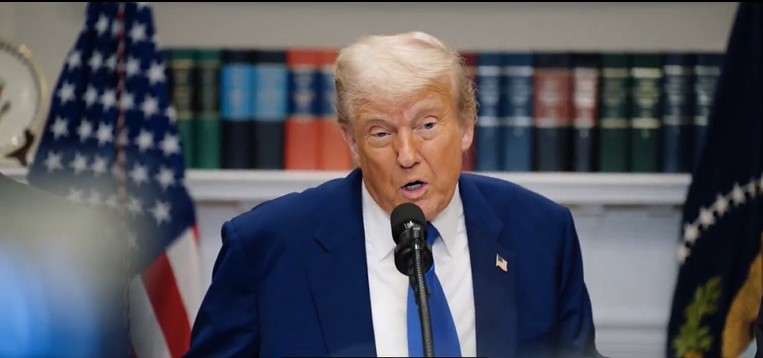
Former President Trump reacted strongly to the lower court’s decision. Posting on social media, he slammed the judges and said he hoped the U.S. Supreme Court would overturn what he called a “country-threatening decision.”
“The horrific decision stated that I would have to get the approval of Congress for these Tariffs,” Trump wrote. “If allowed to stand, this would completely destroy Presidential Power — The Presidency would never be the same!”
He claimed the ruling was being celebrated by foreign governments who would benefit if the tariffs were lifted, and he accused the judicial branch of undermining American interests.
Cautious Responses from U.S. Trade Partners
Governments around the world responded carefully. The British government called the court decision an internal U.S. matter and pointed out that it was just the first stage of a long legal process. Germany and the European Commission declined to comment.
Canadian Prime Minister Mark Carney, however, said the ruling was “consistent with Canada’s longstanding position” that the Trump tariffs were unlawful.
Uncertainty for Markets and Businesses
Financial markets showed muted optimism after the trade court ruling, but gains were limited due to the likelihood of a lengthy legal battle. Analysts said businesses remained in limbo, unsure of whether the tariffs would ultimately be removed or reinforced.
According to a Reuters analysis, Trump’s tariff measures have already cost companies over $34 billion in lost sales and increased supply chain costs.
Some industry-specific tariffs—such as those on steel, aluminum, and automobiles—were imposed by Trump under different national security provisions. These remain unaffected by the recent legal challenges.
The Liberty Justice Center, which represents five small businesses that sued to stop the tariffs, said the appeals court’s decision was only a procedural move. Jeffrey Schwab, the center’s senior counsel, said the court would ultimately recognize the harm done to these businesses, which are dealing with the loss of suppliers, rising costs, and threats to their survival.
A Second Court Also Rules Against Trump
In a related case, another federal court ruled on Thursday that Trump had again overstepped by using the IEEPA to justify imposing at least 10% tariffs on goods from most trade partners and 25% on products from Canada, Mexico, and China over the fentanyl issue.
However, this second ruling was narrower in scope, and its relief applied only to the toy company that brought the case. The administration is appealing that decision as well.
Trade Talks in Jeopardy
Trump’s tariff strategy has been central to his international negotiations. On April 2, he announced sweeping duties but paused them for 90 days following negative market reactions. Since then, he has made little progress securing new trade deals, except for one recently signed with the United Kingdom.
Analysts now fear that the ongoing legal uncertainty could discourage countries such as Japan from entering into fresh trade agreements with the U.S.
“Assuming that an appeal does not succeed in the next few days, the main win is time to prepare, and also a cap on the breadth of tariffs—which can’t exceed 15% for the time being,” said George Lagarias, chief economist at Forvis Mazars.
According to Oxford Research, if the lower court ruling had gone into effect, it would have reduced the overall U.S. tariff rate to about 6%. Instead, the emergency stay means tariffs will remain around 15%, the level they reached after Trump recently rolled back some tariffs on Chinese goods until late summer. Before Trump returned to the presidency in January, the average U.S. tariff rate was between 2% and 3%.
Economic Impact Widens
The ripple effects of the tariffs have been significant. Manufacturers of luxury goods, footwear, home appliances, and automobiles have all reported disruptions due to rising material costs.
Major companies such as Diageo, General Motors, and Ford have abandoned earnings forecasts because of uncertainty surrounding tariffs. International firms including Honda, Roche, Campari, and Novartis are either planning to relocate parts of their operations or expand their U.S. presence to soften the blow.
As the appeals process plays out, businesses, governments, and investors will continue to navigate an unpredictable trade landscape shaped by one of the most contentious uses of executive power in modern U.S. history.






CM Yogi directs action on 2,200 proposals: Budget to be released by July 15, projects to be launched on the ground from August 15
CM takes a tough stand during PWD review, warns of action over delays in pending projects …

CM Yogi directs action on 2,200 proposals: Budget to be released by July 15, projects to be launched on the ground from August 15
CM takes a tough stand during PWD review, warns of action over delays in …