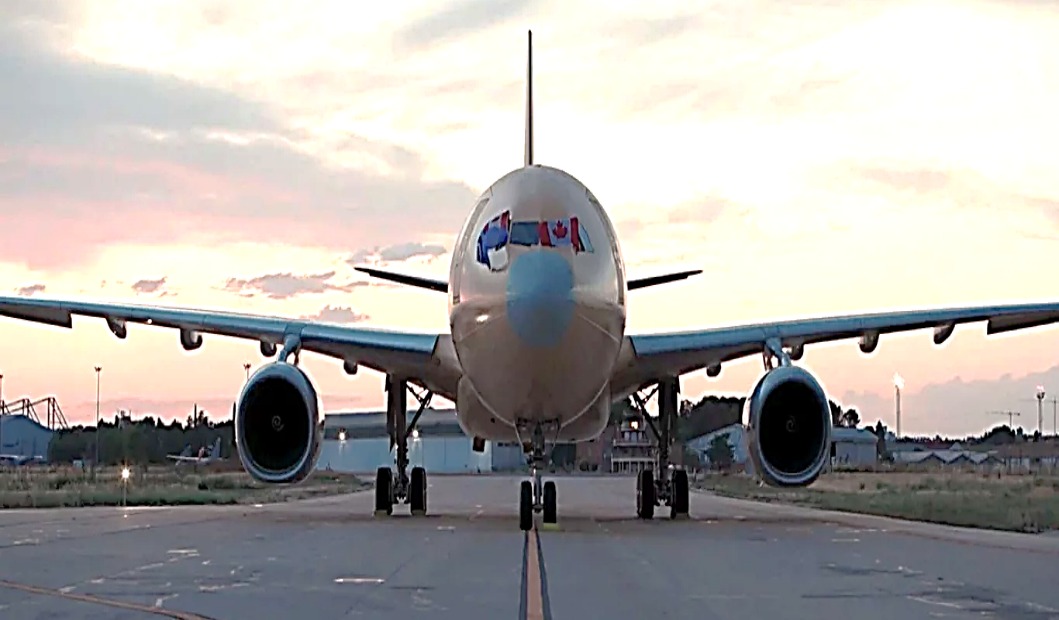
First Airbus A330 aircraft arrives in Spain for conversion into tanker aircraft for Canadian Air Force.

The first Airbus A330 aircraft destined for the Royal Canadian Air Force (RCAF) has arrived at the company’s Getafe facility in Spain. The aircraft will undergo its transformation into a Multi-Role Tanker Transport (MRTT), marking a major step in the execution of Canada’s Strategic Tanker Transport Capability (STTC) project. This initiative is aimed at replacing the aging CC-150 Polaris fleet, enhancing the RCAF’s ability to conduct air-to-air refuelling, strategic airlift, and global operations support.
The STTC (Strategic Tanker Transport Capability) project was officially launched with the signing of a contract between the Government of Canada and Airbus Defence and Space on July 25, 2023. The agreement, valued at approximately CAD $3.6 billion, provides for the acquisition of nine MRTT (Multi-Role Tanker Transport) aircraft, including four newly-built Airbus A330 MRTTs and five used A330-200s to be converted into MRTT configuration. This procurement strategy enables Canada to benefit from a mix of new production aircraft and cost-effective conversions, with the first operational MRTT expected to enter service by 2027 and the full fleet to be operational by 2033.
The A330 MRTT is recognised as one of the most advanced and capable aerial refuelling and transport platforms in service today. Each aircraft will be equipped with both the hose and drogue system and an advanced fly-by-wire boom, allowing for compatibility with a wide variety of receiver aircraft across NATO and allied air forces. In addition to its refuelling role, the MRTT can transport up to 300 passengers, 45 tonnes of cargo, or be configured for medical evacuation with Airbus’s modular MEDEVAC kit. This flexibility enables rapid response to both military and humanitarian missions.
The Canadian MRTTs will also be fitted with modern cybersecurity solutions and self-protection countermeasures, ensuring operational effectiveness in contested or hostile environments. These capabilities will significantly enhance Canada’s strategic air mobility, contributing to global stability missions, continental defence under NORAD, and allied operations across the globe. The transition from the aging Polaris fleet to the MRTT represents a substantial leap in range, fuel offload capacity, and multi-role adaptability.
Air-to-air refuelling tankers such as the A330 MRTT are vital assets in supporting NATO operations that demand extended range and endurance. These aircraft allow fighter jets and other air platforms to remain airborne longer, reducing the need for ground stops and increasing mission persistence over long distances. The A330 MRTT supports both of NATO’s standardised aerial refuelling systems: the probe-and-drogue and the boom. This dual compatibility ensures that Canadian aircraft can refuel allied platforms and vice versa, enhancing interoperability within coalition operations.
The probe-and-drogue system features underwing fuel pods with retractable hoses, as well as a central hose for refuelling larger aircraft. Receiver aircraft equipped with a refuelling probe can connect with the drogue in flight to receive fuel. This method allows for simultaneous refuelling of two aircraft and is commonly used by helicopters, light aircraft, and naval operations through buddy-buddy refuelling between fighters. The boom system, on the other hand, uses a rigid, telescopic tube operated from the rear of the tanker. This method offers a higher fuel transfer rate and is less affected by adverse weather but is limited to one receiver at a time and requires a dedicated boom operator.
The versatility of the MRTT in accommodating both systems allows the RCAF to support a wide array of mission profiles and allied platforms, reinforcing Canada’s role in joint operations. Moreover, ongoing advancements such as the Automated Aerial Refuelling (A3R) system will pave the way for future capabilities including refuelling of unmanned aerial systems. By investing in the MRTT, Canada is not only enhancing its national defence posture but also contributing meaningfully to the collective security and readiness of NATO.
For the Royal Canadian Air Force, acquiring the A330 MRTT fleet is a strategic investment in national defence and international interoperability. The aircraft will bolster Canada’s ability to project power, support deployed forces, and respond swiftly to crises at home and abroad. As global threats evolve and the demand for agile and resilient air power increases, the A330 MRTT will become a cornerstone of Canada’s air mobility and force sustainment architecture well into the future.
Team Maverick





US-Led Israel-Lebanon Peace Talks to Resume in Rome from August 4
Washington, July 2026 : The United States will host the next round of negotiations between…

US-Led Israel-Lebanon Peace Talks to Resume in Rome from August 4
Washington, July 2026 : The United States will host the next round of negotiations …