With avid Stoicism, Surgeon in Gaza fights to uphold humanity.

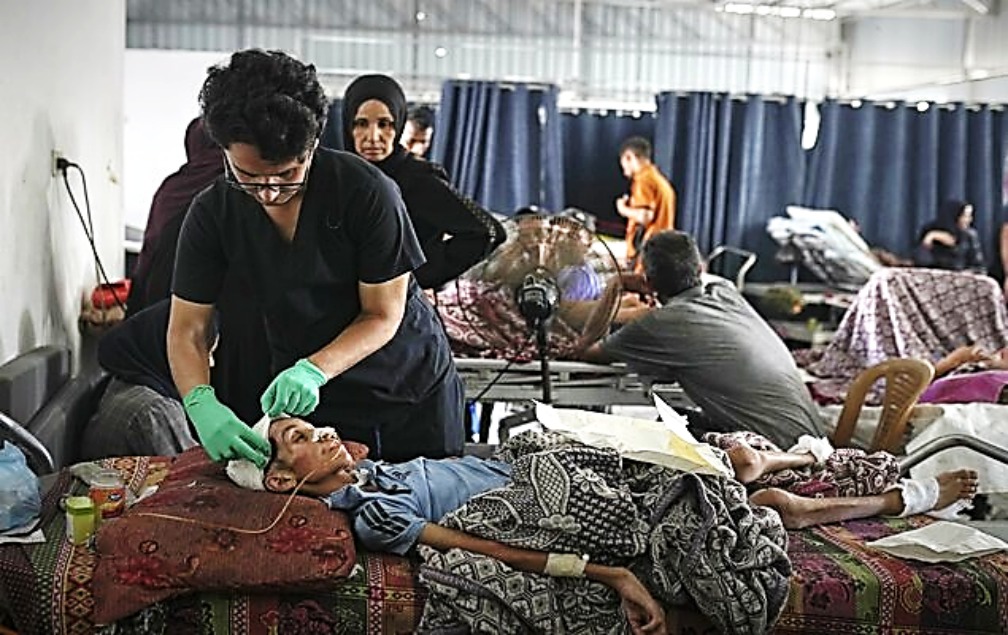
At Shifa hospital in the Gaza Strip, nothing is sterilized, so Dr. Jamal Salha, an aspiring Neuro Surgery Specialist and other surgeons wash their instruments in soap. While, infections are rampant, the stench of medical waste is overwhelming, with the flies demonstrating their menace everywhere.
Without painkillers, patients moan while lying on metal beds lining the corridors. There’s no electricity and no ventilation amid searing heat, leaving anxious visitors to fan bedridden relatives with pieces of cardboard.
Shifa, once the largest hospital in Gaza and the cornerstone of its health care system, is a shell of its former self after 22 months of war. The hospital complexes the size of seven soccer fields has been devastated by frequent bombings, two Israeli raids and blockades on food, medicine and equipment. Its exhausted staff works around the clock to save lives.
“It is so bad, no one can imagine”, said Salha, the 27 year’s old neurosurgeon who, like countless doctors in Gaza, trained at Shifa after medical school and hopes to end his career there. But the future is hard to think about when the present is all-consuming. Salha and other doctors are overwhelmed by a wartime caseload that shows no sign of easing. It has gotten more challenging in recent weeks as patients’ bodies wither from rampant malnutrition.
Shifa was initially part of a British military post when it opened in 1946. It developed over the years to boast Gaza’s largest specialised surgery department, with over 21 operating rooms. Now, there are only three, and they barely function. Because Shifa’s operating rooms are always full, surgeries are also performed in the emergency room, and some of the wounded must be turned away. Bombed-out buildings loom over a courtyard filled with patients and surrounded by mounds of rubble.
Under international law, a hospital is ought to lose its protected status if they are used for military purposes. Hamas has denied using hospitals for military purposes, though its security personnel can often be seen inside them and they have placed parts of hospitals off limits to the public. Israeli forces returned to Shifa in March 2024, igniting two weeks of fighting in which the military said it killed some 200 militants who had regrouped there. The hospital was left in ruins. The World Health Organisation said three hospital buildings were extensively damaged and that its oxygen plant and most equipment were destroyed, including 14 baby incubators.
While all this was going on, Salha worked at a hospital in central Gaza, where he performed over 200 surgeries and procedures, including dozens of operations on fractured skulls; a feat by its own merits, since many surgeons spend a lifetime without ever seeing one.
When he returned to Shifa as a neurosurgeon resident, the buildings he used to run between — some had been rehabilitated — felt haunted. “They destroyed all our memories”, he said.
Shifa once had 700 beds. Today there are roughly 200, and nearly as many patients end up on mattresses on the floor, the hospital manager said. Some beds are set up in storage rooms, or in tents. An extra 100 beds, and an additional three surgery rooms, are rented out from a nearby facility.
The hospital once employed 1,600 doctors and nurses. Now there about half as many, according to Shifa’s administrative manager, Rami Mohana. With Gaza beset by extreme food insecurity, the hospital can no longer feed its staff, and many workers fled to help their families survive. Those who remain are rarely paid.
There are shortages of basic supplies, like gauze, so patients’ bandages are changed infrequently. Gel foams that stop bleeding are rationed. Shifa’s three CT scan machines were destroyed during Israeli raids, Mohana said, so patients are sent to another nearby hospital if they need one. Israel has not approved replacing the CT scanners, he said. Patients wait for hours — and sometimes days — as surgeons prioritise their caseload or as they arrange scans. Some patients have died while waiting, Salha said.
After months without a pneumatic surgical drill to cut through bones, Shifa finally got one. But the blades were missing, and spare parts were not available, Salha said. ″So instead of 10 minutes, it could take over an hour just to cut the skull bones. It leaves us exhausted and endangers the life of the patient”.
When a girl bleeding from her head arrived at Shifa, Salha’s colleague stopped it with his hand until a gel foam was secured. The girl, who had temporarily lost her vision, greeted Salha after her successful recovery. “Her vision was better than mine”, the bespectacled Salha said, breaking a smile.
“Sometimes it seems we are living in a stupor. We deal with patients in our sleep and after a while, we wake up and ask: what just happened?”.
[The contents may be compelling, but Team Maverick wants to appeal that this genocide should be terminated].
Team Maverick






Deschamps Admits France Fell Short as Spain End World Cup Dream with 2-0 Semifinal Win
Arlington (Texas), July 2026 : France head coach Didier Deschamps admitted his side was ou…

Deschamps Admits France Fell Short as Spain End World Cup Dream with 2-0 Semifinal Win
Arlington (Texas), July 2026 : France head coach Didier Deschamps admitted his side was …