
White House Clarifies $100,000 H-1B Visa Fee as One-Time Payment Amid Industry Concerns

Washington, Sept 2025 : The White House issued a major clarification on Saturday regarding its new H-1B visa policy, aimed at calming uncertainty that had rattled the U.S. tech industry and multinational corporations. The clarification confirms that the $100,000 fee announced earlier will be a one-time payment, applicable only to new applicants, and will not affect renewals or current visa holders.
The confusion stemmed from remarks made by U.S. Commerce Secretary Howard Lutnick on Friday, when he announced a sweeping overhaul of the H-1B visa program. Lutnick initially described the $100,000 fee as an annual requirement, applying both to individuals seeking new visas and to those renewing existing ones. His statements prompted widespread concern among U.S. companies and foreign employees, many of whom scrambled to understand the potential financial impact of the changes.
Hours before the new policy was set to take effect, White House Press Secretary Karoline Leavitt clarified the situation in a social media post. “This is NOT an annual fee. It’s a one-time fee that applies only to new visas, not renewals, and not current visa holders,” she wrote. Leavitt also assured current H-1B holders that they would be able to travel internationally and re-enter the U.S. under the same conditions as before. “Those who already hold H-1B visas and are currently outside of the country will not be charged $100,000 to re-enter,” she said.
The executive order is scheduled to go into force Sunday at 12:01 a.m. Eastern Time (0401 GMT), or 9:01 p.m. Pacific Time on Saturday. While the White House maintains that the measure targets new applicants, the announcement had already triggered disruptions for many U.S. companies. Some employees reportedly de-boarded flights out of fear that they would be unable to re-enter the United States, according to the San Francisco Chronicle.
H-1B visas are designed to allow companies to sponsor foreign workers with specialized skills—including scientists, engineers, and software developers—for employment in the U.S. The visas are issued initially for three years and can be extended to six. They are particularly prevalent in the tech industry, where Indian nationals receive nearly three-quarters of the visas distributed via the lottery system each year. In 2024, the United States approved approximately 400,000 H-1B visas, two-thirds of which were renewals.
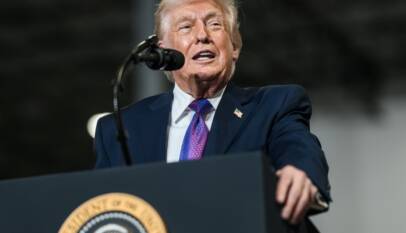
The visa policy overhaul was introduced by President Donald Trump on Friday, who justified the changes as a way to support American workers. The executive order states that the H-1B program “has been deliberately exploited to replace, rather than supplement, American workers with lower-paid, lower-skilled labor.” Alongside the H-1B fee adjustment, Trump also unveiled a $1 million “Gold Card” residency program, which he had previewed months earlier. “The main thing is, we’re going to have great people coming in, and they’re going to be paying,” Trump said in the Oval Office.
Lutnick, who joined the President during the announcement, emphasized the $100,000 fee as a mechanism for companies to evaluate the value of employing foreign talent. “The company needs to decide… is the person valuable enough to have a $100,000 payment to the government? Or should they head home, and they should go hire an American,” he told reporters. Despite these assurances, many corporations remained confused about the order’s implications. For example, JPMorgan confirmed that it had advised employees on H-1B visas to remain in the U.S. and avoid international travel until further guidance was provided.
The policy has also drawn criticism from tech entrepreneurs and industry leaders. Elon Musk, among others, warned that restricting H-1B visas could exacerbate talent shortages, noting that the U.S. lacks sufficient homegrown expertise to fill crucial positions in the technology sector.
India’s Ministry of External Affairs highlighted the broader implications, noting that the mobility of skilled talent contributes to innovation and wealth creation in both countries. The ministry indicated it would carefully assess the U.S. policy changes and expressed concern about potential humanitarian consequences, particularly disruptions to families of H-1B holders.
With legal challenges anticipated, the Trump administration faces the task of balancing protection of domestic employment with maintaining the U.S.’s position as a global hub for top talent. The clarification on Saturday has provided some reassurance to companies and foreign workers, but the full impact of the new H-1B rules is likely to unfold over the coming months.
Team Maverick.




Museums will be named after India’s National Heroes, not invaders: Chief Minister
Grand museum named after Chhatrapati Shivaji Maharaj being constructed at a rapid pace: CM…
Museums will be named after India’s National Heroes, not invaders: Chief Minister
Grand museum named after Chhatrapati Shivaji Maharaj being constructed at a rapid pace: CM …