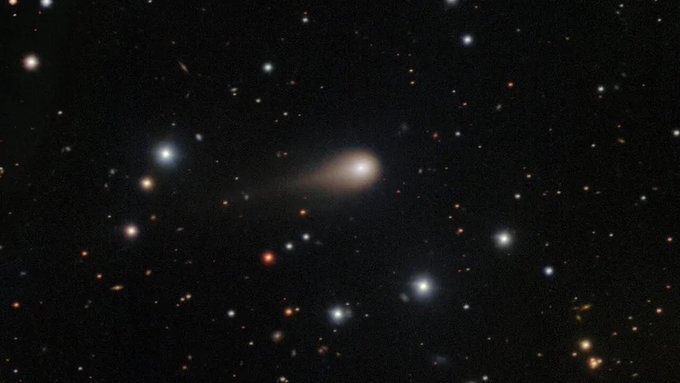
NASA Confirms Rare Interstellar Comet 3I/ATLAS Poses No Threat to Earth

New Delhi, Oct 2025 : A rare interstellar comet, designated 3I/ATLAS, is racing through the solar system at an astonishing speed of 61 kilometers per second, but US space agency NASA has assured that it poses no danger to Earth.
The discovery of 3I/ATLAS marks only the third known interstellar object detected to date, following ‘Oumuamua in 2017 and 2I/Borisov in 2019. The “I” in its name denotes “interstellar,” signifying that it originates from outside our solar system, while the “3” reflects its place as the third such object identified.
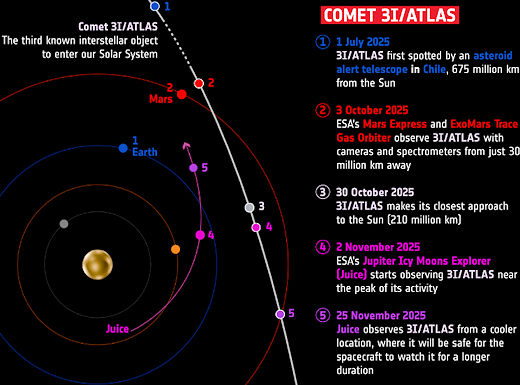
The comet was first spotted on July 1, 2025, by NASA’s Asteroid Terrestrial-impact Last Alert System (ATLAS) survey telescope in Rio Hurtado, Chile. Its trajectory and speed were later confirmed by the Minor Planet Center, which tracks small celestial bodies.
At the time of discovery, the comet was moving at about 137,000 miles per hour (221,000 km/h). Scientists note that its velocity will continue to rise as it nears the Sun. According to NASA, 3I/ATLAS will make its closest approach to the Sun around October 30, coming within 210 million kilometers, just inside the orbit of Mars.
Despite its speed and close solar pass, the comet will remain at a safe distance from Earth. NASA estimates its nearest approach to our planet will be about 1.8 astronomical units (270 million kilometers), ensuring no risk of impact.
“Comet 3I/ATLAS poses no threat to Earth and will remain far away,” NASA confirmed in a statement. The agency is closely monitoring the object with multiple observatories, including the Hubble Space Telescope, the James Webb Space Telescope, and SPHEREx.
Although it will briefly pass behind the Sun in late October, the comet will continue its journey outward, passing Jupiter in March 2026 before leaving the solar system altogether.
Astronomers say the comet offers a unique scientific opportunity. Studying interstellar objects like 3I/ATLAS helps researchers understand the composition and behavior of celestial bodies formed in other star systems, offering insights into how planets and comets develop across the galaxy.
For now, scientists and stargazers alike can safely track this rare visitor, reassured that its cosmic voyage will leave Earth untouched.





Solar Defence Showcases Indigenous ‘Bhargavastra’ Counter-Swarm Drone System to Indian Army
New Delhi, July 2026 : Solar Defence and Aerospace Ltd. (SDAL) on Friday showcased its ind…

Solar Defence Showcases Indigenous ‘Bhargavastra’ Counter-Swarm Drone System to Indian Army
New Delhi, July 2026 : Solar Defence and Aerospace Ltd. (SDAL) on Friday showcased …