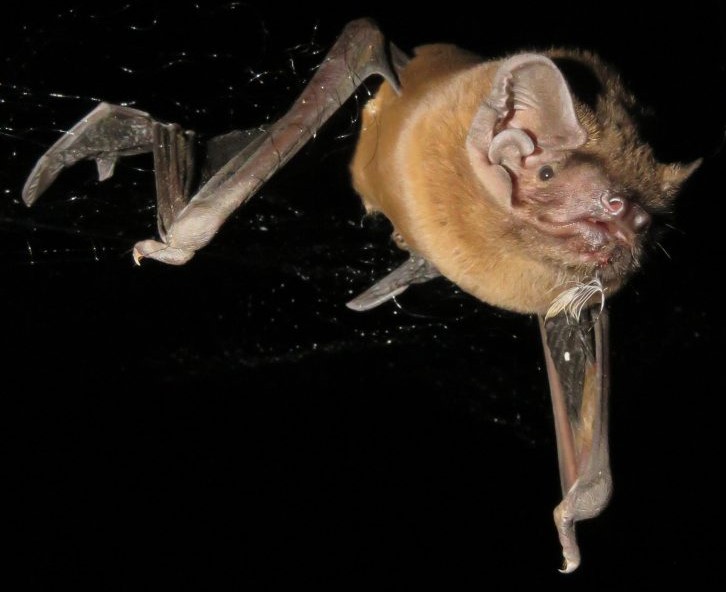
The Mystery as to How Europe’s Largest Bat Hunts Birds Like a Fighter Jet been solved after 25 years.

After nearly 25 years of investigation, scientists have solved the mystery. Europe’s largest bat not only eats small birds, it hunts and catches them more than a kilometre above the ground, and consumes them while still in flight.
Each year, billions of songbirds migrate between their breeding and wintering grounds. Many species choose to fly at high altitudes and during the night, a strategy that helps them avoid daytime predators. However, the darkness does not guarantee safety, since the dreadful bats are active hunters after sunset.
To study this behaviour, researchers effectively “rode along” with Europe’s largest bat, the greater noctule (Nyctalus lasiopterus), by fitting the animals with miniature “backpacks” equipped with biologgers created at Aarhus University. These devices tracked movement, altitude, acceleration, and sound (including echolocation), allowing scientists to observe how the bats locate and capture prey more than a kilometre above the ground in complete darkness.
The study revealed that greater noctules can ascend high into the night sky to hunt unsuspecting birds. Unlike many insects, birds cannot detect the bats’ echolocation calls and often remain unaware of the approaching threat until it is too late to evade capture.
The bats’ success lies in their powerful, low-frequency echolocation calls, which enable them to detect targets over long distances. Once they have identified a bird, they close in quickly, signalled by a rapid series of short echolocation pulses just before the strike.
Data recorded by the biologgers revealed that the bats chased their prey by performing steep, high-speed dives toward the ground, similar to fighter planes engaging in aerial combat. During these descents, which lasted 30 and 176 seconds respectively, the bats increased their wingbeat rate and force while tripling their acceleration and producing a constant stream of attack calls.
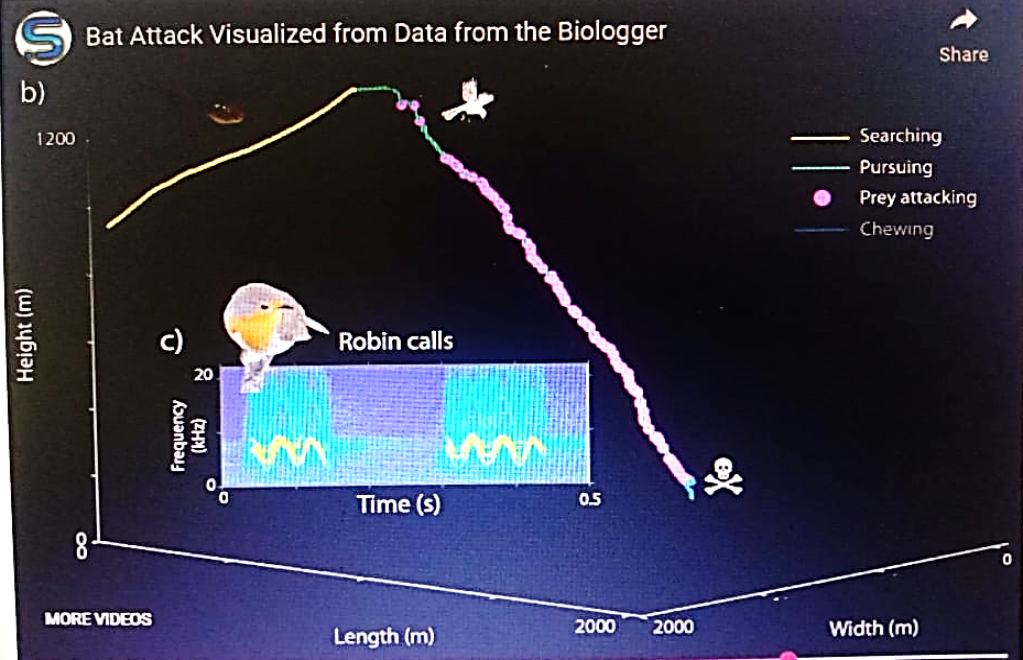
The bat attack visualised from data from the biologgers. The greater noctule bat ascends to high altitudes to detect its songbird prey. After a vertically downwards sprint of several minutes, the bat finally catches its prey.
The second bat, however, caught its prey close to the ground after nearly three minutes of pursuit. The microphone recorded 21 distress calls from the bird (a robin), followed by 23 minutes of chewing sounds from the bat as it flew at low altitude.
Combined with X-ray and DNA analyses of songbird wings found under the bats’ hunting grounds, the data from just two bats paint a clear picture of the final act:
The bats kill the birds by biting them, then bite off their wings, probably to reduce weight and drag. The researchers believe that the bats then stretch the membrane between their hind legs forward like a pouch and eat the bird mid-flight.
“We know that songbirds perform wild evasive manoeuvres such as loops and spirals to escape predators like hawks during the day, and they seem to use the same tactics against bats at night. It’s fascinating that bats are not only able to catch them, but also to kill and eat them while flying. A bird like that weighs about half as much as the bat itself, it would be like me catching and eating a 35 kilos of animal while jogging”, says Assistant Professor Laura Stidsholt from the Department of Biology at Aarhus University.
By the time she has finalised the data collection and did the analysis for this paper, Stidsholt was a Postdoc at the Leibniz Institute for Zoo and Wildlife Research (Leibniz-IZW) in Berlin.
For a couple of decades, it has been known that at least three large bat species feed on small birds in flight. Much of this knowledge stems from the tireless work of Spanish bat researcher Carlos Ibáñez and his colleagues at the Doñana Biological Station (CSIC) in Seville. Nearly 25 years ago, Ibáñez discovered feathers in the droppings of greater noctules and has since gathered mounting evidence that these bats catch and eat songbirds.
The Doñana research team has long studied the greater noctule, a rare and difficult-to-monitor forest species. They have installed “smart” artificial roosts in the Doñana Reserve and implanted each bat with a tiny subcutaneous microchip that is detected by an antenna in each roost. The system logs the bats’ movements, stores the data, and sends alerts directly to the team’s mobile phones. For years, the researchers tried to uncover exactly how the bats managed to catch and eat birds in flight.
Since, bats hunt at night, it was impossible to film the chase. Researchers instead tried surveillance cameras on roosts, military radar, ultrasound recorders attached to hot-air balloons, and GPS trackers. The main challenge was finding equipment light enough for the bats to carry. Now, with the lightweight devices from Aarhus University, and just as Carlos Ibáñez approaches retirement the team has finally caught a greater noctule in the act.
For Elena Tena, also a lead author of the study, hearing the sound recording of the bird’s distress calls followed by sudden silence and long chewing noises was an intense moment after so many years of effort:
“While it evokes empathy for the prey, it is part of nature. We knew we had documented something extraordinary. For the team, it confirmed what we had been seeking for so long. I had to listen to it several times to fully grasp what we had recorded”.
Fortunately, there is little cause for concern about bats threatening songbird populations. The greater noctule is extremely rare and, in many areas, endangered as its forest habitats disappear. Thus, this discovery has important conservation implications. Understanding the greater noctule’s ecology and hunting behaviour is essential for designing effective conservation and management strategies.
Team Maverick








Team Special Olympics Bharat Accorded Grand Send-Off Ahead of Special Olympics Unified Football World Cup 2026
Faridabad July 2026 : Team Special Olympics Bharat was accorded a warm send-off at Manav R…

Team Special Olympics Bharat Accorded Grand Send-Off Ahead of Special Olympics Unified Football World Cup 2026
Faridabad July 2026 : Team Special Olympics Bharat was accorded a warm send-off at …