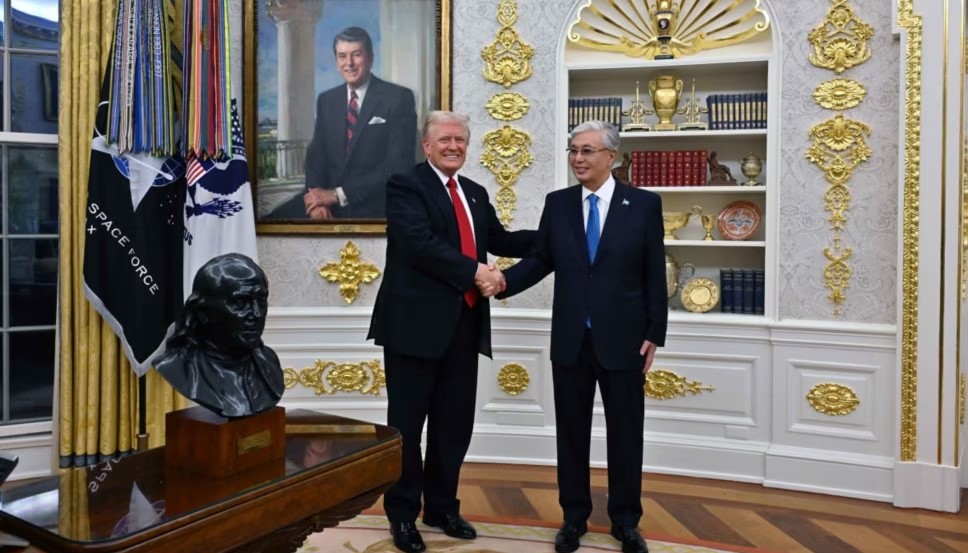
The Abraham Accord gains Solidarity with Kazakhstan to be the Latest Member.

Kazakhstan, the largest and wealthiest country in Central Asia, will become the first country from that region to join the Abraham Accords. The move expands the diplomatic agreement from the Middle East and North Africa to Central Asia. The Abraham Accords were designed to bolster cooperation between Israel and the Muslim world, with the United Arab Emirates, Bahrain, and Morocco have signed the agreement in 2020 to normalise their relations, thereby not only strengthening their mutual relations, but also augmenting their individual bipartite relation with the United States.
Astana’s decision on November 06th is largely symbolic because Kazakhstan has long recognised Israel and maintained diplomatic ties with the country since gaining independence following the collapse of the Soviet Union in 1991. But joining the Abraham Accords, a hallmark achievement of US President Donald Trump’s first term in office, puts Kazakhstan at the centre of a new push by the White House to reinvigorate the foreign policy initiative. The Trump administration is looking to expand the initiative, and it will be a focus of a planned visit to Washington on November 18th by Saudi Crown Prince Mohammed bin Salman.
Meanwhile, while reaffirming their stands the Kazakhstan Government has asserted, “our anticipated accession to the Abraham Accords represents a natural and logical continuation of Kazakhstan’s foreign policy course grounded in dialogue, mutual respect, and regional stability”. For oil-rich Kazakhstan, a longtime ally of Moscow and a deepening partner of Beijing, joining the Abraham Accords is seen as an opportunity to partner with the United States.
“Juxtaposed between Russia and China, Kazakhstan wants as many partners as it can get, and in particular Astana wants a more active relationship with the United States and Europe”, Andrew D’Anieri, the associate director of the Atlantic Council’s Eurasia Center, wrote in an analysis. “Joining the Abraham Accords is a smart pragmatic step to get positive attention from Washington to help catalyse more concrete economic interest in Kazakhstan from US government agencies and the private sector”.
It was not a coincidence, experts said, that Kazakhstan announced that it will join the Abraham Accords as Trump hosted Central Asia’s five leaders at the White House. During the one-day summit, Trump announced trade, diplomatic, and mineral deals to strengthen US ties with a region long dominated by Moscow and increasingly tied to China.
Prior to the summit, Kazakhstan announced a major mineral deal through a new partnership with the United States to develop one of the world’s largest untapped deposits of tungsten, which sits in the Central Asian country.
Joseph Epstein, director of the Washington-based Yorktown Institute’s Turan Research Center, said that while the move by Kazakhstan may appear symbolic, it could hold diplomatic weight moving forward. Astana’s decision to join the Abraham Accords marks the beginning of a new phase, transforming the accords from a Middle East peace initiative to a pro-US coalition of moderate Muslim countries devoted to tolerance and prosperity.
Other countries in Central Asia and the Caucasus have shown interest in joining the accords, including Uzbekistan and Azerbaijan, which borders Iran.
Winning over key players such as Astana and Baku, with rich gas and uranium deposits and a location at the doors of the Caspian Sea, will provide the United States and Israel with a strategic edge over Russia and Iran in regions the latter traditionally viewed as their exclusive sphere of influence.
Team Maverick




Viren Rasquinha Questions India Hockey Team’s New Saffron Jersey
New Delhi, July 2026 : Former India hockey captain Viren Rasquinha has criticised Hockey I…

Viren Rasquinha Questions India Hockey Team’s New Saffron Jersey
New Delhi, July 2026 : Former India hockey captain Viren Rasquinha has criticised Hockey …