FIFA World Cup – When East defeated West in an All German Grudge Match.

FIFA recalls the pulsating showdown that marked the first & last clash between East and West Germany at the FIFA World Cup.
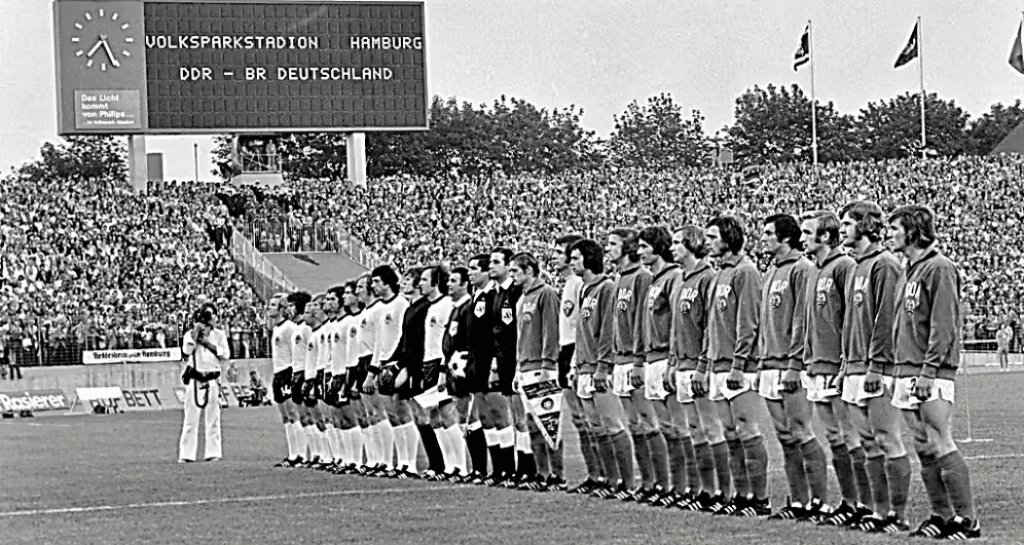
East Germany 1-0 West Germany; West Germany 1974 | First group stage at the Volksparkstadion, Hamburg amidst a pulsating attendance of 60,200. The scorer for East Germany was Jurgen Sparwasser (77).
Teams –
East Germany: Coach: Georg Buschner
Starting XI: Jurgen Croy; Siegmar Watzlich, Bernd Bransch, Konrad Weise, Gerd Kische; Lothar Kurbjuweit, Hans-Jurgen Kreische, Harald Irmscher, Reinhard Lauck; Martin Hoffmann, Jurgen Sparwasser.
Substitutions: Erich Hamann for Irmscher (65).
West Germany: Coach: Helmut Schon
Starting XI: Sepp Maier; Paul Breitner, Hans-Georg Schwarzenbeck, Franz Beckenbauer, Berti Vogts; Wolfgang Overath, Bernhard Cullmann, Uli Hoeness; Heinz Flohe, Gerd Muller, Jürgen Grabowski.
Substitutions: Horst-Dieter Hottges for Schwarzenbeck (68), Gunter Netzer for Overath (69).
While both teams were already through to the next round before a ball had been kicked in this highly-charged showdown, there was still plenty at stake, not least top spot in Group 1 and “brotherly” bragging rights.
Having overcome Chile 1-0 in their opener and eased past Australia 3-0, West Germany went into the match knowing that a share of the spoils would be enough for them to win the group.
On the other hand, only victory would suffice for Georg Buschner’s side, who had been held 1-1 by the Chileans after defeating the Australians 2-0, to remain ahead of their arch-rivals.
A total of 60,200 fans, including some 1,500 East German citizens, were packed into the Volksparkstadion to witness a piece of history: the first and only meeting between the German full national teams, and on football’s grandest stage no less. The pecking order ahead of the encounter could not have been clearer: the East Germans, contesting their maiden FIFA World Cup campaign, were major underdogs up against their heavyweight neighbours, the UEFA EURO title holders and 1954 world champions.
The Game –
It was a cagey affair right from the get-go: with both teams desperate not to lose, the two sets of players largely cancelled each other out, meaning that clear-cut openings were few and far between. Although there was no shortage of fight and passion on display during a keenly contested clash, the game was played in the right spirit. Indeed, Uruguayan referee Ramon Barreto was only forced to reach into his pocket three times, on each occasion to show a yellow card to an East German player.
West Germany’s most notable chance came in the 40th minute, when Gerd Muller controlled the ball with his back to goal in the penalty area and, in trademark fashion, swivelled and got a shot away in one fell swoop. Less characteristically, however, Der Bomber slightly scuffed his strike, which bobbled agonisingly onto the foot of the woodwork. At the other end, Hans-Jurgen Kreische should have given his side the lead eight minutes earlier. Presented with a tap-in at the far post following a fizzed cross from the left, the midfielder contrived to balloon his first-time effort over the crossbar.
With the clock ticking down, it looked for all the world like the contest would end with honours even. However, all that changed in the 78th minute, when quick-thinking East German goalkeeper Jurgen Croy held onto a header following a corner and launched a lightning counter-attack, releasing Erich Hamann down the right. The substitute, who had only been on the pitch for a little more than ten minutes, made the most of his fresh legs to power forward 30 yards.
With legendary sweeper Franz Beckenbauer slow to close him down, Hamann had time to pick his spot and lofted an inch-perfect diagonal pass to the edge of the box, which the onrushing Jurgen Sparwasser was able to take in his stride, first nodding the ball down and then cushioning it with a combination of shoulder and chest. The closest two West Germany players, Berti Vogts and Horst-Dieter Hottges, were wrong-footed and reduced to mere bystanders as Sparwasser burst through before clipping an unstoppable finish home from five yards to secure a sensational 1-0 success for the World Cup newcomers.
After the completion of the match:
“If one day my tombstone reads simply ‘Hamburg 74’, everybody will still know who’s buried below”. East Germany’s hero of the hour, Jurgen Sparwasser.
“Sparwasser’s goal was a wake-up call. Without it, we’d never have been crowned world champions”. West Germany captain Franz Beckenbauer.
“The glamorous Western professionals against the cloggers from the East – that’s how it was billed. Of course, we wanted to prove everyone wrong”. East Germany defender Gerd Kische.
“We thought that, up against East Germany, Chile and Australia, we could cruise through with one eye closed and one leg tied behind our backs. As a result, we were a long way off hitting top gear at that point”. West Germany full-back Paul Breitner.
Trivia –
- To sidestep potential political commotion, the players forwent the time-honoured ritual of swapping shirts on the pitch after the final whistle. However, Paul Breitner was able to catch Jurgen Sparwasser in the tunnel and exchange jerseys with the match-winner prior to the pair disappearing into the dressing rooms. Both would auction these mementos for charity following the tragic floods that hit Germany and other parts of Europe in August 2002.
- The triumph over their former and future countrymen would prove to be East Germany’s final hurrah at the tournament and last-ever World Cup win. Georg Buschner’s charges proceeded to suffer successive losses in the second round – 1-0 to Brazil and 2-0 at the hands of the Netherlands – before bowing out with a 1-1 draw against Argentina. The nation never graced the global stage again. By stark contrast, West Germany were galvanised by their shock defeat and duly regrouped to sweep to their second World Cup title, beating Yugoslavia 2-0, Sweden 4-2 and Poland 1-0 in the second group phase before edging past the Netherlands 2-1 in the final.
- While the 1974 tournament marked the end of the line for the East Germans at FIFA’s flagship event, their Western counterparts went from strength to strength, showing themselves to be contenders at each edition of the competition and eventually lifting the trophy for the third time in 1990. Building on this rich legacy, in 2014, Joachim Low guided Germany to a first World Cup conquest since reunification.

Team Maverick


Israel, Lebanon Agree on Ceasefire Framework Amid Continued Cross-Border Hostilities
Washington/Beirut, June 2026 : Israel and Lebanon on Wednesday agreed to move forward with…
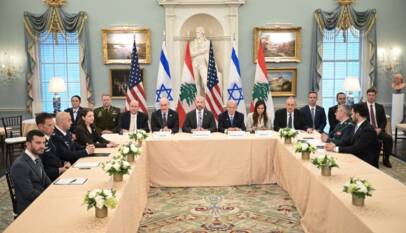
Israel, Lebanon Agree on Ceasefire Framework Amid Continued Cross-Border Hostilities
Washington/Beirut, June 2026 : Israel and Lebanon on Wednesday agreed to move forward with …