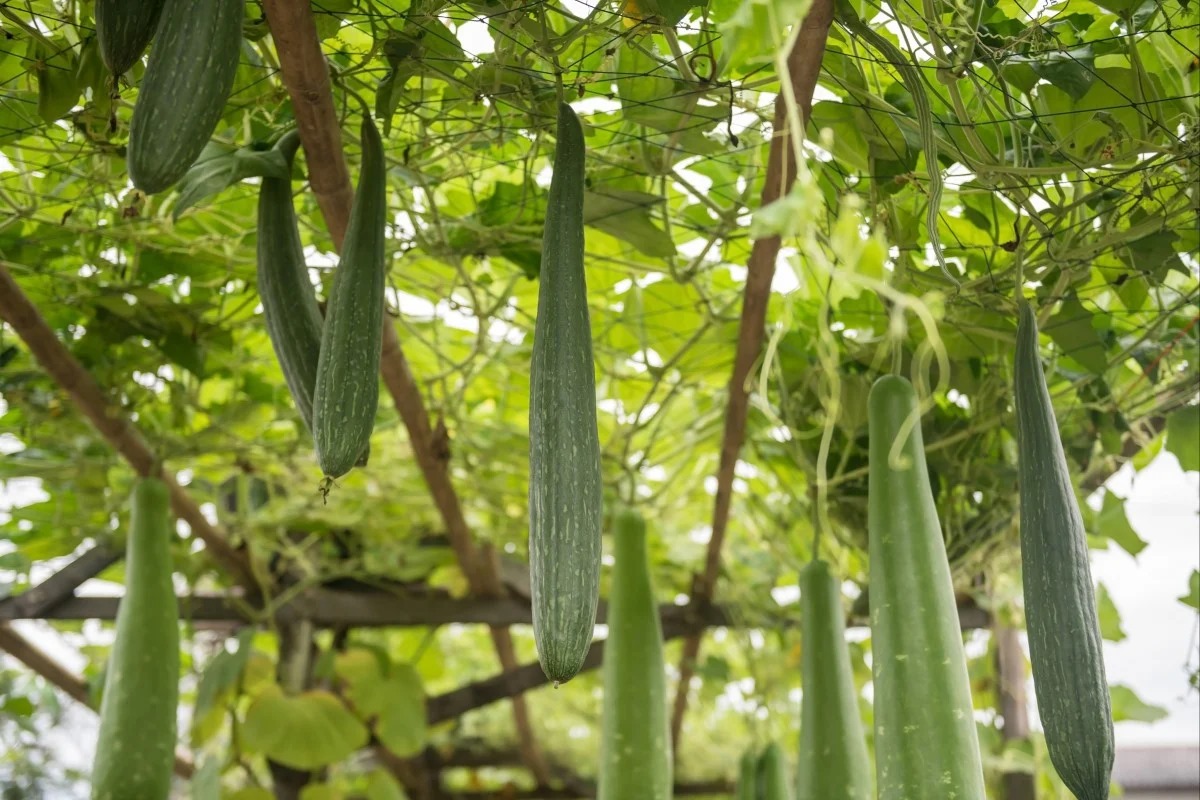
How A Humble Kitchen Vegetable May Hold The Key in Defeating Space Based Radar Hunters.

A fibrous, spongelike gourd, the loofah which is a porous plant is a natural exfoliant, a symbol of purity and refinement. Light as a feather, yet strong and intricately structured, the loofah scrubs away impurities, both physical and spiritual in rituals that blended hygiene with holiness. But of late, this unassuming vegetable, “Luffa cylindrica” is once again stepping into the spotlight as a powerful weapon shield in the silent battle of electronic warfare.
In a peer-reviewed study published in the journal High Power Laser and Particle Beams, a team of scientists from the People’s Liberation Army (PLA) and China Aerospace Science and Industry Corporation (CASIC) has transformed the loofah into a next-generation stealth coating capable of shielding advanced aircraft from the most formidable threat in modern warfare: space-based radar satellites.
For decades, stealth aircraft like the American F-22 Raptor and B-2 Spirit relied on shape-shifting designs and radar-absorbing materials to shrink their radar cross-sections (RCS), sometimes down to the size of a bird. But technology has caught up.
China’s deployment of a revolutionary low-Earth-orbit radar satellite constellation has changed the game.
Flying high above the clouds, these satellites use synthetic aperture radar (SAR) and bistatic illumination techniques to peer through darkness and weather. Crucially, they illuminate
stealth aircraft from above, where traditional stealth coating and shaping,
optimised for head-on detection fails.
When radar waves strike a stealth jet from directly overhead, its flat back can reflect signals like a mirror, causing its radar cross-sections to balloon from bird-size to tens of square metres,
an easy target for detection, even for satellites hundreds of kilometres away.
But the team, led by defence scientist Chen Jun with CASIC’s Guizhou Aerospace Metrology and Testing Technology Institute, may have found an answer in the common vegetable, also known as luffa which is sold at farmers’ markets across Asia.
Chen and his colleagues made a flexible, ultra-thin microwave-absorbing material by turning dried loofah into carbon and embedding it with magnetic nanoparticles of nickel cobalt oxide (NiCo₂O₄).
The result is a composite dubbed NCO-2, just 4mm (0.14 inches) thick, that can absorb over 99.99 per cent of incident electromagnetic waves in the critical Ku-band (12–18 GHz), one of the most important frequencies used by modern radar satellites.
This loofah-derived coating could reduce the intensity of reflected radar signals by nearly 700 times, even when the beam came right from above, the study found.
This means a stealth aircraft with a vertical RCS of 50 square metres (538 square feet) could effectively shrink to less than 1 square metre (10.7 square feet), making it much harder to detect by space-based radars.
“When the test angle is zero degrees, which means the direction of the electromagnetic wave is perpendicular to the surface of the test plate, the RCS value decreases from 26.46 dBsm to −1.94 dBsm, indicating that the RCS of the surface coated with NCO-2 material is reduced to less than 1 square metre, showing excellent radar stealth performance”, Chen’s team wrote.
The secret lies in the loofah’s natural architecture, which is a 3D network of interconnected cellulose fibres that, when carbonised at high temperatures, becomes a lightweight, conductive scaffold resembling a microscopic jungle.
Electromagnetic waves entering the material bounce around endlessly within the mazelike pores – a phenomenon called multiple internal reflection giving the material more time and opportunities to absorb energy, according to the researchers. The carbonised loofah also forms a conductive network, allowing electrons to move freely and convert microwave energy into heat via conductive loss.
Because the nanoparticles are grown uniformly across the carbon fibres, they create countless boundaries that change the polarisation of radar waves while the magnetic particles themselves generate magnetic losses through natural and exchange resonance, a dual-action mechanism rarely seen in traditional absorbers.
Together, these effects achieve near-perfect impedance matching, meaning the material lets microwaves enter easily, then prevents them from escaping.
The production process is relatively simple and scalable. Fresh loofah is cleaned, dried and baked from 300 to 700 degrees Celsius (572 to 1,292 Fahrenheit) in inert gas to form a porous carbon skeleton.
Chen’s team then soaked in a solution of nickel and cobalt nitrates with urea to allow nano-particle crystals to grow directly on the carbon fibres.
For years, China was often dismissed as a follower, adept at copying Western technology but lacking originality. This loofah breakthrough adds new evidence for a deeper transformation.
Today, Chinese scientists are no longer looking solely to MIT or Cambridge for inspiration. Instead, they’re turning to bamboo forests, silk and blacksmith techniques seeking innovation from nature and ancient wisdom. However, the road from lab sample to combat aircraft could be time taking for the loofah coating.
- Durability; the material must withstand supersonic vibrations, moisture and extreme temperatures.
- The current design works best at specific frequencies, it requires further broadband absorption turning for real combat, according to the researchers.
Team Maverick





Trump Marks America’s 250th Independence Day with Patriotic Address, Highlights Military Strength, Economy and Future Vision
Washington, July 2026 : US President Donald Trump delivered a wide-ranging address during …

Trump Marks America’s 250th Independence Day with Patriotic Address, Highlights Military Strength, Economy and Future Vision
Washington, July 2026 : US President Donald Trump delivered a wide-ranging address during the …