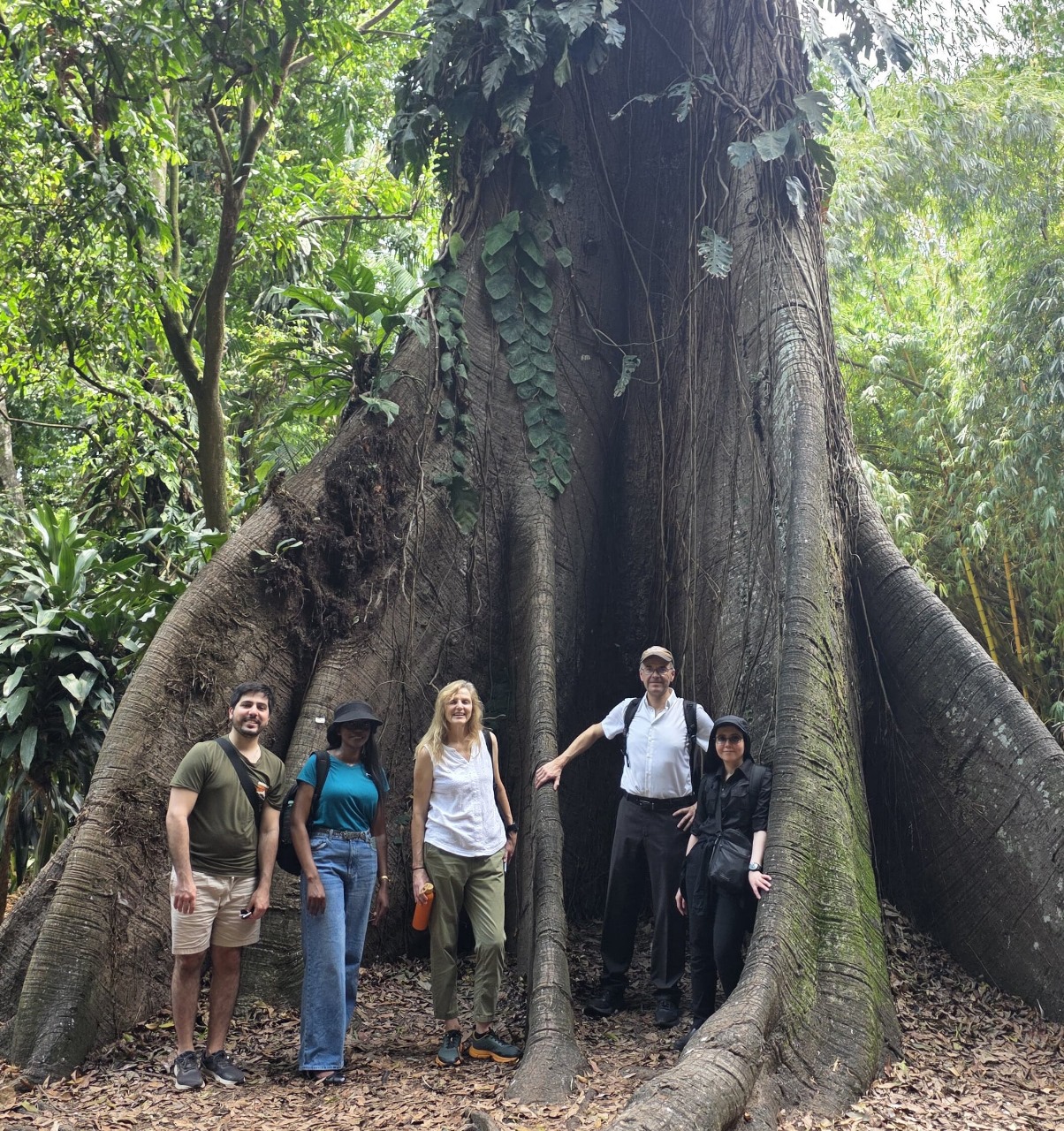
Deforestation has turned Africa’s Forests from Carbon Sinks to Carbon Sources.

“New research warns that Africa’s forests, once vital allies in the fight against climate change,
have turned from a carbon sink into a carbon source”.
Dec 2025: A new international study led by researchers at the National Center for Earth Observation at the Universities of Leicester, Sheffield and Edinburgh reveals that Africa’s forests, which have long absorbed carbon dioxide from the atmosphere, are now releasing more carbon than they remove. This alarming shift, which happened after 2010, underscores the urgent need for stronger global action to protect forests, a major focus of the COP30 Climate Summit that concluded last week in Brazil.
Using advanced satellite data and machine learning, the researchers tracked more than a decade of changes in aboveground forest biomass, the amount of carbon stored in trees and woody vegetation. They found that while Africa gained carbon between 2007 and 2010, widespread forest loss in tropical rainforests has since tipped the balance.
Between 2010 and 2017, the continent lost approximately 106 billion kilograms of forest biomass per year. That is equivalent to the weight of about 106 million cars. The losses are concentrated in tropical moist broadleaf forests in countries such as the Democratic Republic of Congo, Madagascar, and parts of West Africa, driven by deforestation and forest degradation. Gains in savanna regions due to shrub growth have not been enough to offset the losses.
The aboveground biomass stocks across African biomes over a decade. Between 2007 and 2010, the continent gained 439 ± 66 Tg yr⁻1 of aboveground biomass, but from 2010 to 2015 biomass declined by: 132 ± 20 Tg yr-1 and from 2015 to 2017 this decline continued with a loss of − 41 ± 6 Tg yr-1, primarily driven by deforestation in tropical moist broadleaf forests. Gains in savanna biomass partially offset these losses, likely due to shrub encroachment.
Professor Heiko Balzter, senior author and Director of the Institute for Environmental Futures at the University of Leicester, said, “This is a critical wake-up call for global climate policy. If Africa’s forests are no longer absorbing carbon, it means other regions and the world as a whole will need to cut greenhouse gas emissions even more deeply to stay within the 2°C goal of the Paris Agreement and avoid catastrophic climate change. Climate finance for the Tropical Forests Forever Facility must be scaled up quickly to put an end to global deforestation for good“.
The research draws on data from NASA’s spaceborne laser instrument called GEDI and Japan’s ALOS radar satellites, combined with machine learning and thousands of on-the-ground forest measurements. The result is the most detailed map to date of biomass changes across the African continent, covering a decade, at a resolution fine enough to capture local deforestation patterns.
Tropical Grasslands, Savannas and Shrublands are by far the largest biome by area with an average aboveground biomass density of 32 Mg ha-1, while Tropical Moist Broadleaf Forests cover a much smaller area with much higher biomass density. An accuracy assessment against an extensive set of field plot measurements gave a coefficient of determination (R2) of 0.70, a Root Mean Square Difference (RMSD) of 74.2 Mg ha-1, a Relative Root Mean Square Difference (Rel. RMSD) of 33%, and a Mean Bias Difference (MBD) of 8 Mg ha-1, but the higher aboveground biomass densities tended to be overestimated. A further comparison with airborne LiDAR-based biomass estimates for 2015 and 2016 showed that the aboveground woody biomass map is unbiased even at higher biomass levels (R2 = 0.85, RMSD = 47.7 Mg ha-1, Relative RMSD = 48%, MBD = 0 Mg ha-1), though these results may be overoptimistic, due to the spatial proximity to the training data. While both validation approaches suggest there may be potential underestimations beyond 350 Mg/ha-1, this is a common issue in remote sensing derived AGBD maps. Quantifying AGBD in dense forests is still challenging and AGBD remote sensing retrieval algorithms suffer from large uncertainties at high AGBD27.
From 2007 to 2010, Africa gained 439 ± 66 Tg yr-1 (0.37% yr-1) net aboveground woody biomass. However, between 2010 and 2015 the continent lost -132 ± 20 Tg yr-1 or -0.11% yr-1 biomass. Between 2015 and 2017 the average net aboveground biomass change decreased to a loss rate of -41 ± 6 Tg yr-1 or -0.03% yr-1. These results indicate that Africa’s forests have transitioned from a net sink of aboveground biomass to a net source over that time period. We now investigate where that switch has taken place.
The findings come as the COP30 Presidency announced the new Tropical Forests Forever Facility, which aims to mobilise billions of pounds for climate finance. It would pay forested countries to leave their tropical forests untouched. The results show that without urgent action to stop forest loss, the world risks losing one of its most important natural carbon buffers.
Dr. Nezha Acil, co-author from the National Center for Earth Observation at the University of Leicester’s Institute for Environmental Futures, said, “Stronger forest governance, enforcement against illegal logging, and large-scale restoration programs such as AFR100, which aims to restore 100 million hectares of African landscapes by 2030, can make a huge difference in reversing the damage done“.
Dr. Pedro Rodríguez-Veiga, who carried out the bulk of the analysis at NCEO and University of Leicester and now working at Sylvera Ltd., said, “This study provides critical risk data for Sylvera and the wider voluntary carbon market (VCM), and shows that deforestation isn’t just a local or regional issue, it’s changing the global carbon balance. If Africa’s forests turn into a lasting carbon source, global climate goals will become much harder to achieve. Governments, the private sector, and NGOs must collaborate to fund and support initiatives that protect and enhance our forests“.
Team Maverick.







Netanyahu Meets Trump at White House for Eighth Bilateral Talks Amid Regional Tensions
Jerusalem/Washington, July 2026 : Israeli Prime Minister Benjamin Netanyahu arrived at the…

Netanyahu Meets Trump at White House for Eighth Bilateral Talks Amid Regional Tensions
Jerusalem/Washington, July 2026 : Israeli Prime Minister Benjamin Netanyahu arrived at the White House …