Ukraine’s Drone Attack On Putin’s Residence Has Jeopardised US Security Guarantees

Moscow; January 2026: Russian President Vladimir Putin’s residence in Novgorod, known as Dolgiye Borody, also known as Valdai and Uzhin, was attacked by waves of drones on December 29th. This was officially reiterated by a formal statement from Sergey Lavrov, the Russian Defense Minister. The Foreign Ministry subsequently had released a report after a Duma deputy provided preliminary details of the attack.
The attack raises major questions about proposed US security guarantees for Ukraine as part of some sort of deal on settling the Ukraine war. While, the Ukrainians having denied the attack, and much of the Western media’s vetting Ukraine’s claim; but substantial evidence is emerging that the Russian claims have merit.
According to official Russian statements, supported by details circulated by state-aligned channels, similar to the reporting of Duma Deputy Alexander Khinshtein, the drones were reportedly intercepted at the following locations in the Novgorod Region: the Lake Valdai area around Dolgiye Borody; Yashcherovo, the intercept point west of the residence; Roschino, a forested area near the village where debris has been found; and Valday town where debris is said to have fallen.
The attack carried out by Ukraine was by deploying the drone UJ-26 Beaver (Bober). This loitering munition has a distinctive canard layout with sleek fuselage and inverted tail. The type was introduced in 2023 and has reportedly entered mass production. Its range is in the order of 1,000 kilometers (620 miles) and payload is reported as 20 kilograms (44 pounds). This type was previously used to attack Moscow and other targets in Russia.

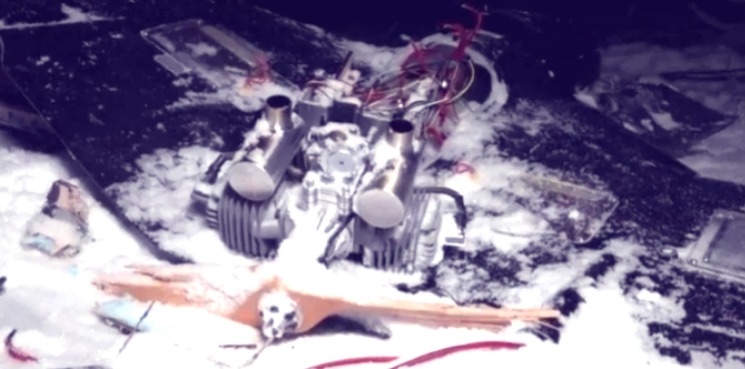
Moscow’s Defense Ministry has published a video showing one of the Ukrainian long-range drones that was shot down during Kiev’s failed attack on Russian President Vladimir Putin’s residence early on Monday. All 91 UAVs which Kiev launched at the presidential compound in Novgorod Region on the night of December 28-29 were destroyed, according to the Russian military.
The ministry also published a map showing the route of the Ukrainian UAVs that targeted the presidential compound. According to the scheme, Russian air defenses shot down 49 drones above Bryansk Region, one above Smolensk Region and another 41 above Novgorod Region. The Kremlin noted previously that the Ukrainian drone attack was aimed not only against Putin, but also “against US President Donald Trump’s efforts to facilitate a peaceful resolution of the Ukraine conflict”.
The Dolgiye Borody residence is surrounded by air defenses, some of them mounted on towers above the surrounding forest trees. There are at least 12 improved versions of the Pantsir S1 in the area, which have been optimized for anti-drone warfare.
Nearby there also is an S-400 air defense installation. In addition, the region is blanketed by heavy electronic warfare units, among them jammers and spoofers including the Krasukha-4 and Pole-21E, an electronic RF jammer. These systems are designed to jam GPS signals and disrupt the communication links between drones and their operators.
Quite possibly the Ukrainian drones were equipped with Starlink mini terminals or were using a mother drone with Starlink linked to the attack drones. The Russians also are using mini Starlink for some drones, bought on the black market. Starlink is very difficult to jam or spoof.
The Putin residence is a very secure facility. Putin accesses it by a secret rail link from Moscow and a helicopter connection at the end. The train is specially armored and the train cars undercarriage are reinforced with extra road wheels to carry the added weight. It isn’t known if Putin was at the Dolgiye Borody residence at the time of the attack. Some say he was in Moscow and stayed away from Dolgiye Borody because of the threat of drone or missile attacks from the sea.
On May 3, 2023, two Ukrainian drones exploded over the Senate Palace within the Kremlin complex in Moscow. The Senate Palace is the working residence for Putin. The attack marked the first time that the Kremlin was targeted since World War 2.
Some think that with Zelensky arriving in Mar-a-Lago, he would not have authorised an attack on Putin’s residence, especially since he was seeking to obtain American security guarantees for Ukraine.
Larry Johnson argues this was an unauthorised Ukrainian intelligence operation, possibly linked to British intelligence, to derail Zelensky leading to his ouster as President. It is fairly well known that the British, especially MI-6, Britain’s overseas secret intelligence service, is backing Valeri Zaluzhny to replace Zelensky.
In the Trump-Zelensky meeting both sides, according to Zelensky, discussed US security guarantees for Ukraine. Allegedly, Trump offered a 15 years guarantee which Zelensky says would include US troops in Ukraine. Zelensky told reporters “we are discussing this with President Trump and with representatives of the ‘coalition of the willing’. We would like this”.
It is obvious that the attack on Putin’s residence was a provocation, whether it took place with Zelensky’s knowledge or not. It raises a profound question of why the US would agree to give any security guarantee to Ukraine, and challenges the wisdom of stationing American soldiers in Ukraine.
If, as Zelensky implies, such guarantees are linked to a “coalition of the willing” which no doubt includes Germany, France and the UK, we get a “streamlined NATO” where there is no veto power, as troublemakers like Hungary are excluded. One consequence: an offer of a security guarantee to Ukraine is worse than putting Ukraine in NATO.
Team Maverick.







More Than a Café: How MITTI Café is Brewing Hope, Dignity and Dreams at Rashtrapati Nilayam
Hyderabad, July 2026 : Tucked away inside the serene campus of Rashtrapati Nilayam in Boll…

More Than a Café: How MITTI Café is Brewing Hope, Dignity and Dreams at Rashtrapati Nilayam
Hyderabad, July 2026 : Tucked away inside the serene campus of Rashtrapati Nilayam in …