Why Did The Farmers Que For Fertilisers When Government Announced A Record Production?

New Delhi; January 2026: The Union Minister Dr. Mansukh Mandaviya, had claimed that record availability of fertilisers was ensured in the country during 2024–25, and that farmers did not face any shortage throughout the year. According to official figures, while the estimated national requirement was 152.50 crore bags (72.204 million tons), as many as 176.79 crore bags (83.464 million tons) of fertilisers were made available, which is nearly 24 crore bags more than the requirement.
Speaking on the occasion, Dr Mansukh Mandaviya said, “With the government’s proactive steps in pre-positioning Urea, DAP and NPK and other fertilisers supply, currently, we have more stock for supply of fertilisers for this kharif season than the demand”.
He also advised states to keep providing farmers with adequate and accurate information regarding availability and to not create either a panic situation or misinformation related to fertilizer stocks.
Stressing on the need to tackle the issues of malpractices like hoarding, black-marketing or diversion of fertilisers, the Union Minister said that the government will take strict action in case of such scenarios. He also urged States to make farmers aware of recent trends in the fertilisers market and alternate fertilisers and agriculture practices like use of nano urea, and organic farming should be promoted.
The Union Minister informed that the increase in the international prices of Di-ammonium phosphate (DAP) and its raw materials have been primarily absorbed by the Union Government. The Union Government has decided to provide a subsidy of Rs. 2501 per bag on DAP instead of the existing subsidy of Rs.1650 per bag which is a 50% increase over the last year’s subsidy rates. The increase in the prices of DAP & its raw material is in the range of approx. 80%. It will help farmers to receive notified P&K fertilisers on subsidized, affordable and reasonable rates and support the agriculture sector, he added.
The Union Minister also advised States to undertake micro-planning of fertilizer movement within the states strictly as per the requirement and do timely unloading of rakes for better utilization of the rolling stock. States were also advised to do adequate prepositioning of fertilisers especially in the Co-operative Channel.
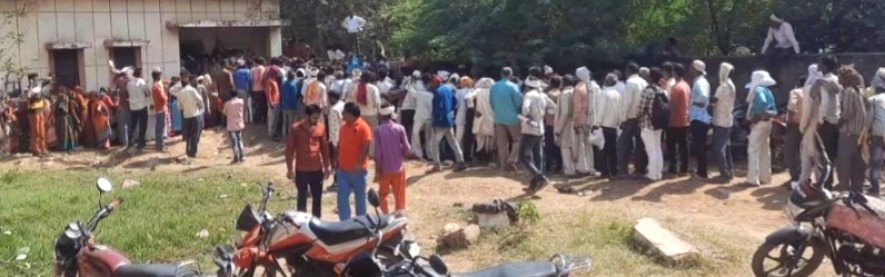
But the real question is not how much fertiliser was available on paper. The real question is: why did farmers still not get fertilisers on time? Why were they forced to wait for days and stand in long queues, sometimes overnight, outside fertiliser distribution centres?
Claims Collided With Ground Reality –
As per the Union Railway Minister Ashwani Vaishnaw, Indian Railways prioritised fertiliser rakes, imported fertilisers were unloaded quickly at ports, and storage and distribution systems were strengthened. Regular review meetings with fertiliser companies and continuous monitoring were also claimed. If all these arrangements were truly effective, then why did farmers in states such as Madhya Pradesh, Rajasthan, Chhattisgarh and many others have to struggle so hard to procure fertilisers?
Crisis in both Kharif and Rabi seasons –
The reality is that farmers faced acute fertiliser shortages in both the Kharif and Rabi seasons. Reports of black marketing emerged from several regions, and many farmers were forced to buy fertilisers from private shops at inflated prices. Ironically, during the same period, both central and state governments kept repeating that “there is no shortage of fertilisers”.
Root Cause Of The Problem –
If there was genuinely no shortage, why was there a delay in delivering fertilisers to farmers? This contradiction clearly indicates that the problem was not in production or imports, but in the transport, storage and distribution system. If fertilisers were available in excess of demand, why was there negligence in ensuring timely delivery to every district and block?
When Accountability Is Not Fixed?
Is it not administrative apathy when fertilisers remained stocked in warehouses while farmers struggled to get them during sowing time? Farmers bore the biggest burden of this mismanagement. In districts where shortages persisted and fertilisers were not supplied on time, accountability should have been fixed on concerned officials. Instead, as has often happened, this systemic failure was buried under impressive statistics.
Farmers still in queues in the age of technology –
The government talks about digital portals, modern communication tools and artificial intelligence, yet the ground reality is that farmers are still forced to stand in queues for fertilisers. If, even in this era of technology, farmers have to run from pillar to post for basic agricultural inputs, it raises serious questions about the entire system.
What is the solution?
The solution does not lie in making new claims, but in implementing a demand-based distribution system, ensuring mandatory minimum stocks at district and block levels, and making fertiliser distribution data publicly available. Cooperative societies and FPOs must be strengthened, and effective checks must be placed on private profiteering. Most importantly, government claims must be proven true at the field level.
The final question –
Farmers must be assured that they will not have to stand in humiliating queues for fertilisers during sowing time. Until “record availability” of fertilisers actually reaches farmers on time, such claims will remain achievements confined to government paperwork. Both central and state governments must now conduct a comprehensive review of fertiliser availability, demand, transport, storage and distribution, and rectify past shortcomings, so that in the coming Kharif and Rabi seasons, farmers receive fertilisers as per their requirement and exactly when they need them.
Team Maverick.




Trump Vows Continued Military Pressure on Iran, Expresses Doubts Over Diplomacy
Washington, Aug 2026: US President Donald Trump has vowed to maintain military pressure on…
Trump Vows Continued Military Pressure on Iran, Expresses Doubts Over Diplomacy
Washington, Aug 2026: US President Donald Trump has vowed to maintain military pressure on …