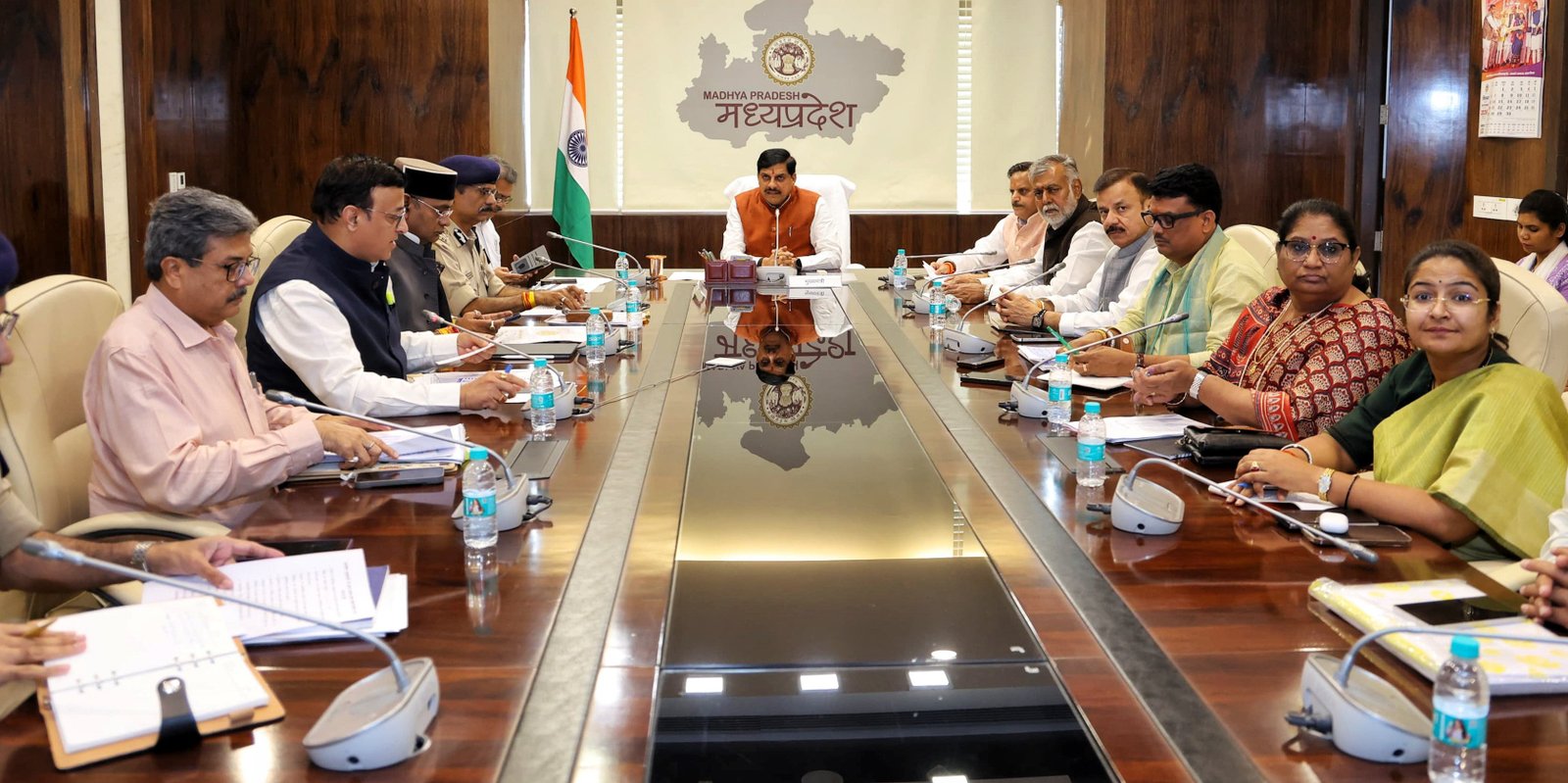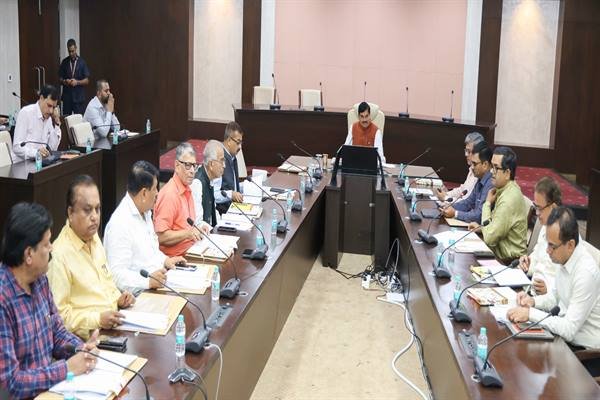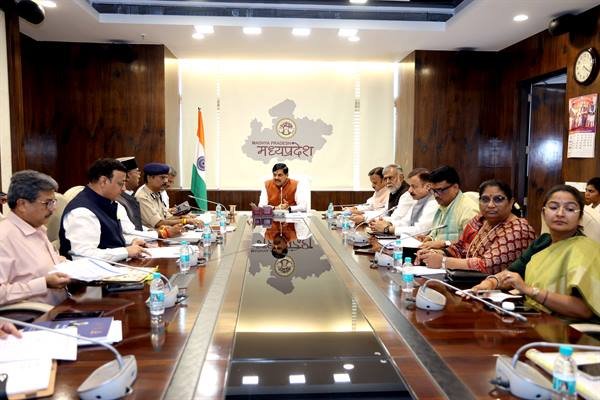
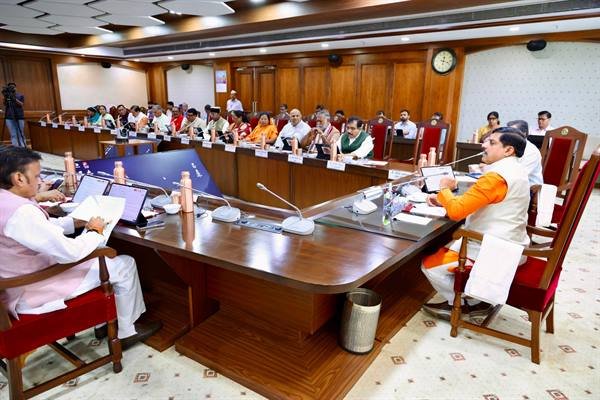
Chief Minister Dr. Mohan Yadav chaired the Cabinet meeting held at the Mantralaya on Tuesday. The Cabinet approved the formation of the ‘Nirmal Evam Aviral Maa Narmada (NAMAN) Mission for the conservation, rejuvenation and long-term sustainable management of the Narmada, the lifeline and backbone of the State’s economy. The Cabinet also approved ₹734 crore to promote research, innovation and scientific capacity building in science and technology. Over the past 20 years, the State Government has increased the budget allocation for promoting scientific research and capacity building by nearly 150 times. Several important decisions were also approved to accelerate the State’s overall development, water conservation, women’s empowerment, healthcare and technological advancement. The meeting approved nearly ₹1.46 lakh crore to ensure the uninterrupted continuation of major public welfare schemes in the coming years.
Giving priority to women’s welfare, financial continuity was approved for the Mukhyamantri Ladli Behna Yojana with an allocation of ₹1,14,365 crore, the Madhya Pradesh Ladli Laxmi Yojana with ₹16,326.47 crore, and the Pradhan Mantri Matru Vandana Yojana with ₹2,137.65 crore. An amount of ₹11,835.35 crore was approved for healthcare services and expanding infrastructure. ₹870.16 crore was approved for agricultural education and research. The Cabinet also approved the creation of 35 new posts in the Madhya Pradesh Road Development Corporation to strengthen administrative efficiency and infrastructure.
Formation of ‘Nirmal Evam Aviral Maa Narmada Mission Approved
The Cabinet approved the formation of the ‘Nirmal Evam Aviral Maa Narmada Mission’ for the conservation, rejuvenation and long-term sustainable management of the Narmada River, the lifeline of Madhya Pradesh. Nearly 33% of the State’s population is directly or indirectly dependent on the Narmada and its catchment area. Keeping this in view, the mission has been designed as an integrated, scientific and multi-departmental institutional mechanism.
Management Structure of NAMAN Mission
The NAMAN Mission will be registered as an autonomous organisation under the Madhya Pradesh Society Registration Adhiniyam, 1973. It will incorporate the priorities and monitoring mechanisms of the previously constituted Cabinet Committee, Inter-Departmental Executive Committee and State-Level Monitoring Committee and work on a strengthened action plan. The administrative structure of the NAMAN Mission will have three levels.
Chief Minister to Chair General Assembly
The Chief Minister will chair the apex General Assembly, with the Minister for Panchayat and Rural Development as Vice-Chairperson and ministers of 19 participating departments as members. Up to 10 eminent experts from the fields of river science, hydrology, environment, biodiversity and community management will also be nominated to the General Assembly. The Administrative Executive Committee of the mission will be headed by the Chief Secretary, while the Additional Chief Secretary, Panchayat and Rural Development Department, will serve as Vice-Chairperson. The Chief Executive Officer (CEO) will serve as Member Secretary for the functioning of the committee. Experts from prestigious national institutions such as IISER, IIT, IRMA, NIH, IIFM, ICAR and NEERI will also be associated with the Executive Committee.
Strong Financial Framework for the Mission
A robust financial framework has been established for the smooth functioning of the mission and implementation of its projects. Under the ‘Nirmal Evam Aviral Narmada Mission Fund’, ₹100 crore will be provided annually from the State grant for Narmada conservation and development works. In addition, ₹100 crore annually will be utilised from the Forest Department’s CAMPA fund. In exceptional circumstances, ₹100 crore will be made available from the State budget over five years for works outside the scope of existing schemes. The mission will also mobilise public participation through CSR funds, Central assistance and the PPP model.
Project Management Unit to Undertake Scientific Assessment
The Project Management Unit (PMU) will be established for technical expertise. The PMU will function as a technology engine and innovation hub. It will use modern systems such as Artificial Intelligence (AI), data analytics, GIS, remote sensing, Decision Support Systems (DSS) and climate change modelling to scientifically assess the river health.
₹2,137.65 Cr Approved for Pradhan Mantri Matru Vandana Yojana
The Cabinet approved ₹2,137.65 crore for the continued implementation of the Centrally Sponsored Pradhan Mantri Matru Vandana Yojana, under the Mission Shakti–Sambal sub-scheme, from 2026-27 to 2030-31. The scheme aims to provide cash incentives to pregnant women as partial compensation for wage loss and to encourage the birth of a girl child during the second pregnancy. Under the scheme, an eligible woman for her first pregnancy receives ₹3,000 as the first instalment upon early registration of pregnancy and undergoing at least one antenatal check-up within six months of the Last Menstrual Period (LMP). A second instalment of ₹2,000 is provided after registration of the child’s birth and completion of the first cycle of vaccination, taking the total benefit to ₹5,000. In the case of a second pregnancy resulting in the birth of a girl child, ₹6,000 is provided in a single instalment after completion of the first cycle of vaccination.
₹1,14,365 Cr Approved for Mukhyamantri Ladli Behna Yojana
The Cabinet approved ₹1,14,365 crore for the continued implementation of the Mukhyamantri Ladli Behna Yojana from 2026-27 to 2030-31. The scheme was launched in 2023 to promote women’s economic self-reliance, continuously improve their health and nutritional status, and strengthen their role in family decision-making. Under the scheme, beneficiaries receive ₹1,500 per month directly into their DBT-enabled bank accounts. At present, around 1.27 crore women are benefiting from the Ladli Behna Yojana.
₹16,326.47 Cr Approved for Madhya Pradesh Ladli Laxmi Yojana
The Cabinet approved ₹16,326.47 crore for the continued implementation of the Madhya Pradesh Ladli Laxmi Yojana from 2026-27 to 2030-31. The scheme aims to promote a positive attitude towards the birth of girl children, improve the sex ratio, enhance girls’ educational and health outcomes, and lay the foundation for their better future. Around 50.99 lakh girls have benefited from the scheme so far.
Under the scheme, eligible beneficiaries receive ₹2,000 on admission to Class 6, ₹4,000 on admission to Class 9, ₹6,000 on admission to Class 11 and ₹6,000 on admission to Class 12 through e-payment. Upon admission to college, an incentive of ₹12,500 in the first year and ₹12,500 in the final year is provided in two equal instalments. In addition, ₹1 lakh is provided on attaining the age of 21 years.
₹870.16 Cr Approved for Agriculture, Education and Research Activities
The Cabinet approved ₹870.16 crore for the continued implementation of three schemes under the Department of Farmers’ Welfare and Agriculture Development from April 1, 2026, to March 31, 2031. An amount of ₹310.23 crore has been approved for the self-financing pension scheme of Jawaharlal Nehru Krishi Vishwavidyalaya, Jabalpur. The amount will facilitate regular pension payments to retired officers and employees of the university. The Cabinet also approved ₹469.93 crore for the Block Grant Scheme of Rajmata Vijayaraje Scindia Krishi Vishwavidyalaya, Gwalior.
The university is a major centre for agricultural education, research and extension activities in the State. The block grant will support the salaries and allowances of officers, scientists and employees, research activities, institutional expenses, and other permissible financial obligations. The scheme’s continuation is essential for strengthening the university’s institutional capacity and academic quality and for effective implementation of agricultural development programmes. In addition, ₹90 crore was approved for the Agricultural Infrastructure Development Scheme. The scheme will support the development and upgradation of laboratories, training facilities, research infrastructure and other essential assets. Its continuation will strengthen the institutional capacity of the department and agricultural universities and ensure the development of infrastructure in line with the changing needs of the agriculture sector.
₹11,835.35 Cr Approved for Upgradation and Strengthening of Health Services
The Cabinet approved a total of ₹11,835.35 crore to upgrade and strengthen health services. An amount of ₹4,742.45 crore was approved for the Sub-Health Centre Scheme. Under the scheme, salaries of ANMs/LHVs working under the Chief Medical and Health Officers across the State are drawn. The scheme is primarily implemented through the offices of the Chief Medical and Health Officers. A further ₹518.93 crore was approved under the Health Services Upgradation and Strengthening Scheme. It will facilitate the provision of modern equipment required for treatment of both in-patients and out-patients at the offices of Chief Medical and Health Officers, Civil Surgeons-cum-Chief Hospital Superintendents, Sub-Health Centres, Community Health Centres and Primary Health Centres. An amount of ₹3,219.22 crore was approved under the Hospital and Dispensary Building Construction Scheme. The scheme covers construction and upgradation of buildings of various healthcare facilities, including Primary Health Centres, Sub-Health Centres, Community Health Centres, District Hospitals and Civil Hospitals.
The Cabinet also approved ₹3,354.75 crore under the scheme for providing additional incentives to ASHA workers. ASHA workers are the grassroots link in the health system, providing information, services and support door-to-door on maternal and child health, immunisation, nutrition, tuberculosis, malaria, malnutrition and other national health programmes. Their role is also crucial in meeting the growing demand for health services in rural and urban areas. The State has 71,000 ASHA workers, including 5,200 in urban areas and 65,800 in rural areas, along with 5,200 ASHA supervisors working in rural areas.
Approval of 35 New Posts in Madhya Pradesh Road Development Corporation
The Cabinet approved the creation of 35 new posts in the Madhya Pradesh Road Development Corporation in addition to the 288 posts already sanctioned. It also approved continuation of seven previously sanctioned posts for the next five years, up to September 18, 2031. The Managing Director will be authorised to determine consolidated pay scales for all appointments and prescribe minimum eligibility and qualifications for various posts. The Board of Directors may prescribe minimum qualifications and procedures for promotions and may also change the designation of any post based on the nature of work. The decision is expected to entail an annual financial burden of ₹4.12 crore, which will be met from the Corporation’s own resources.
₹734 Cr Approved to Promote Scientific Research, Innovation and Capacity Building
The Cabinet approved ₹734 crore for the continued implementation of Department of Science and Technology schemes aimed at promoting research, innovation and scientific capacity building in the State from April 1, 2026, to March 31, 2031. Over the past 20 years, the State Government has increased budgetary allocations for promoting scientific research and capacity building by nearly 150 times. An amount of ₹201.28 crore was approved for the Research and Development Activities Scheme. It will promote science- and evidence-based policymaking by strengthening research, innovation and technological capabilities. The scheme will promote natural resource management, innovation, skill development, intellectual property protection and technological advancement through remote sensing and GIS, research and development, biotechnology, patent information, climate change studies, rural technology and the Atlas Project.
An amount of ₹119.04 crore was approved for the Direction and Administration scheme. It will cover general administration, financial management, infrastructure operations, and coordination and monitoring of programmes. The scheme will cover salaries and allowances, office expenses, training, capacity building, meetings, workshops, and technical and administrative support, providing the administrative foundation for the effective, transparent and outcome-oriented implementation of science and technology programmes. Similarly, ₹172.52 crore was approved for the scheme for popularisation of science and support for science dissemination, while ₹241.16 crore was approved for activities of the Madhya Pradesh State Electronics Development Corporation.
The science popularisation scheme will organise science awareness programmes, mobile science laboratories, science education and innovation workshops, and Vigyan Manthan Yatras to promote the reach of science and technology in rural and tribal areas.
Regular monitoring, evaluation and documentation of the scheme’s activities will also be undertaken to ensure effective implementation. Activities under the scheme include programmes organised on National Science Day, National Mathematics Day, World Environment Day and National Technology Day, along with divisional-level science fairs (Divisional Scientific Conferences), Science on Wheels initiatives and programmes through Creativity Learning Centres.