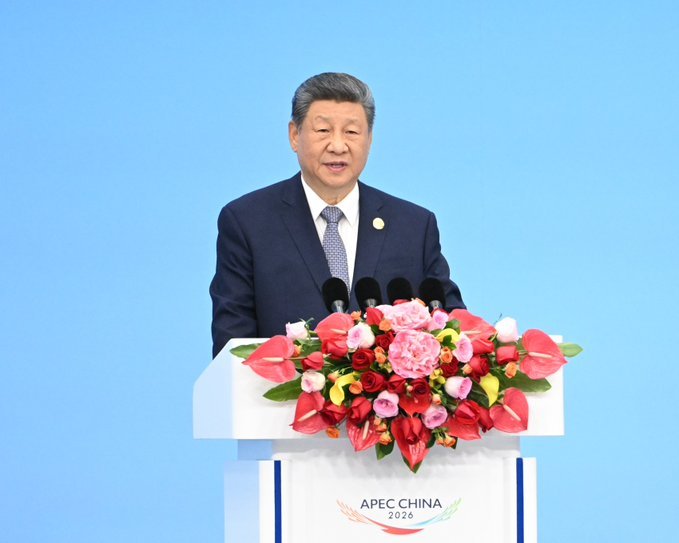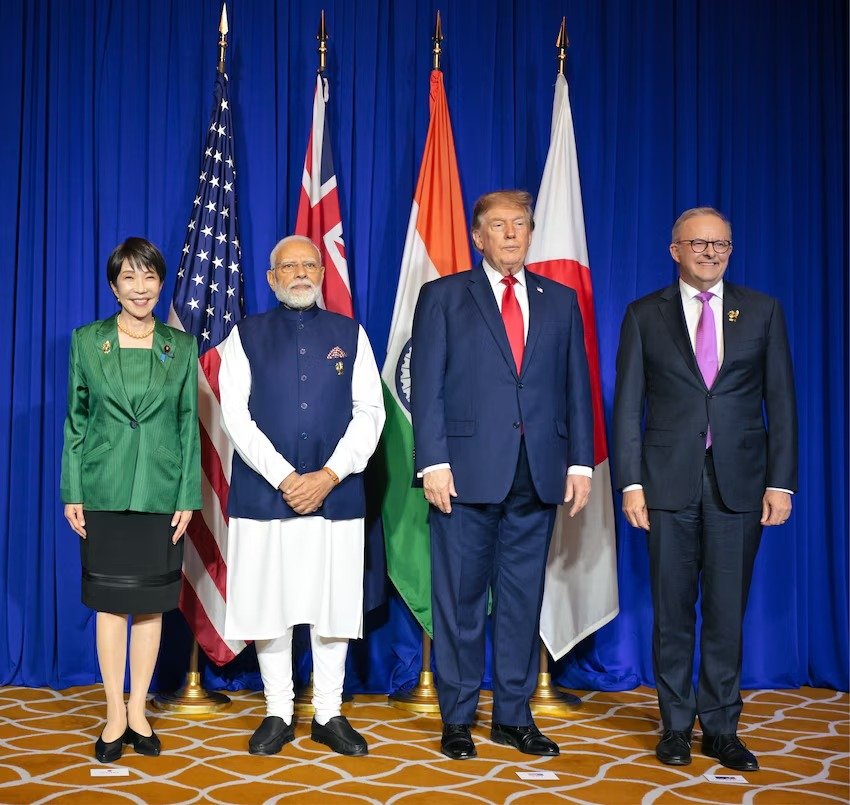
Shenzhen; November 2026: President Donald Trump has arrived at Shenzhen, where he was accorded a grand welcome by the Chinese President Xi Jinping. It is tommorow (Thursday – 19th November 2026) – the three world leaders are schedule to meet (dubbed as trilateral).
While the summit between the three leaders is unprecedented, Trump, Xi, and Putin have been holding bilateral meetings over the years. Xi has met with Trump three times since October 2025 and more than 40 times with Putin since becoming president in 2013. Trump and Putin recently met in Alaska in August 2025.
As the three world leaders meet tommorow, Maverick News 30 envisages that each of them has their own agendas – which apparently is likely to trigger a discord of own prerogatives.
US President Donald Trump has reiterated, what he would be focusing on when he meets his Russian and Chinese counterparts. He told reporters that he would raise the issue of denuclearisation. This comes after the expiry of the New Start treaty between the US and Russia in February this year (2026). The agreement placed restrictions on the strategic nuclear arsenals of the two countries. At the time of that treaty lapsing, Trump had presented the possibility of striking a “better agreement” including China.
However, China has shown no indication whatsoever of downsizing its nuclear proliferation. As Lizzi Lee, a fellow at the Asia Society Policy Institute (ASPI), was quoted as saying, “From Beijing’s perspective, the starting point is fundamentally unequal. The US and Russia have much larger arsenals, and China sees its own build-up as necessary for a credible deterrent”.
Another issue that Trump wants to raise at the meeting with Xi and Putin is the Iran war. Both China and Russia have extended help to the Islamic Republic amidst its war with the US, which began in February. Trump could use the opportunity to discuss how China and Russia could influence Iran to stop the fighting.
Ukraine is another key issue Trump wants to discuss with Xi and Putin. “We’ll talk about, my favourite subject, Ukraine. Ukraine’s losing Ukraine”, Trump had told reporters earlier at the White House on Monday (16th November 2026) morning before departing for Asia (tour to Manila). “Russia is losing 25,000 soldiers in the month. So, we’ll be talking about that”.
However, there’s a fear that Trump’s discussion of the war with Putin and Xi will not bode well for Kyiv. Ukrainian Foreign Minister Andriy Sybiga was quoted as saying that a meeting between US, Chinese and Russian leaders would “only encourage Putin to continue this war”.
Ukrainian President Volodymyr Zelenskyy has also expressed concern about the potential of the three leaders using the moment to redraw global spheres of influence.
Chinese President Xi Jinping on the otherside is said to promulgate world peace. The Chinese Government has asserted that Xi, Trump and Putin would engage in “in-depth discussions on preserving global peace and promoting stability in relations. It will be of ground-breaking significance”, foreign ministry spokeswoman Mao Ning said while briefing the media houses on Monday (16th November 2026) hours after China had confirmed the meeting.
Russian President Vladimir Putin in a sharp contrast to the Trump’s push of concluding the Russia-Ukraine war is expected to remain unperturbed. Last week, when Trump’s special envoys, Steve Witkoff and Jared Kushner, met Putin in Russia, he had said that Europe should “figure out” whether “they want peace or war”. And according to Russian presidential aide Yuri Ushakov, the talks in Shenzhen would continue the diplomatic efforts aimed at reaching a negotiated settlement to the Ukraine war.
As it can be deemed understandable that tomorrow’s meeting between the three leaders would benefit Putin the most. He could negotiate favourable terms for an exit from the war in Ukraine. By simply sitting down with the leaders of the world’s two most powerful countries in a trilateral format, Putin will be recognised as a major player on the world stage rather than a pariah.
This proposed meeting has, however, drawn comparisons with the 1945 Yalta Conference, which laid out the foundations for the Soviet domination of Eastern Europe and the Cold War. For countries like Ukraine, the fear is palpable, with President Zelenskyy saying, “We really don’t want this to turn into ‘Yalta 2, 3, 4,’ with a redistribution of influence”.
The words 'Yalta 2.0' were bound to follow what is being touted as a historic trilateral gathering. The label recalls the February 1945 conference at which Franklin Roosevelt, Winston Churchill and Joseph Stalin set out key parts of the post-war order, and which later became shorthand in Eastern Europe for great powers deciding the fate of smaller nations.
The Yalta Conference took place from February 4 to 11, 1945, at the Livadia Palace near the Crimean resort town of Yalta, as the Second World War in Europe neared its end. The leaders dealt with several major questions:
·The defeat and occupation of Germany, including how the country would be administered after surrender.
·The future of Eastern Europe, above all Poland, whose borders and government were reshaped under Soviet influence.
·The Soviet Union’s entry into the war against Japan, which Stalin agreed to join after Germany’s defeat, in return for concessions in Asia that included influence in Manchuria.
·The United Nations, including the structure of a Security Council with permanent members and a veto.
·The Declaration on Liberated Europe, a pledge that liberated peoples would be able to choose their own governments through free elections.
Yalta was not a treaty carving up the whole world, and historians have long argued over how much it created and how much it merely recognised, since Soviet armies already held much of Eastern Europe. But the promise of free elections went largely unkept as Soviet-aligned governments took power across the region. Roosevelt died that April. In March 1946, Churchill delivered his “iron curtain” speech, and the wartime partnership gave way to the Cold War.
That is why “Yalta” carries such emotional weight.
·In Poland, the Baltic states and much of Central and Eastern Europe, it is remembered as a symbol of Western betrayal.
·In the United States, it became a long-running political reproach, and President George W Bush famously described the Yalta arrangements as one of history’s great wrongs during a 2005 visit to Riga.
·For Russia, by contrast, it has often been remembered as a moment when the Soviet Union’s wartime role and security interests were recognised by its allies.
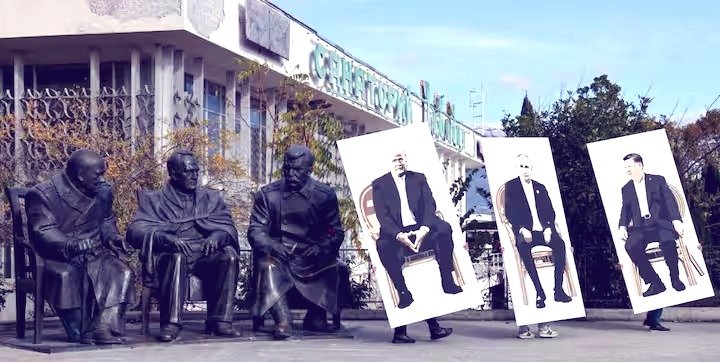
One symbolic detail has not escaped from Maverick’s column that Yalta lies in Crimea, which Russia seized from Ukraine in 2014. In 2025, an exhibition titled “Yalta 2.0” opened in Livadia Park in Crimea, picturing Trump, Putin and Xi.
The summit has not yet taken place, no agenda has been published, and officials on all sides have given conflicting signals about what will be discussed. What is clear is that the meeting is unprecedented, and that it comes at a delicate moment for the war in Ukraine, nuclear arms control and the Iran conflict.
Team Maverick.