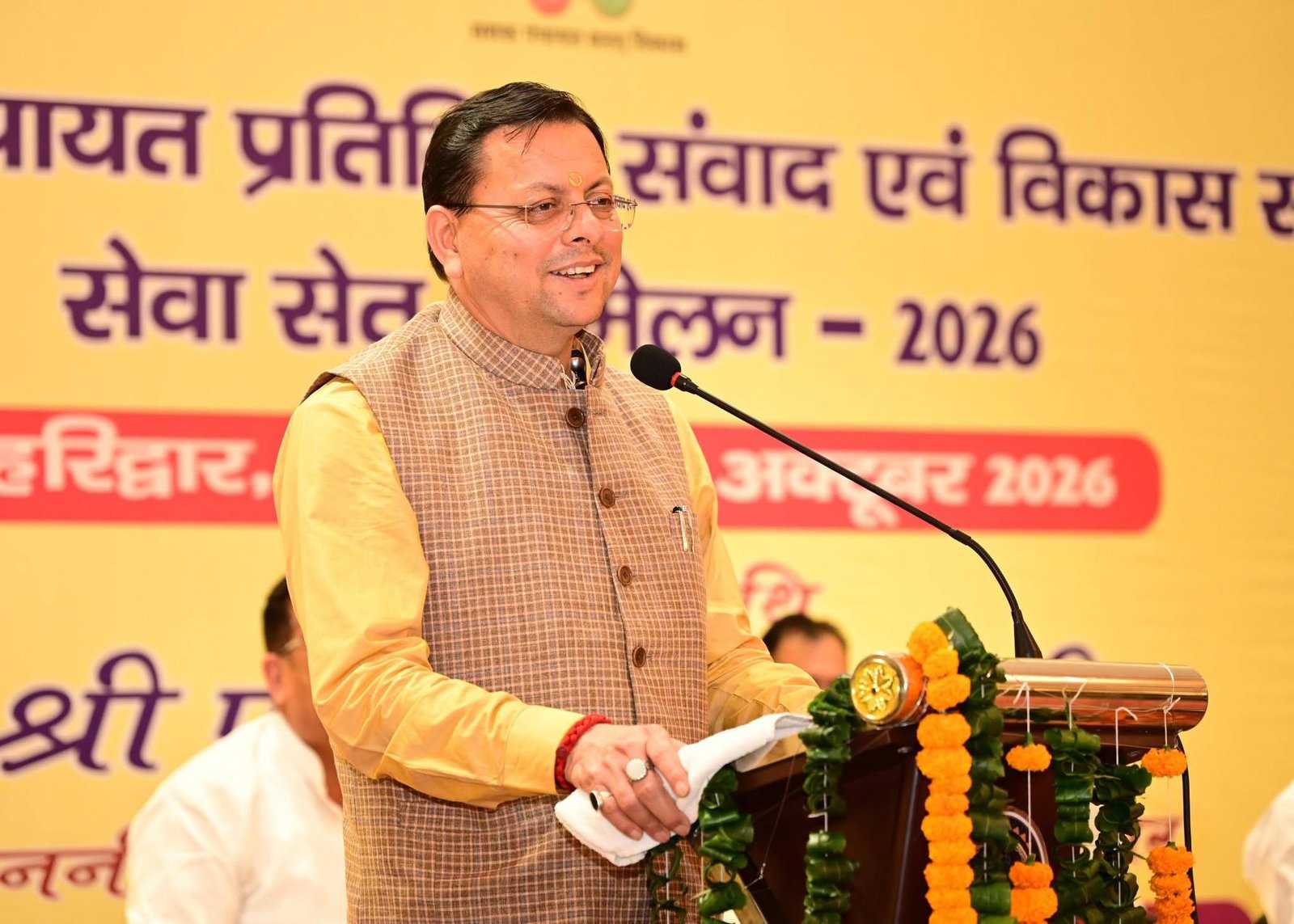
Haridwar, October 2026: Uttarakhand Chief Minister Pushkar Singh Dhami on Thursday participated in a one-day orientation and capacity-building training programme for representatives of the three-tier Panchayati Raj system in Haridwar.
Speaking on the occasion, Dhami said empowered panchayats are the strong foundation of a developed Uttarakhand. He said the initiative to provide capacity-building training simultaneously to more than 60,000 elected Panchayat representatives across all development blocks of the state was an important step towards giving a new direction to development at the grassroots level.
The Chief Minister said Panchayat representatives are an important link in the democratic system and serve as a bridge between the government and the people. Since they understand local issues closely, they play a decisive role in ensuring that the benefits of government schemes reach the last person.
He urged Panchayat representatives to work with the spirit of “My Village, My Responsibility” and ensure that every eligible person receives information about and benefits from government welfare schemes.
Dhami said that under the leadership of Prime Minister Narendra Modi, Panchayats are being strengthened as institutions capable of leading development by providing them with adequate resources, infrastructure and modern technology. The state government is also continuously working in the same direction, he said.
Referring to the Jan Yojana Abhiyan, which began on October 2, 2026, the Chief Minister said development plans were being prepared at the Gram Panchayat, Kshetra Panchayat and District Panchayat levels. He stressed that local requirements, public suggestions and available resources must be given priority while preparing these plans.
Each Panchayat should set clear targets, timelines and expected outcomes so that the actual benefits of development works reach villagers, he said.
Dhami said every Panchayat development plan should clearly address basic requirements such as drinking water, roads, sanitation, education and healthcare. Suggestions from people should be sought during Gram Sabha meetings and the progress of development works should be reviewed regularly.
Panchayat representatives should also assess whether the benefits of various schemes are actually reaching the intended families, he said, adding that the needs of vulnerable and disadvantaged sections should receive special attention.
The Chief Minister said more than 56,000 Panchayat representatives were provided training during 2025-26. Of the state's 7,817 Gram Panchayats, 5,972 are currently operating Panchayat buildings as Gram Sachivalayas. Over the past five years, 1,362 Panchayat buildings have been constructed and 584 have been repaired. More than 1,000 Gram Panchayats have also been computerised.
He said Panchayat action plans, financial and physical progress of works, and geo-tagging of development projects are being monitored through the e-GramSwaraj portal. The objective of the Digital Panchayat initiative is to make the functioning of Panchayats more transparent, simple and effective.
“Panchayat funds are public money and every penny must be accounted for before the people,” Dhami said, stressing that the impact of development works is more important than merely increasing their number.
He called for special attention to the quality of roads, the utility of drinking water schemes and the services being provided through Panchayat buildings.
The Chief Minister said Panchayats have a crucial role to play in creating clean and healthy villages. To strengthen solid waste management, district panchayats have been provided garbage collection machines for cleaning rural motor roads and local markets. Special machines have also been installed at the development block level for the purpose.
Dhami urged Panchayat representatives to make cleanliness a people's movement and ensure regular sanitation in villages.
He said the government was working to strengthen the rural economy by promoting self-help groups, women entrepreneurship, agriculture, horticulture, local products and tourism. Increasing employment and self-employment opportunities in villages and reducing migration remain key priorities of the government, he said.
Dhami highlighted several measures taken for women's empowerment, including 30 per cent horizontal reservation for women in government jobs. He also stressed that equal attention must be paid to preserving the cultural heritage of villages.
The Chief Minister urged Panchayat representatives to ensure quality, timely execution and accountability in every development project. He asked them to make effective use of the knowledge gained through the training programme to transform Panchayats into clean, prosperous and self-reliant institutions.
Cabinet Minister Madan Kaushik said Panchayats have a crucial role in successfully implementing various government schemes at the grassroots level. Development initiatives relating to roads, electricity, Panchayat buildings and schools reach people through Panchayats, he said.
Kaushik said greater participation and active representation in Panchayats would bring significant changes to villages. He also referred to the nationwide Seva Sankalp Abhiyan being conducted to mark 25 years of public service under Prime Minister Narendra Modi and said the campaign was opening up new possibilities for rural development.
He urged Panchayat representatives to implement development schemes effectively and ensure that their benefits reach the last person.
Cabinet Minister Pradeep Batra, District Panchayat President Kiran Chaudhary, Ranipur MLA Aadesh Chauhan, former Cabinet Minister Swami Yatishwaranand, Minister of State Deshraj Karnwal, Aadesh Saini, Bahadrabad Block Pramukh Asha Negi, District Magistrate Mayur Dixit, Superintendent of Police Navneet Singh Bhullar, Chief Development Officer Dr Lalit Narayan Mishra, Additional District Magistrate (Administration) Jitendra Kumar, Haridwar Sub-Divisional Magistrate Yogesh Mehra, District Panchayati Raj Officer Atul Pratap Singh, village heads and Panchayat representatives from various Gram Panchayats, along with other officials, were present at the programme.