Digital Public Infrastructure is a Necessity, not a Luxury, for Sustainable Development Across the Global South: Union MoS, Dr Chandra Sekhar Pemmasani
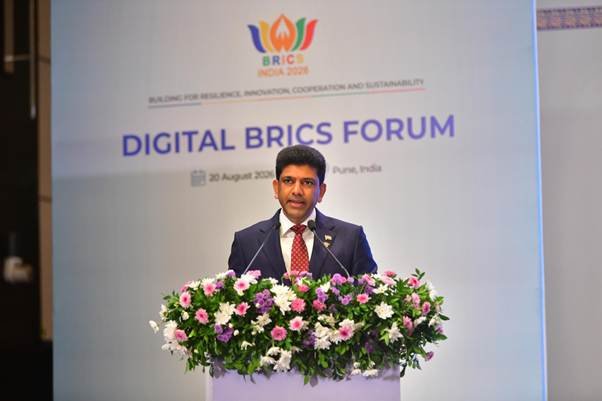
Dr Chandra Sekhar Pemmasani delivers keynote address on sustainable and resilient digital and ICT ecosystems at BRICS ICT Track in Pune
Union Minister of State for Communications, Dr Chandra Sekhar Pemmasani, delivered a keynote address today at the BRICS ICT Track Thematic Panel Discussion on "Sustainable and Resilient Digital and ICT Ecosystems: Digital Public Infrastructure for Impact – Global South Insights on Powering Public Services and Economic Growth" held in Pune.
Addressing an international delegation comprising ministers, policymakers, academicians, and industry leaders from BRICS nations, the Union Minister of State outlined India’s strategic vision for open, inclusive, and resilient digital architectures designed to empower citizens and accelerate economic progress.
Highlighting India’s transformative journey, Dr Pemmasani stated that while the conventional narrative of infrastructure historically revolved around physical assets like roads, ports, and power grids, India has demonstrated a modern paradigm built on population-scale digital rails encompassing identity, banking, payments, verifiable documents, and consented data.
He noted that the true innovation lies in establishing an open, interoperable foundational public layer upon which banks, fintech enterprises, and government departments can build diverse consumer services under the leadership of Prime Minister Shri Narendra Modi.
Elaborating on the core pillars of India’s Digital Public Infrastructure (DPI), the Union MoS detailed how the foundational identity layer enables low-cost remote verification across billions of authentications, SIM issuances, and banking access. In the payments sphere, the Unified Payments Interface (UPI) has democratized finance, linking 720 banks, processing 85% of India’s digital transactions, and contributing to nearly 49% of global real-time payment volumes while expanding to nine partner nations.
He also emphasized the role of the Direct Benefit Transfer (DBT) portal, which integrates 318 schemes across 56 ministries to eliminate intermediaries, alongside DigiLocker’s ecosystem of over 700 million users and 9 billion issued verifiable credentials. Newer initiatives such as the Open Network for Digital Commerce (ONDC), Government e-Marketplace (GeM), and Account Aggregator framework are further democratizing market access and individual data sovereignty.
Underpinning these software innovations is India’s robust telecommunications expansion. The Union Minister of State highlighted that 4G mobile coverage now spans nearly 99% of villages, backed by a $4 billion saturation drive, while the nation has accomplished one of the fastest global 5G rollouts with over 500,000 base stations deployed. Concurrently, a $17 billion BharatNet mission is laying high-speed optical fibre across every major village. On environmental sustainability, Dr Pemmasani shared that India has already achieved 12.4% green energy usage across mobile towers against a national mandate of powering 30% of telecom infrastructure through renewable sources by 2030.
Concluding his address, Dr Pemmasani stressed that DPI is not a luxury reserved for advanced economies, but an imperative for sustainable development across the Global South. He called for a stronger BRICS digital partnership anchored in sharing modular, open-source technology frameworks to eliminate prohibitive licensing costs, alongside joint capacity-building initiatives to ensure fair representation in international ICT standard-setting bodies.
The thematic panel session witnessed the participation of distinguished international dignitaries and BRICS representatives, including Mr Frederico de Siqueira Filho, Minister of Communications of the Federative Republic of Brazil, and Mr Mondli Gungubele, Deputy Minister of Communications and Digital Technologies of the Republic of South Africa, among other ministerial delegates and global technology leaders.