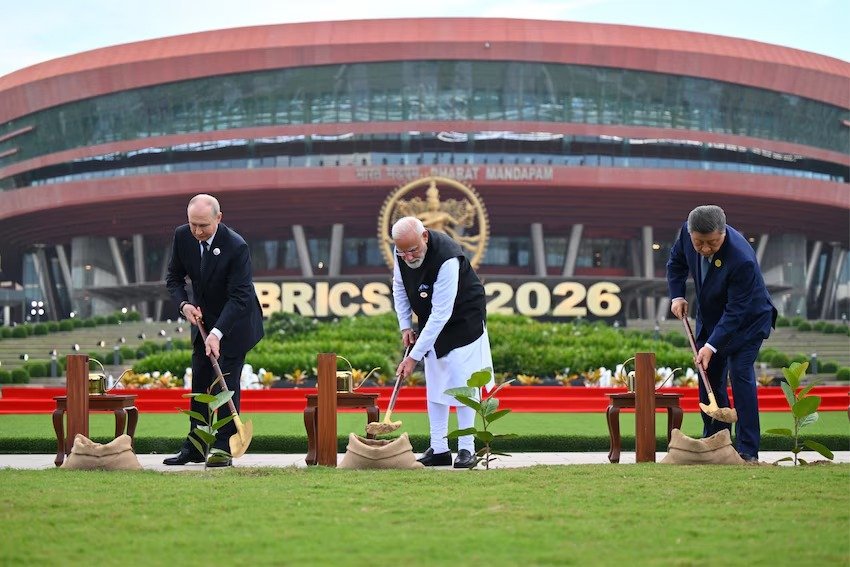
New Delhi, Sep 2026 : Prime Minister Narendra Modi and leaders of BRICS member countries participated in a joint tree plantation initiative at Bharat Mandapam in New Delhi on Saturday, marking a symbolic moment during the 18th BRICS Summit.
Russian President Vladimir Putin, Chinese President Xi Jinping, Indonesian President Prabowo Subianto, South African President Cyril Ramaphosa, Egyptian President Abdel Fattah el-Sisi, Abu Dhabi Crown Prince Sheikh Khaled bin Mohamed bin Zayed Al Nahyan, Iranian President Masoud Pezeshkian, Ethiopian Prime Minister Abiy Ahmed Ali and Brazil's Foreign Minister Mauro Vieira joined Modi for the plantation initiative.
The leaders also posed for the traditional family photograph during the event at the lawns of Bharat Mandapam, with the participating leaders coming together for the ceremonial moment.
Earlier in the day, the BRICS leaders attended the Summit session on “Inclusive Global Governance and Strengthening Multilateralism” at Bharat Mandapam. India is hosting the two-day 18th BRICS Summit in New Delhi on September 12 and 13, bringing together leaders of member and partner countries as well as outreach invitees.
During the Summit, Prime Minister Modi announced the unanimous adoption of the New Delhi Declaration 2026 and launched two postage stamps commemorating two decades of BRICS.
In his closing remarks at the session on inclusive global governance and strengthening multilateralism, Modi said the New Delhi Declaration provided a clear direction to the collective resolve of BRICS members. He stressed that the next step would be to translate the commitments contained in the declaration into concrete outcomes.
“The New Delhi Declaration adopted today gives clear direction to our shared resolve. Now it is our responsibility to convert these resolutions into concrete results,” Modi said.
The Prime Minister said discussions among BRICS leaders covered perspectives on important regional and global developments, along with priorities aimed at further strengthening cooperation within the grouping.
Describing the discussions as “meaningful and constructive,” Modi said the exchange of views demonstrated that the changing global order could not be effectively managed through institutions created for an earlier era.
“Our diversity of views as well as our shared commitment to BRICS cooperation has also come out clearly,” he said.
Modi stressed that reforms were required in three key areas — representation, responsiveness and rule-making — to make global governance more reflective of contemporary realities.
He also underlined the need for the Global South to have equal participation in shaping emerging technologies and the rules governing them. Areas such as artificial intelligence, cyberspace, biotechnology, outer space and other critical technologies are increasingly influencing the global economy and future governance.
BRICS currently comprises Brazil, China, Egypt, Ethiopia, India, Indonesia, Iran, Russia, Saudi Arabia, South Africa and the United Arab Emirates. Its partner countries are Belarus, Cuba, Bolivia, Kazakhstan, Malaysia, Nigeria, Thailand, Uganda, Uzbekistan and Vietnam.
India is a founding member of BRICS and has previously held the grouping's Chairship in 2012, 2016 and 2021. It assumed its fourth BRICS Chairship on January 1, 2026.
The year also marks an important milestone for the grouping as BRICS completes 20 years since its establishment. India's Chairship has focused on strengthening cooperation while promoting a people-centric approach and greater representation for the Global South in international decision-making.
The tree plantation initiative and family photograph brought the Summit's formal proceedings to a symbolic close, as leaders came together to underline cooperation and shared responsibility amid discussions on the future of global governance and multilateralism.