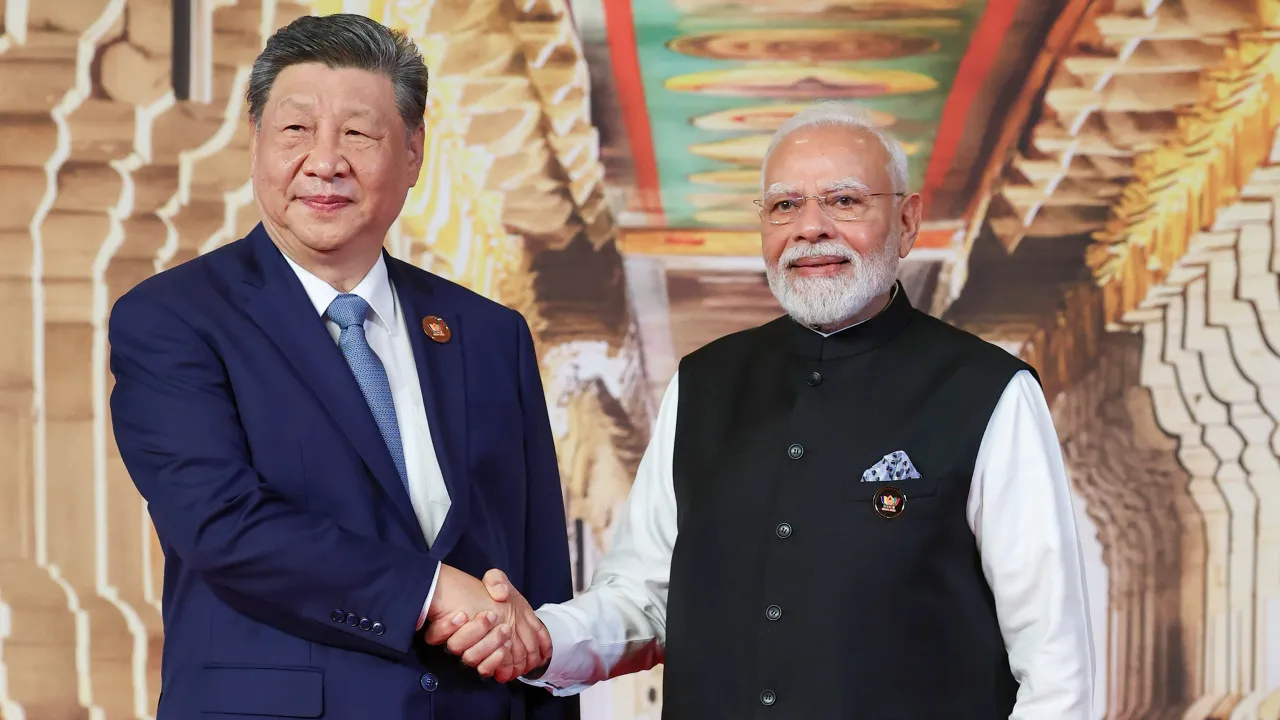
New Delhi, Sept 2026 : Prime Minister Narendra Modi and Chinese President Xi Jinping held a bilateral meeting at Bharat Mandapam in New Delhi on Saturday on the sidelines of the 18th BRICS Summit, with discussions expected to focus on strengthening bilateral cooperation and consolidating the recent efforts to stabilise India-China relations.
At the beginning of the meeting, Modi welcomed Xi and expressed gratitude to China for its support and cooperation during India’s BRICS chairship in 2026.
“I feel very happy in welcoming you. I thank you for your positive statement at the BRICS Summit. I express my gratitude for the support and cooperation received from China during India’s BRICS chairship. We now have the opportunity to discuss bilateral cooperation. Once again, a warm welcome to you in India,” Modi said.
External Affairs Minister S Jaishankar, National Security Advisor Ajit Doval and other senior officials were present during the meeting.
India, which holds the BRICS chairship in 2026, is hosting the two-day 18th BRICS Summit at Bharat Mandapam in New Delhi from Saturday. The summit brings together leaders of BRICS member and partner countries, besides outreach invitees, for discussions on strengthening multilateral cooperation and addressing global challenges.
Ahead of the summit, Modi and Xi were seen sharing warm moments with Russian President Vladimir Putin at Bharat Mandapam. The three leaders were seen holding hands and exchanging smiles, in a gesture that drew attention ahead of the formal deliberations.
Modi also warmly welcomed Xi and other BRICS leaders at the summit venue. The ceremonial welcome featured the iconic Ramanathaswamy Temple in Rameswaram as its backdrop. During the event, Modi was seen briefly explaining the significance of the temple backdrop to Xi.
The meeting between Modi and Xi assumes significance as the two countries continue efforts to improve bilateral ties following the military confrontation in eastern Ladakh in 2020. India has consistently maintained that peace and tranquillity along the border are essential for the overall development and progress of relations between the two neighbours.
The two leaders also had a brief interaction during the recent Shanghai Cooperation Organisation (SCO) Summit in Bishkek, Kyrgyzstan. Their previous substantive meeting was held on the sidelines of the SCO Summit in Tianjin, China, in August 2025.
Xi arrived in New Delhi earlier on Saturday to participate in the BRICS Summit. Union Minister of State for Commerce and Industry Jitin Prasada received the Chinese President at the airport.
The Ministry of External Affairs welcomed Xi’s arrival, saying India looked forward to constructive discussions as BRICS continued to advance cooperation and contribute to a more balanced, representative and multipolar world.
“Warm welcome to President Xi Jinping of the People’s Republic of China on his arrival in New Delhi to attend the 18th BRICS Summit,” the MEA said in a post on X.
The Chinese President’s visit comes amid efforts by New Delhi and Beijing to stabilise their relationship and expand areas of cooperation while managing differences. India has repeatedly emphasised the importance of maintaining peace and tranquillity in border areas as a prerequisite for sustained improvement in bilateral relations.
Chinese Ambassador to India Xu Feihong had on Friday indicated that Beijing was prepared to work with New Delhi to implement the strategic guidance provided by the two leaders.
“This will be the third year in a row for the two leaders to meet with each other, following their meetings in Kazan (Russia) and Tianjin (China),” Xu said.
The Chinese envoy said Beijing would work with India to handle bilateral relations from a strategic and long-term perspective, strengthen communication, expand cooperation and properly manage differences.
He also described China and India as neighbours and partners, saying both sides should work towards maintaining good-neighbourly relations and helping each other achieve success.
The Modi-Xi meeting is therefore being closely watched for its potential to further consolidate the recent momentum in India-China engagement, particularly on bilateral cooperation, border stability and broader coordination within multilateral groupings such as BRICS and the SCO.