
New Delhi, Aug 2026 : Senior Congress leader Rahul Gandhi on Saturday praised students for raising their voices against what he described as systemic challenges, saying their courage had created a “beacon of light” amid widespread darkness and urging the youth to pursue change through love rather than hatred.
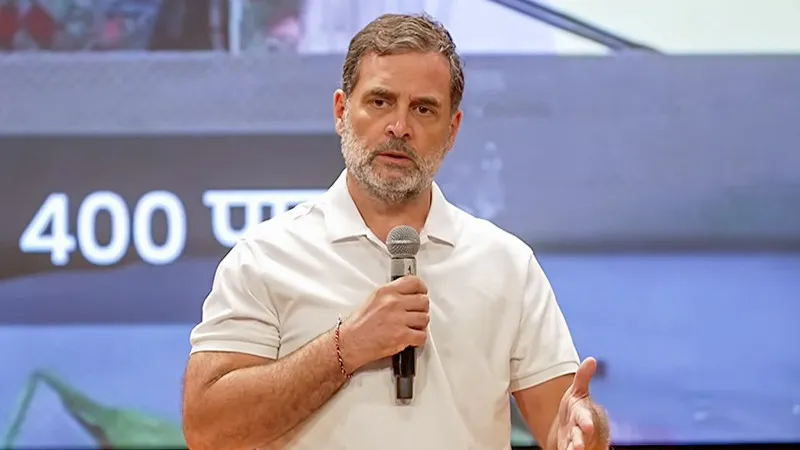
Addressing students at the ‘Chhatron Ki Goonj’ event at KP Ground in Prayagraj, Gandhi said young people had demonstrated a courage that previous generations, including their parents, had sometimes been unable to show. He arrived at the venue at around 7 p.m. and interacted directly with students from several institutions.
Gandhi said the existing system had restricted employment opportunities, weakened universities and created difficulties for students seeking education and jobs. He argued that young people needed to challenge these problems while preserving India’s traditions of truth and non-violence.
“There should be no hatred in any student’s heart—only love,” Gandhi said, urging students to fight for their rights through peaceful and constructive means.
Calling upon the youth to open a “Mohabbat Ki Dukan”, or “shop of love”, Gandhi said India’s future depended on its young population and their ability to confront challenges without allowing anger or hatred to dominate their movement.
“You have to open Mohabbat Ki Dukan -- ‘shop of love’; you have to fight against this system with love,” he told the gathering.
Gandhi said that when he referred to India’s strength, he was specifically referring to its nearly 40 crore young people rather than simply describing the size of a crowd. He called students the country’s future, strength and pride.
During the interaction, students raised a range of concerns relating to unemployment, education, recruitment examinations, university infrastructure and alleged administrative difficulties.
Gandhi highlighted the employment challenges confronting students who spend years pursuing education and preparing for competitive examinations, only to find limited opportunities. He particularly criticised the lack of manufacturing employment, arguing that Indian products were not achieving the same global visibility as those from China and Vietnam.
“Across the world, one sees ‘Made in China’ or ‘Made in Vietnam,’ but not ‘Made in India,’” he said, while blaming policies such as demonetisation and GST for contributing to difficulties in the economic system.
Gandhi also levelled political allegations against the BJP, claiming that the party had acquired enormous financial and institutional influence. He alleged that political and ideological influence had extended into universities and other institutions through appointments and organisational networks.
However, he said students had emerged as a source of hope amid these challenges.
“Yet, amidst this darkness, you lit a beacon of light,” Gandhi said, praising students for raising their voices without resorting to hatred.
Several students were invited to share the platform and describe their experiences during protests and their difficulties within educational institutions.
Kunal Pandey from Patna University and students from Allahabad University spoke about their respective experiences. A former first woman Vice President of the Patna University Students’ Union recalled a peaceful “students for students” protest following detentions in Bihar, saying the movement eventually achieved its objective.
Students from Allahabad University and the wider Purvanchal region said they had been protesting for nearly 30 days, maintaining that the university was their home and that they remained determined to continue their campaign.
A law student from Allahabad University raised concerns about the condition of the institution’s library, claiming that flooding during the monsoon made books inaccessible. He alleged that students had been warned about the risk of electric shocks and that protests over infrastructure issues were met with physical intimidation and cases being filed against demonstrators.
A UPPSC aspirant raised concerns about the examination “normalisation” process, while another student, Avinash, spoke about prolonged delays in teacher recruitment.
Avinash said he had applied for a teacher recruitment process in 2018 and had continued preparing despite vacancies remaining unfilled. He alleged that repeated sit-ins and memoranda submitted by aspirants had failed to produce results and claimed that several recruitment processes under the Uttar Pradesh Subordinate Services Selection Commission remained pending.
Gandhi listened to the students throughout the interaction and reiterated that India’s young population needed greater opportunities, stronger educational institutions and fair recruitment processes.
He encouraged the students to continue raising their concerns but urged them to channel their frustration through peaceful, constructive and compassionate action, maintaining that meaningful change could be achieved through courage, unity and love rather than hatred.