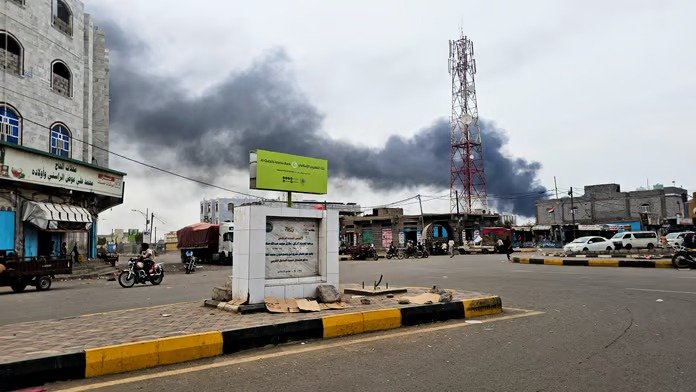
Aden (Yemen), Sep 2026 : Yemeni government warplanes carried out airstrikes on Houthi-held positions in the western provinces of Hodeidah and Taiz, supporting ground forces engaged in heavy fighting against a major Houthi offensive near the strategic Bab al-Mandab Strait, a military official said.
The airstrikes were conducted on Friday as intense clashes continued across several fronts in the two provinces. According to the official, who spoke on condition of anonymity, Houthi fighters had made significant advances during the previous 24 hours, prompting government forces to intensify their military response.
The warplanes targeted Houthi positions and troop movements in areas where ground forces were actively engaged in combat, the official said. No immediate information was available on the extent of the damage or casualties resulting from the airstrikes.
A Houthi military source confirmed that airstrikes had taken place but blamed them on what it described as “Saudi aggression warplanes”. Saudi Arabia has not issued an immediate response or publicly commented on the reported strikes.
The escalation has raised tensions around Bab al-Mandab, one of the world's most strategically important maritime passages linking the Red Sea with the Gulf of Aden. Rashad al-Alimi, chairman of Yemen's Presidential Leadership Council (PLC), said government forces would prevent the Houthis from advancing toward the vital waterway.
The latest round of fighting began at dawn on Thursday and has already resulted in at least 90 deaths across Hodeidah and Taiz, according to medical officials. The casualties reportedly include around 40 government soldiers and at least 50 Houthi fighters.
Military sources said the fighting intensified further on Friday, with both sides deploying additional troops, armoured vehicles and military equipment to the two main fronts. The rapid mobilisation has increased concerns that the confrontation could develop into a wider and more sustained military campaign.
The current escalation is being described as among the most intense episodes of ground fighting witnessed in western Yemen in recent years. It has also raised fears of a return to large-scale hostilities after a period of relative calm on several frontlines of the country's long-running conflict.
The strategic significance of Bab al-Mandab has added to concerns surrounding the latest offensive. The narrow waterway serves as a key maritime link between the Red Sea and the Gulf of Aden and is important for international shipping and regional trade.
Yemen has remained embroiled in civil war since late 2014, when the Iran-aligned Houthi movement seized control of the capital, Sanaa, and large parts of northern Yemen. The conflict subsequently drew direct regional intervention.
In 2015, a Saudi-led coalition intervened militarily in support of Yemen's internationally recognised government, intensifying the conflict. Years of fighting have caused a severe humanitarian crisis and displaced millions of people.
The renewed clashes in Hodeidah and Taiz could further complicate efforts to maintain the relative calm that had emerged across parts of Yemen in recent years, while increasing uncertainty around security in the strategically important Red Sea region.