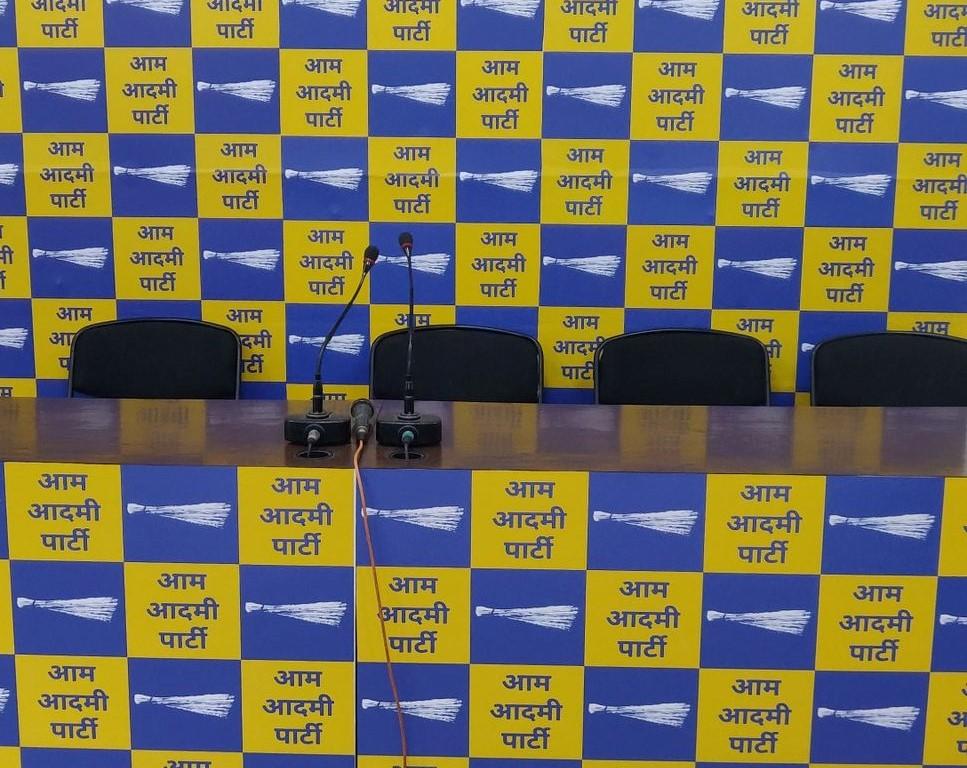
AAP Faces Existential Test in Gujarat After Mass Defections to BJP, Rivals Question ‘Third Front’ Claim

Gandhinagar, April 2026 : The political landscape in Gujarat has witnessed a dramatic shift following the defection of seven Rajya Sabha members from the Aam Aadmi Party (AAP) to the Bharatiya Janata Party (BJP), triggering intense debate over AAP’s organisational strength and its claim of emerging as a viable third political force in a state long dominated by bipolar politics between the BJP and the Indian National Congress.
Among the prominent leaders who switched sides are Sandeep Pathak and Raghav Chadha, whose exit is being viewed as a major setback not just numerically in the Rajya Sabha, but also symbolically for AAP’s national and state-level leadership. The development comes at a politically sensitive time, just ahead of local self-government elections scheduled for April 26, where nearly 10,000 seats across municipal corporations, municipalities, and panchayats are at stake.
Blow to AAP’s Gujarat Strategy
Sandeep Pathak’s departure is particularly significant for Gujarat, where he had served as the party’s state in-charge and was widely credited with building AAP’s organisational structure from the ground up. He played a key role in candidate selection, grassroots mobilisation, and campaign management during the 2022 Gujarat Assembly elections, where AAP made its electoral debut with notable success.
In those elections, AAP secured around 14 percent of the vote share and won five seats in the 182-member Assembly—marking its first legislative presence in the state. Leaders such as Gopal Italia, Umesh Makwana, Hemant Khava, Bhupat Bhayani, and Chaitar Vasava were instrumental in that breakthrough. However, subsequent developments, including resignations, defections, and internal dissent, have steadily eroded that initial momentum.
The defection of Bhupat Bhayani to the BJP earlier had already raised concerns about AAP’s ability to retain its leadership base. Now, with high-profile exits at the national level, questions are being raised about the party’s long-term sustainability in Gujarat.
Internal Dissent and Organisational Strain
The crisis has been compounded by sharp criticism from within the party. Suspended Botad MLA Umesh Makwana openly linked the Rajya Sabha defections to what he described as a broader organisational collapse.
He warned that AAP could soon lose relevance not just in Gujarat but also in states like Punjab and Goa. “Following the latest developments, the party will be finished within months in Gujarat,” he said, predicting further defections by senior leaders.
Makwana also alleged internal sabotage, claiming that individuals aligned with the BJP were operating within AAP’s state leadership and sidelining effective leaders. According to him, the party’s inability to manage internal conflicts and identify loyal leadership has contributed significantly to its weakening structure.
Taking aim at AAP’s national leadership, particularly Arvind Kejriwal, Makwana said the party lacked the ability to distinguish between loyal members and those allegedly working against its interests. He also hinted at the possibility of a prominent leader—referred to as a “poster boy”—defecting along with a sizable support base from the Leuva-Patidar community before the 2027 Assembly elections.
Electoral Readiness Under Question
Beyond internal discord, concerns have also emerged regarding AAP’s preparedness for the upcoming local body elections. According to Makwana, the party has struggled to field candidates across constituencies, managing only around 3,000 candidates for nearly 10,000 seats.
He pointed out that several candidates either withdrew or shifted allegiance, raising doubts about the party’s grassroots strength. “If the party cannot field candidates, how will it form a government?” he questioned.
These concerns have been echoed by political rivals. BJP leaders have dismissed AAP’s claim of a three-cornered contest, asserting that Gujarat remains firmly a two-party state.
Savarkundla MLA Mahesh Kaswala said that Gujarat’s political history has consistently revolved around the BJP and Congress. “There is no space for a third front here. People have never accepted such attempts,” he stated.
Congress Joins the Criticism
Leaders from the Congress have also taken aim at AAP, predicting a steep decline in its political fortunes. Leader of the Congress Legislative Party Tushar Chaudhary argued that AAP’s limited participation in the local elections signals its weakening base.
Congress spokesperson Manish Doshi went further, alleging ideological inconsistency within AAP. He claimed that the party’s earlier anti-corruption stance had lost credibility and accused it of functioning as a “B-team” of the BJP.
Doshi pointed to the defection of leaders like Raghav Chadha as validation of these claims and argued that AAP’s organisational presence in Gujarat has shrunk significantly, with several leaders either joining the BJP or returning to Congress.
AAP Pushes Back
Despite the mounting criticism, AAP leaders have sought to project confidence. State General Secretary Sagar Rabari defended the party’s track record, highlighting its 14 percent vote share in the 2022 Assembly elections and the election of five MLAs.
He argued that Gujarat has effectively been under BJP rule for over three decades, with Congress failing as a strong opposition. In this context, he maintained that AAP continues to represent a credible alternative.
“People may come and go, but the party will continue to fight for the people,” Rabari said, downplaying the impact of recent defections. On Sandeep Pathak’s exit, he described it as a personal decision and suggested that external pressures may have played a role.
Rabari also reiterated AAP’s ideological stance, asserting that all leaders within the party are fundamentally opposed to the BJP and committed to raising public issues.
A Crucial Political Test Ahead
The unfolding developments have placed AAP at a critical juncture in Gujarat. While the party insists that a three-cornered political contest is emerging, the combined impact of high-profile defections, internal dissent, and sustained attacks from both the BJP and Congress has cast serious doubt on that narrative.
With local self-government elections set to take place on April 26, the results are expected to serve as a key indicator of AAP’s grassroots strength and electoral viability in the state. The elections, covering multiple tiers of governance, will test whether the party can retain voter confidence despite organisational challenges.
At the same time, predictions of further defections and continued internal strife suggest that AAP’s immediate future in Gujarat may hinge not just on electoral performance, but also on its ability to rebuild cohesion and leadership stability.
For now, the party finds itself navigating one of its most challenging phases in the state, with its claim of being a rising third force under unprecedented scrutiny.




Amarnath Yatra Crosses Four Lakh Pilgrims as Devotees Continue Sacred Journey
Srinagar, July 2026 : The annual Shri Amarnath Ji Yatra achieved a significant milestone o…

Amarnath Yatra Crosses Four Lakh Pilgrims as Devotees Continue Sacred Journey
Srinagar, July 2026 : The annual Shri Amarnath Ji Yatra achieved a significant milestone …