US Defence Secretary Defends $1.5 Trillion Military Budget, Calls It Crucial for Global Security Challenges

Washington, May 2026 : US Defence Secretary Pete Hegseth mounted a strong defence of President Donald Trump’s proposed $1.5 trillion military budget, describing it as a necessary response to an increasingly volatile global security environment and a decisive step toward restoring American military dominance.
Appearing before the Senate Armed Services Committee, Hegseth argued that the record-breaking budget reflects “the urgency of the moment” and is designed to prepare the United States for both current and future conflicts. He emphasised that the proposal aims to reverse what he called years of underinvestment and inefficiencies within the defence establishment.
“The $1.5 trillion budget will ensure that the United States continues to maintain the world’s most powerful and capable military,” Hegseth told lawmakers, framing the proposal as a generational reset of US defence capabilities.
A key component of the proposed budget is a significant focus on strengthening the country’s defence industrial base. Hegseth highlighted major investments in advanced weaponry, infrastructure, and innovation, stating that the ability to rapidly build and deploy military resources is essential for national security.
“A nation’s ability to build, innovate, and support the critical needs of its warfighters at speed and scale is the foundation upon which its deterrence and survival rests,” he said.
The Defence Secretary also outlined measures aimed at improving the welfare of military personnel. Among them is a proposed seven percent pay increase for junior enlisted troops, along with plans to eliminate substandard housing conditions across military installations. He noted that addressing quality-of-life issues is vital for maintaining morale and readiness within the armed forces.
In addition, Hegseth pointed to ongoing reforms in the Pentagon’s procurement system. He said the department is transitioning from a traditionally bureaucratic approach to a more business-oriented model intended to accelerate decision-making and reduce costs. According to him, these efforts have already attracted over $50 billion in private-sector investments, resulting in the development of hundreds of new or expanded facilities and the creation of tens of thousands of jobs.
Calling it a “historic demonstration of American manufacturing and defence revitalisation,” Hegseth argued that such initiatives would strengthen both the economy and national security.
Addressing the ongoing tensions and conflict involving Iran, Hegseth asserted that US military operations have been highly effective in weakening Tehran’s capabilities. He claimed that Iran’s ability to rebuild key elements of its defence infrastructure has been significantly diminished.
“Our military objectives have been stunningly effective,” he said, adding that the situation has placed Washington in a stronger position to prevent Iran from developing nuclear weapons.
Hegseth also pushed back against critics of the administration’s military strategy, warning that negative rhetoric could undermine progress achieved on the ground. “The biggest adversary we face at this point are the reckless naysayers and defeatist words,” he remarked, defending the administration’s approach as bold and necessary in confronting long-standing threats.
The Defence Secretary stressed that the proposed budget is focused squarely on enhancing combat readiness and deterrence across multiple domains, including missile defence systems, drone warfare, and nuclear capabilities. “This is a warfighting budget,” he said, underscoring that every policy decision is aimed at increasing military effectiveness and survivability.
He further noted improvements in recruitment and retention, claiming that enlistment numbers are rising and that more young Americans are choosing to join the armed forces. According to Hegseth, this reflects renewed confidence in the military’s mission and leadership.
The proposed defence spending represents a substantial increase from the roughly $1 trillion allocation in fiscal year 2026 and comes at a time of heightened geopolitical tensions involving major global players such as China and Russia, as well as ongoing instability in the Middle East.
During the hearing, Hegseth also addressed questions regarding the legal framework governing US military engagement with Iran. Responding to concerns raised by Senator Tim Kaine about the War Powers Act, he suggested that the current ceasefire with Iran effectively pauses the 60-day timeline requiring congressional authorisation for continued military action.
However, Kaine disagreed, stating that the legal clock likely continues to run regardless of the ceasefire, potentially creating a significant constitutional question for the administration.
The issue stems from the War Powers Act, which mandates that the president must seek congressional approval to continue military operations beyond 60 days. President Trump had notified Congress of the campaign against Iran in early March, making May 1 a critical deadline.
Meanwhile, diplomatic developments continue alongside military considerations. Russian President Vladimir Putin recently held a phone conversation with Trump, during which both leaders discussed the situation in Iran and broader regional stability. According to the Kremlin, Putin supported extending the ceasefire, warning of severe global consequences if hostilities resume.
As debates over defence spending and military strategy intensify in Washington, the proposed budget is likely to face rigorous scrutiny in Congress. Nonetheless, the administration maintains that the scale of investment is essential to address evolving threats and ensure that the United States remains prepared to respond decisively in an increasingly uncertain world.
(The content of this article is sourced from a news agency and has not been edited by the Mavericknews30 team.)




South Korean Frigate ROKS Daejeon Wins Top Gunnery Prize at RIMPAC
Seoul, Aug. 2026 : South Korea’s 3,100-ton frigate ROKS Daejeon has secured the top positi…
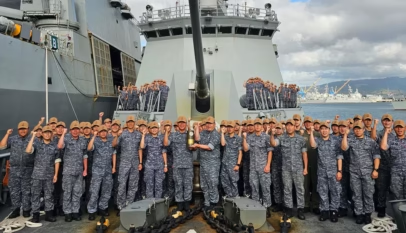
South Korean Frigate ROKS Daejeon Wins Top Gunnery Prize at RIMPAC
Seoul, Aug. 2026 : South Korea’s 3,100-ton frigate ROKS Daejeon has secured the top …