Delhi High Court Rejects Plea Seeking AAP De-Registration, Calls Petition “Highly Misconceived”

New Delhi, May 2026: The Delhi High Court on Wednesday dismissed a Public Interest Litigation (PIL) seeking the de-registration of the Aam Aadmi Party (AAP) and the disqualification of its senior leaders, including Arvind Kejriwal, Manish Sisodia, and Durgesh Pathak from contesting elections.
The plea was filed over allegations that the leaders refused to participate in proceedings before Justice Swarana Kanta Sharma in connection with the excise policy case. However, a Division Bench comprising Chief Justice D.K. Upadhyaya and Justice Tejas Karia dismissed the petition at the outset, terming it “highly misconceived” and refusing to entertain it.
“Having heard the parties, we are of the view that the PIL is highly misconceived,” the Bench observed, rejecting the argument that adverse remarks made in a separate judicial proceeding could serve as a valid ground for de-registering a political party.
During the hearing, the court repeatedly questioned the maintainability of the petition and asked the petitioner to point out any statutory provision that empowers the Election Commission of India (ECI) to de-register a political party under such circumstances.
“You are asking us to direct the ECI to deregister a party. Is there any provision for the de-registration of a political party?” the Bench asked, pressing the petitioner to substantiate the legal basis of the plea.
The petitioner, relying on a Supreme Court ruling, argued that de-registration of a political party is possible in limited situations, including cases where a party is declared unlawful under the Unlawful Activities (Prevention) Act (UAPA) or similar legislation, or where registration has been obtained through fraud.
However, the Bench was not convinced. It noted that none of the legal conditions required for de-registration appeared to be met in the present case. The court pointed out that there was no allegation that AAP had obtained registration through fraud, violated Section 29A of the Representation of the People Act, or declared that it had ceased to believe in the Constitution.
“The third ground is that a party can be deregistered if it is declared unlawful under the UAPA or a similar law. Has this political party been declared unlawful?” the court questioned.
When the petitioner’s counsel admitted that AAP had not been declared unlawful and clarified that the plea was based on observations made by Justice Sharma in contempt proceedings, the Bench responded firmly.
“If someone is found to have scandalised the court, the remedy lies under the Contempt of Courts Act. Even if convicted, where is the provision that bars such a person from contesting elections?” the court observed, highlighting the lack of legal foundation for the relief sought.
The petitioner eventually conceded that no specific statutory provision supported the request for de-registration of the party or disqualification of its leaders.
The PIL had argued that the conduct of AAP leaders amounted to a lack of “true faith and allegiance to the Constitution,” as required under Section 29A(5) of the Representation of the People Act, 1951. It alleged that their actions undermined the dignity and authority of the Delhi High Court and therefore justified the extreme measure of de-registering the party.
However, the High Court firmly rejected the argument, reiterating that judicial observations in related proceedings cannot be stretched to invoke electoral disqualification or party de-registration mechanisms without clear statutory backing.
With this ruling, the court effectively closed the door on the plea, reinforcing the principle that political party registration and disqualification must strictly follow established legal provisions.
(The content of this article is sourced from a news agency and has not been edited by the Mavericknews30 team.)
Mandaviya Hails India’s Winning Start at Commonwealth Games as Bowlers Shine in Glasgow
Glasgow, July 2026 : Union Minister for Youth Affairs and Sports Dr. Mansukh Mandaviya on …
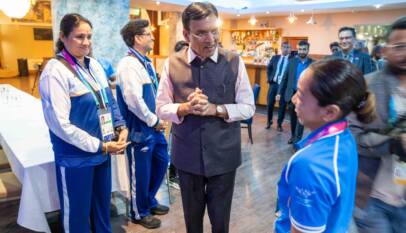
Mandaviya Hails India’s Winning Start at Commonwealth Games as Bowlers Shine in Glasgow
Glasgow, July 2026 : Union Minister for Youth Affairs and Sports Dr. Mansukh Mandaviya …