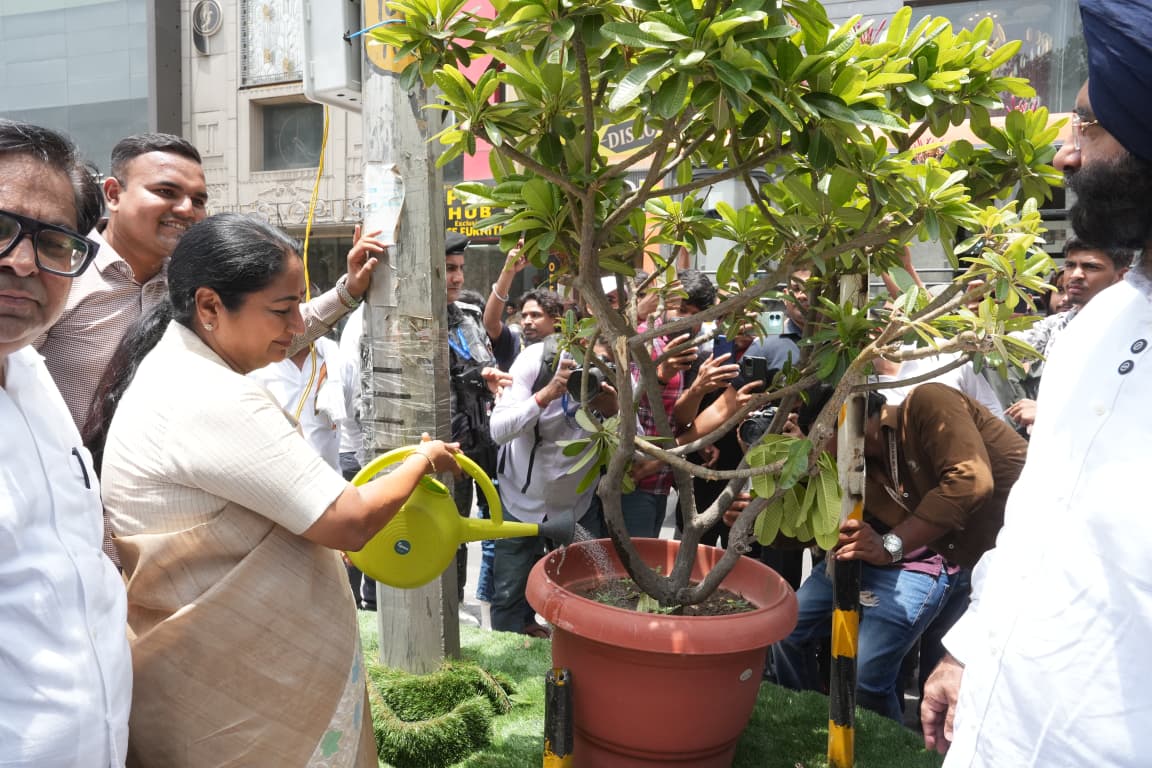
Made-in-India Technologies Take Aim at Pollution, CM Rekha Gupta Conducts Ground Inspection of Three Ultra-Modern Air Purifiers

Filter-Free Technology to Help Clean Delhi’s Air, Vehicle Emissions to Be Captured at the Source
Fight Against Pollution Will Continue All 365 Days of the Year, Not Just in Winter: Chief Minister Rekha Gupta
Delhi Government Is Working with a Multi-Pronged Approach to Control Pollution: Environment Minister Manjinder Singh Sirsa
New Delhi, May 2026 : Delhi Chief Minister Smt. Rekha Gupta on Saturday inspected three state-of-the-art Made-in-India air purification technologies installed in the capital. These technologies have been specifically developed to tackle urban air pollution, including dust, smoke, PM2.5, PM10 and other harmful pollutants. Delhi Environment Minister Sardar Manjinder Singh Sirsa was also present during the inspection. During the visit, the Chief Minister reviewed the advanced pollution-control systems and sought detailed information from officials regarding their functioning, pollution-reduction capabilities and the results achieved so far. She also held detailed discussions on their operation, maintenance requirements, capacity and the potential for large-scale deployment across Delhi.
Speaking on the occasion, Chief Minister Rekha Gupta said Delhi’s campaign against pollution is not confined to a few winter months but is a year-round commitment to ensuring clean air and better health for citizens. The Delhi Government, she said, is giving equal priority to innovative technologies, scientific research and innovation-driven solutions alongside conventional measures to achieve concrete and long-lasting results in making the capital pollution-free. She said that under the leadership of Hon’ble Prime Minister Shri Narendra Modi Ji, the Make in India initiative and innovation have gained a new identity. Technologies developed within the country are now offering effective solutions in critical areas such as environmental protection and public welfare. The Delhi Government is studying all such technologies that can help control pollution and can be deployed on a large scale in the capital.
Inspection of STR-101 Filter-Free Air Purifier

The Chief Minister first inspected the STR-101 filter-free air purifier system installed on Sat Guru Ram Singh Marg (Rama Road). A total of 21 units have been installed on electricity poles located along the central verge of the road. This modern outdoor air purification system is capable of reducing smoke, dust, PM1, PM2.5, PM10, carbon particles and other pollutants present in the air. Its high-frequency chip technology also works to neutralise bacteria and viruses in the atmosphere, thereby helping improve air quality. The Chief Minister said the system has the capacity to purify nearly three lakh litres of air every hour. It also helps reduce harmful gases such as sulphur dioxide, nitrogen dioxide and carbon monoxide. One of its key features is that it is a completely filter-free, self-cleaning and low-maintenance system that requires no consumable materials. It is also equipped with IoT-based live monitoring and data-tracking facilities, allowing continuous oversight of its performance.
Observation of India’s First EV-Mounted Anti-Smog Gun
The Chief Minister then inspected India’s first EV-based anti-smog gun operating on the Kirti Nagar-Mayapuri stretch. This is a completely zero-emission and mobile system that can be deployed in different locations as required. CM Rekha Gupta said the technology uses a high-pressure pump and high-speed fan to spray ultra-fine water droplets, creating an effect similar to artificial rain. These droplets collide with dust and other pollutants present in the air and help settle them, thereby reducing pollution levels. She said the technology helps create clean-air corridors, improves visibility and makes breathing easier for people. The system is equipped with real-time PM sensors and an IoT-based control mechanism that automatically operates according to air quality conditions, ensuring savings in both water and energy.
Inspection of PAWAN III Pollution Control System
The Chief Minister also inspected the PAWAN III roadside air pollution control device installed near the Kirti Nagar Fire Station. The technology has been developed to capture pollution emitted by vehicles close to its source. Installed on roadside dividers, the system draws in polluted air through a high-capacity suction mechanism and releases clean air back into the atmosphere after passing it through a multi-stage purification process. The Chief Minister said field trials conducted in Kolhapur, Maharashtra, recorded a reduction of nearly 29 per cent in particulate pollution levels. The system is capable of controlling pollution before it spreads into the surrounding environment. Owing to its low maintenance requirements and potential for large-scale deployment, it is being regarded as an effective technology.
Commitment to a Cleaner Delhi Through Technology
The Chief Minister said the Delhi Government has already made it clear that air pollution is not merely a seasonal challenge but an issue that requires sustained efforts throughout the year. With this approach, the government is working extensively on pollution control and environmental protection round the year. She said the Environment Department recently organised an Innovation Challenge in which innovators and startups from across the country presented several innovative solutions related to pollution control and environmental improvement. These innovations were evaluated with the support of experts from IIT Delhi. The best projects were selected and the process of implementing them in Delhi has been initiated.
The Chief Minister said the advanced pollution-control technologies and devices inspected today are among the innovations selected under the same initiative. The government has installed them as pilot projects at different locations to evaluate their effectiveness, and if found successful, they may be implemented on a larger scale. She added that the government will continue adopting new and effective solutions in the future so that the capital is better prepared before the onset of challenging pollution seasons. The Delhi Government is working with a 360-degree approach to pollution control. Continuous efforts are being made in all critical areas, including dust control, reduction of vehicular emissions, strengthening public transport, expansion of green cover and large-scale plantation drives.
Delhi Environment Minister Sardar Manjinder Singh Sirsa said the Delhi Government is conducting ground-level trials of modern, scientific and effective technologies to reduce air pollution caused by vehicles and other sources in the capital. He said 21 units of the STR-101 filterless air purifier have been installed on Rama Road. Together, they process nearly three lakh litres of air per hour and help reduce PM2.5, PM10, dust, smoke and other harmful gases. The IoT-enabled system is fully automated, operates according to weather and humidity conditions, and automatically shuts down during rainfall.
Sirsa explained that the device draws in polluted air, purifies it through electrostatic and dust-separation technologies, and releases clean air back into the environment. The particulate matter collected by the system is safely removed and disposed of in the form of bricks so that it does not re-enter the atmosphere. He added that these technologies are being monitored under the Indian Technical and Economic Cooperation (ITEC) programme and that the initiative also strengthens Prime Minister Narendra Modi’s Make in India vision.
The Environment Minister further said that under the Innovation Challenge, modern technologies such as the EV-mounted anti-smog gun, the PAWAN III device and the ShuddhVayu vehicle-mounted air filter are being tested at different locations across Delhi. He said the anti-smog gun helps settle dust and pollutants through ultra-fine water droplets, PAWAN III captures vehicular emissions at the source and releases cleaner air, while the ShuddhVayu system, mounted on moving vehicles, helps reduce PM10 and PM2.5 particles. The technologies will continue to be tested over the next two to two-and-a-half months under the supervision of National Physical Laboratory (NPL) and International Centre for Automotive Technology (ICAT). Those that successfully meet scientific standards will be considered for large-scale implementation in the future.
Japanese F-2 Fighter Reloaded With New Large Stealth Cruise Missile Under Its Wings.
Gifu Air Field, Kakamigahara City, Japan; August 2026: Yesterday (Friday – 31st July 2026)…

Japanese F-2 Fighter Reloaded With New Large Stealth Cruise Missile Under Its Wings.
Gifu Air Field, Kakamigahara City, Japan; August 2026: Yesterday (Friday – 31st July 2026) …