Trump Says Iran Talks Showing Progress, Warns Military Option Still on Table Amid Hormuz Tensions

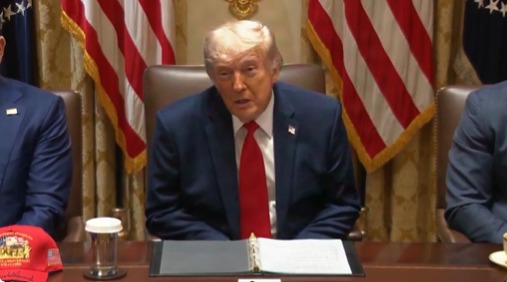
Washington, May 2026 : US President Donald Trump on Wednesday said negotiations with Iran were showing signs of progress, but warned that military action remained a possible option if diplomacy fails, as geopolitical tensions and oil market volatility continued to rise around the Strait of Hormuz.
Speaking at a Cabinet meeting at the White House, Trump reiterated that the United States’ primary objective was to prevent Iran from acquiring a nuclear weapon, describing it as a non-negotiable red line in ongoing talks.
“Iran cannot have a nuclear weapon,” Trump said. “I’m doing that for the world.”
He said Tehran had begun to show flexibility in negotiations, suggesting that Iran was making concessions under pressure, but stressed that Washington would only accept a “complete and strong” agreement.
“We can make a good deal right now, but maybe not a great deal, and if it’s not a great deal, we’re not making it,” he said, signalling that the US was prepared to walk away if conditions were not met.
Trump also directly linked the negotiations to heightened tensions in the Strait of Hormuz, one of the world’s most critical energy chokepoints, through which a significant share of global oil shipments pass daily. He ruled out any possibility of Iran gaining control over the strategic waterway.
“The Strait is going to be open to everybody,” he said. “Nobody’s going to control it. It’s international waters.”
His remarks came amid continued instability in global oil markets following recent military escalation involving Iran and fears that disruptions in the region could push fuel prices higher. Trump acknowledged that American consumers had experienced increased fuel costs but said the spike would not last long.
“Those prices are going to come down fast,” he said, attributing the outlook to increased US energy production and broader supply adjustments.
The President defended recent US military actions against Iran, claiming they had significantly weakened Tehran’s nuclear capabilities and delayed its progress toward developing a weapon.
“If they had a nuclear weapon, it would have been used already,” Trump said, arguing that American intervention had prevented what he described as an imminent threat.
US Secretary of State Marco Rubio echoed Trump’s position, stating that diplomacy remained Washington’s first choice, but emphasised that Iran would never be allowed to develop nuclear weapons under any agreement.
“The bottom line is Iran’s never going to have a nuclear weapon. Diplomacy is always the first option,” Rubio said.
He added that negotiators had achieved “some progress” and indicated that the coming days would be critical in determining whether a broader framework agreement could be reached between the two sides.
US Defence Secretary Pete Hegseth described recent US operations as part of a broader strategy to pressure Iran militarily and economically. He said Iran’s missile production capacity had been disrupted and its defence infrastructure significantly degraded.
“They may have missiles, but they can’t build more right now,” Hegseth said.
He also referred to ongoing efforts under “Operation Epic Fury,” which he said had intensified pressure on Tehran’s military and financial systems, adding that Iranian economic conditions were deteriorating sharply under sanctions and operational constraints.
Trump further claimed that the United States was now producing more oil than Russia and Saudi Arabia combined, arguing that strong domestic output would help offset global price shocks linked to instability in the Middle East.
He said large numbers of oil tankers were currently waiting near the Strait of Hormuz for clearance to pass through.
“You have about 1,400–1,500 boats in the strait wanting to get out, and at the right time we’ll release them,” he said.
Trump also suggested that any eventual nuclear agreement with Iran could be linked to wider Middle East diplomatic initiatives, including expansion of the Abraham Accords. He urged countries such as Saudi Arabia and Qatar to consider joining the framework, calling it a potential step toward long-term regional stability and economic cooperation.
(The content of this article is sourced from a news agency and has not been edited by the Mavericknews30 team.)



Delivery Of Second Indigenous Diving Support Vessel – ‘Nipun’
‘Nipun’ the second Diving Support Vessel (DSV), built by Hindustan Shipyard Limited&n…
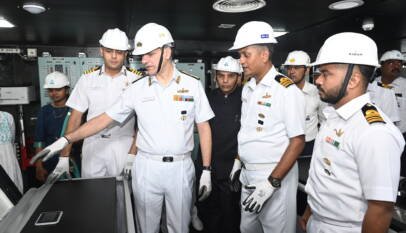
Delivery Of Second Indigenous Diving Support Vessel – ‘Nipun’
‘Nipun’ the second Diving Support Vessel (DSV), built by Hindustan Shipyard Limited was delivered to the …