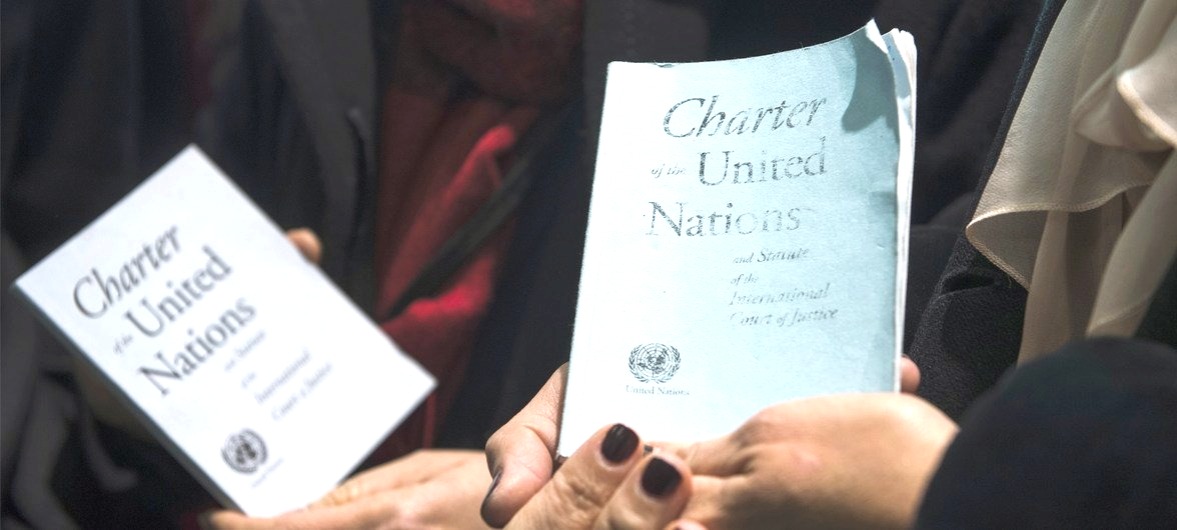
United Nations Secretary General Urges Renewed Commitment To Multilateralism On UN Charter Day.

Geneva; June 2026: Today early morning (Saturday – 27th June 2026, IST; Friday – 26th June ET), the United Nations Secretary General Antonio Guterres and General Assembly President Annalena Baerbock reaffirmed the principles outlined in the UN Charter and called for a renewed commitment to multilateralism at a General Assembly meeting marking the UN Charter’s 81st anniversary.
“The Charter was a promise to the world: That humanity can choose cooperation over chaos; law over lawlessness; dignity over domination; and hope over fear”, Secretary General Antonio Guterres said. Guterres and Baerbock has framed the Charter’s 81st anniversary as a call to defend the Charter’s principles while modernizing the UN, arguing that global challenges cannot be addressed without international cooperation.
Signed on 26 June 1945 in San Fransisco, the Charter is the founding document of the United Nations. It codified the major principles of international relations and outlined the UN’s goals of maintaining peace and security, reaffirming fundamental human rights, establishing the conditions for cooperation between states, and promoting social progress. Since then, 26 June has been recognized as UN Charter Day. The theme of this year’s commemoration is “Better Together: One Charter, One Future”.
The United Nations can take action on a wide variety of issues due to its unique international character and the powers vested in its Charter, which is considered an international treaty. As such, the UN Charter is an instrument of international law, and UN Member States are bound by it. The UN Charter codifies the major principles of international relations, from sovereign equality of States to the prohibition of the use of force in international relations.
Since the UN’s founding in 1945, the mission and work of the Organization have been guided by the purposes and principles contained in its founding Charter, which has been amended three times in 1963, 1965, and 1973.
The International Court of Justice, the principal judicial organ of the United Nations, functions in accordance with the Statute of the International Court of Justice, which is annexed to the UN Charter, and forms an integral part of it.
Meanwhile, at the just concluded General Assembly today early morning (IST), Guterres, Baerbock and several Member States renewed their commitments to the Charter’s principles. The commemoration came as the UN faces growing criticism over its ability to prevent conflicts and address global crises, with both speakers arguing that current challenges demonstrate the need for stronger multilateral cooperation rather than its abandonment.
The Secretary General said the UN’s founding promise of cooperation and dignity is under immense strain, citing wars of territorial expansion, civilians being targeted, broken ceasefires and selective enforcement of international law as examples of global challenges, while applauding the UN’s accomplishments, including peacekeeping, humanitarian aid, vaccination campaigns, conflict mediation, international justice and development assistance.
“The United Nations has never been perfect, but it is irreplaceable”, Guterres said, while adding that the Charter is ‘not an à la carte menu’, arguing that countries cannot selectively apply its principles on sovereignty, international law and human rights.
While responding to criticisms, Guterres and Baerbock called for reform but stressed that this reform should strengthen multilateralism and preserve the UN, rather than weakening it.
Annalena Baerbock argued the UN’s existence itself is ‘a miracle of humanity’, noting that today’s 193 Member States would struggle to create such an institution from scratch. She has also recognised the UN’s shortcomings, including its failure to prevent conflicts in Sudan, Ukraine, Gaza and Lebanon, and argued that the UN80 reform initiative is an opportunity to make the organization more agile and efficient.
In her speech, Baerbock celebrated achievements such as UNICEF immunisation campaigns that have saved more than 150 million children’s lives, decades of peacekeeping missions, expanded access to education and healthcare, and humanitarian assistance around the world, arguing that international cooperation remains essential to achieve these goals. “Multilateralism has not failed. Multilateralism works every day when humanitarian workers are delivering food even before sunrise in a crisis. Multilateralism works every day even if the Security Council is blocked, when peacekeepers protect civilians”, Baerbock said.
Team Maverick.




Drones Revolutionising Modern Warfare, Reshaping Global Defence Strategies
New Delhi, July 2026 : Drones have emerged as one of the most transformative technologies …

Drones Revolutionising Modern Warfare, Reshaping Global Defence Strategies
New Delhi, July 2026 : Drones have emerged as one of the most transformative …