Russia Is Negotiating Fuel Imports From Other Countries.

Moscow; June 2026: Russian Presidential Press Secretary Dmitry Peskov has informed that Russia is negotiating with other countries about the possible import of petroleum products. “This will be another step toward stabilising the market, aimed at reducing this surge in demand”, Peskov said. He added that imported fuel purchases would be possible if the parties were able to agree on cooperation “at acceptable prices”. However, Peskov declined to specify which countries could supply Russia with fuel.
The Russian spokesman emphasised that meetings on the gasoline situation in the country are held daily. He noted that President Vladimir Putin held an event on the topic last Sunday (28th June). A government working group, headed by Deputy Prime Minister Alexander Novak, is also constantly at work. The latter “is working on these issues virtually daily, on a hands-on basis. As for details, in this case, it’s best to contact the government, Alexander Novak’s office”, Dmitry Peskov concluded.
Meanwhile, the Vladimir Putin’s government has extended permission for certain refineries to produce Euro-3-compliant gasoline and diesel fuel on the Russian market. According to recent sources, the authorities may allow the production of gasoline and diesel fuel with lower standards, all the way down to Euro-2.
In a bid to saturate the domestic market, the Russian government may authorise the production of gasoline and diesel fuel with lower standards, down to Euro-2, for a year. Imports of such gasoline may also be permitted. Analysts note that this will allow the use of naphtha without deep refining, increasing gasoline supply by hundreds of thousands of tons/month. However, such fuel may be unsafe for modern vehicles.
The government may authorise the production and circulation of Euro-2, Euro-3, and Euro-4 gasoline and diesel fuel in Russia by July 2027. Methanol content for gasoline will be limited to 3%. Imports of gasoline with these specifications may also be permitted, and they will not be subject to compliance with EAEU technical regulations.
In the beginning of 2025, the government had authorised some refineries to produce Euro-3-compliant gasoline and diesel fuel for the domestic market. This permission was granted to refineries that held a certificate of registration as an entity engaged in petroleum refining operations. This included refineries that had signed agreements to commission new refinery units.
The current technical regulations stipulate a sulfur content of no more than 10 mg/kg for Euro-5 gasoline and diesel fuel, and 500 mg/kg for Euro-2. Euro-2 gasoline is also permitted to contain a higher proportion of benzene, and diesel fuel is permitted to have a lower cetane number, which is a measure of flammability (depicted in table below). The sale of Euro-2 fuel in Russia has been banned since 2013.
The situation on the fuel market worsened at the end of May 2025 amid a reduction in the supply of petroleum products, which led to higher prices at gas stations and a shortage of gasoline and diesel fuel in a number of regions.
Several gas station chains have imposed limits on fuel sales to customers. An official report of June 18, 2026 noted that gasoline inventories in Russia have fallen by several hundred thousand tons over the past three months. Analysts note that the situation is similar to what was observed in July–September 2025. At a meeting on the fuel market on June 28, President Vladimir Putin stated that the largest refineries are operating at maximum capacity, the potential of medium- and small-sized plants is being utilized, routine maintenance periods have been shortened, and scheduled maintenance has been postponed. According to Ministry of Energy data cited by the president, gasoline inventories have decreased by 04% year-on-year, to 1.7 million tons.
According to an official source, the relaxation of gasoline requirements to Euro-3 was likely insufficient to saturate the market with high-octane gasoline.
Dmitry Prokofiev, Communications Director at NEFT Research, notes that the key difference lies in sulfur content requirements and production complexity. He explained that – Euro-2 allows the use of naphtha as a base without deep refining, utilising facilities that cannot produce higher-quality fuel, and significantly simplifying the production process. According to the expert, the use of naphtha could increase gasoline production by hundreds of thousands of tons/month, and also opens up opportunities for importing cheaper fuel. However, he believes this is unlikely to fully compensate for the lost volumes.
Open Oil Market CEO Sergey Tereshkin has said that adjusting standards will reduce fuel production’s dependence on downtime at certain process units.
The risks to the vehicle fleet, he says, depend on the extent of production of fuel with lower environmental performance. Dmitry Prokofiev notes that for a large portion of modern vehicles, using Euro-2 fuel may be unsafe. However, in the regions, a significant portion of the vehicle fleet is still designed for low-quality fuel, so the authority’s decision favours fuel availability at the expense of quality, he adds.
As part of measures to stabilise the fuel market, the government has banned gasoline exports for all market participants until July 31st this year (2026) and may extend restrictions to diesel fuel exports to refineries.
Furthermore, the standard for gasoline sales on the exchange has been reduced from 15% to 10% for three months starting July 01, and the zero duty on gasoline imports into the EAEU is planned to be extended. The State Duma, in its third reading, passed a bill that will allow refineries to receive a reverse excise tax on motor gasoline produced by blending and establishes a procedure for calculating the damper on fuel produced in other EAEU countries and outside the Customs Union.
According to Kpler, in addition to lowering fuel production standards and increasing imports, including from Belarus, Azerbaijan, Central Asian countries, India, and Turkey, Russia may ban gasoline supplies under intergovernmental agreements and loosen controls on prices at gas stations. The latter step, however, is unlikely before the September elections, analysts say.
Team Maverick.



Parliament Paralysed for Second Day as Opposition Protests Over NEET Leak, Student Crackdown
New Delhi, July 2026 : Parliament remained deadlocked for the second consecutive day of th…
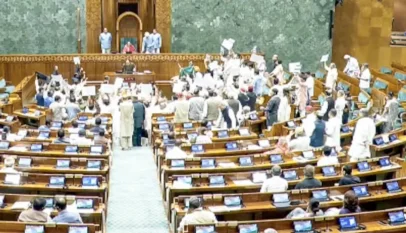
Parliament Paralysed for Second Day as Opposition Protests Over NEET Leak, Student Crackdown
New Delhi, July 2026 : Parliament remained deadlocked for the second consecutive day of …