Nirmala Sitharaman’s Saree Sends a Message Ahead of Union Budget

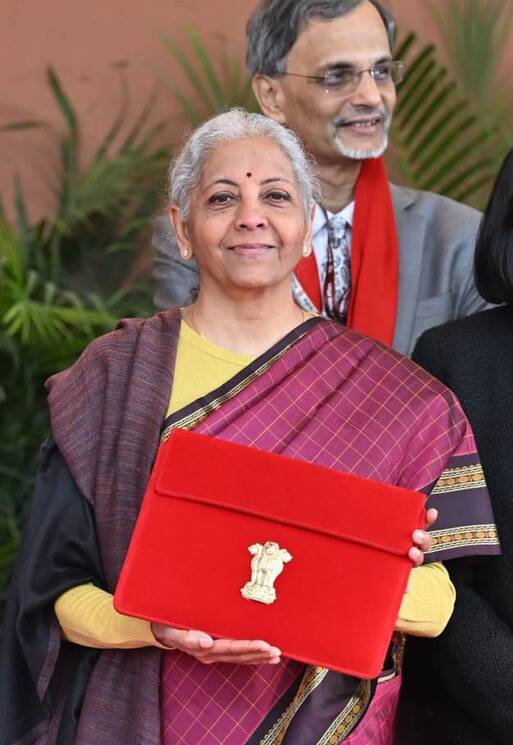
New Delhi, Feb 2026 : Ahead of presenting the 9th Union Budget, Finance Minister Nirmala Sitharaman arrived at the Parliament building on Sunday wearing a striking purple Kanjeevaram saree from Tamil Nadu, adorned with a rich golden border. As has now become a tradition, her choice of attire once again drew attention—not merely as a fashion statement, but as a symbolic gesture carrying deeper social, cultural, and economic messages.
Over the years, Nirmala Sitharaman’s Budget Day sarees have emerged as a unique medium of expression. Each saree she wears reflects India’s diverse handloom heritage, highlights regional craftsmanship, and subtly reinforces the importance of local artisans, rural economies, and women’s participation in nation-building. This year’s purple Kanjeevaram saree is particularly significant, both in its color and its origin.
The color purple holds a powerful association with women’s empowerment, dignity, justice, and equality. Globally, purple has been linked with the women’s rights movement and International Women’s Day, symbolising resilience and leadership. Its appearance on Budget Day has sparked discussions that this year’s Union Budget may place special emphasis on women-centric schemes, including education, healthcare, skill development, and financial inclusion. With Tamil Nadu also heading into an election season, the choice of a traditional Kanjeevaram saree from the state adds an additional political and cultural layer to the symbolism.
What special provisions the Budget may hold for women will be revealed when the Finance Minister presents it in Parliament at 11 AM. However, the visual message conveyed through her attire has already set expectations for a gender-sensitive economic agenda.
Nirmala Sitharaman began this meaningful tradition in 2019, her first Budget presentation as Finance Minister. That year, she wore a bright pink Mangalagiri saree with a golden border, marking a confident and historic beginning. Since then, each Budget Day saree has represented a different state, weaving India’s cultural diversity into the country’s most important economic announcement.
In Budget 2020, presented during the early phase of the pandemic, she chose a bright yellow silk saree with a green border—yellow symbolising hope, optimism, and prosperity during a period of uncertainty. For Budget 2021, she wore a red and off-white Pochampally Ikat silk saree from Telangana, showcasing intricate geometric designs and the excellence of traditional weaving.
In 2022, the Finance Minister opted for a deep brown Bomkai saree from Odisha, reinforcing the message of supporting age-old handloom traditions and local artisans. Budget 2023 saw her in a red Ilkal handloom silk saree from Karnataka, featuring traditional Kasuti embroidery and gold zari work, representing timeless Indian elegance.
For Budget 2024, Sitharaman chose a blue Tussar silk saree from West Bengal, decorated with delicate Kantha embroidery, highlighting the skill of regional artisans. Most recently, during Budget 2025, she wore an off-white Madhubani saree from Bihar, gifted by Padma Shri awardee artist Dulari Devi, beautifully promoting folk art and women-led craftsmanship.
Through these carefully chosen sarees, Nirmala Sitharaman has transformed Budget Day attire into a powerful narrative—one that blends economics with culture, tradition with progress, and policy with people.



Sonam Wangchuk Stable but Under Close Observation After 21-Day Hunger Strike, Says Safdarjung Hospital
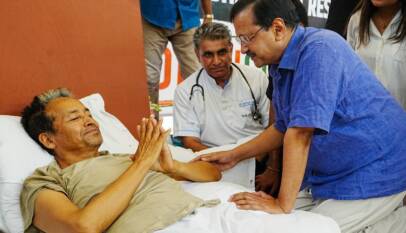
New Delhi, July 2026 : Innovator, educator and climate activist Sonam Wangchuk is stable b…
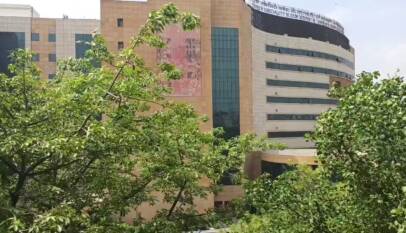
Sonam Wangchuk Stable but Under Close Observation After 21-Day Hunger Strike, Says Safdarjung Hospital
New Delhi, July 2026 : Innovator, educator and climate activist Sonam Wangchuk is stable …