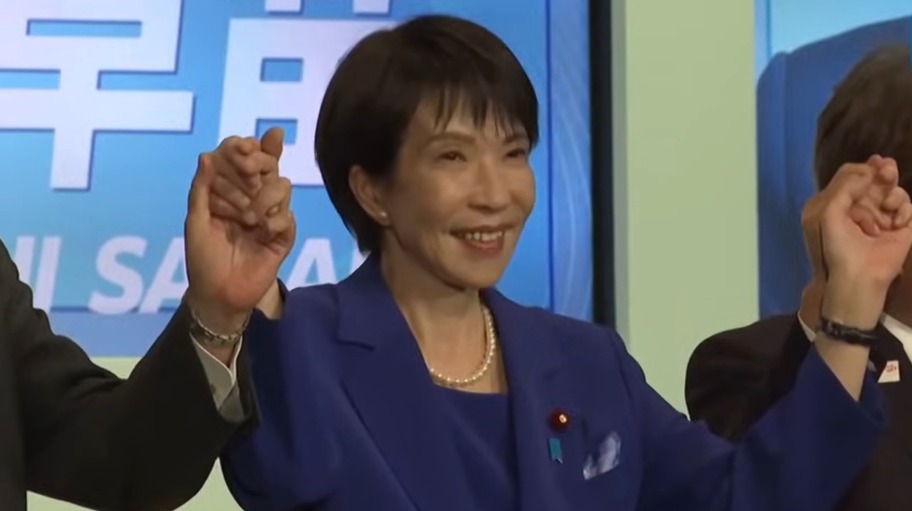
Takaichi’s LDP Poised for Strong Mandate in Snap Japan Election, Exit Polls Show

Feb 2026 : Japanese Prime Minister Sanae Takaichi’s Liberal Democratic Party (LDP) is on course for a comfortable solo majority and could even secure a two-thirds supermajority with allies in the snap general election held on Sunday, according to exit polls published by major Japanese media outlets.
An exit poll conducted by public broadcaster NHK projected that the ruling LDP would win between 274 and 328 seats in the 465-member House of Representatives, comfortably surpassing the 233-seat threshold required to form a majority government. The estimates underscore a decisive endorsement of Takaichi’s leadership, just weeks after she took the bold step of dissolving parliament and calling an early election.
When combined with seats expected to be won by the Japan Innovation Party (Ishin)—the LDP’s current coalition partner—the ruling bloc could command as many as 366 seats, a tally that would allow it to pass legislation and constitutional initiatives with relative ease. Such an outcome would significantly strengthen Takaichi’s hand as she seeks to push through economic and security reforms.
As projections of her victory emerged, congratulatory messages poured in from world leaders, including Indian Prime Minister Narendra Modi, marking a moment of international recognition for Japan’s first-ever woman Prime Minister. Addressing reporters after the release of exit polls, Takaichi reiterated her commitment to what she described as an “aggressive but responsible” fiscal approach.
“We have consistently stressed the importance of proactive fiscal policy,” she said. “At the same time, sustainability will remain our priority. We will ensure that necessary investments are made while maintaining fiscal discipline.”
Voting began early Sunday morning across Japan, with 1,284 candidates contesting 465 seats in the powerful lower house. Of these, 289 members are elected from single-member constituencies, while the remaining 176 seats are allocated through proportional representation across 11 regional blocs.
The election was widely seen as a referendum on whether the LDP–Ishin coalition should continue in power under Takaichi’s leadership, or whether opposition parties could expand their presence enough to block the government’s legislative agenda. According to analysts cited by Xinhua news agency, the ruling bloc entered polling day with a clear advantage, though uncertainty lingered due to undecided voters.
Recent surveys by Kyodo News and other major outlets suggested that the newly formed opposition grouping, the Centrist Reform Alliance—launched by the Constitutional Democratic Party of Japan along with Komeito, a former LDP ally—was struggling to gain traction and appeared set to lose seats compared to its pre-election strength. However, pollsters cautioned that a sizeable portion of the electorate remained undecided until the final hours of voting.
Complicating the political landscape further are the lingering slush fund scandals involving factions within the LDP. While the controversies did not appear to derail the party’s overall prospects, they injected an element of volatility into the race and provided ammunition for opposition criticism during the campaign.
Takaichi’s decision to dissolve the lower house on January 23 was historic, marking the first such dissolution at the opening of a regular parliamentary session in 60 years. She framed the move as a bid to seek a fresh mandate, but critics accused her of prioritising political strategy over legislative responsibility—particularly the passage of an initial budget for fiscal year 2026, which begins in April. Takaichi has pledged to resign if the ruling coalition fails to retain its majority.
Sunday’s vote also carried logistical challenges. It was the first lower house election held in February since 1990, and heavy snowfall along the Sea of Japan coast raised concerns about transportation disruptions and voter safety. Officials had warned that adverse weather conditions could suppress turnout in affected regions, potentially influencing final results.
Polling stations closed at 8 p.m. local time, with vote counting expected to continue late into the night. While official results were still awaited, exit polls suggested that Japan is heading toward a period of political continuity, with Prime Minister Takaichi emerging strengthened and better positioned to pursue her policy agenda at home and abroad.
(The content of this article is sourced from a news agency and has not been edited by the Mavericknews30 team.)







Govt. to formulate policy to provide relief in encroachment cases involving poor and landless families: CM
Chief Minister Thakur Sukhvinder Singh Sukhu today laid the foundation stone of the new Mu…

Govt. to formulate policy to provide relief in encroachment cases involving poor and landless families: CM
Chief Minister Thakur Sukhvinder Singh Sukhu today laid the foundation stone of the new …