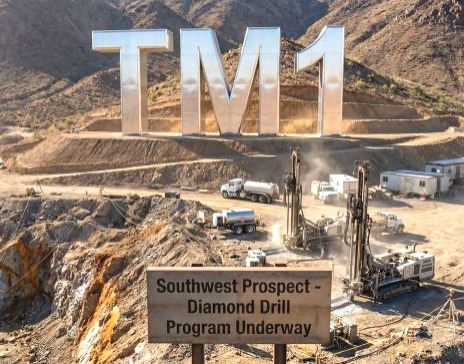
Abundance Of Platinum Unearthed In Dante, Western Australia.

Dante, Australia; February 2026: Terra Metals Limited has reported new assay results from 03 drill holes at the Southwest SW6 Prospect, one reverse circulation (RC) hole and two diamond tail extensions, saying the results support the scale and continuity of its platinum group metals (PGM)–copper–nickel (Cu–Ni) sulphide system.
The prospect is part of TM1’s Dante Project in Western Australia’s West Musgrave region, which hosts what is described as a globally significant multi-metal discovery within the Jameson Layered Intrusion, part of the Giles Complex, a large mafic-ultramafic system the company compares in scale and style to South Africa’s Bushveld Complex.
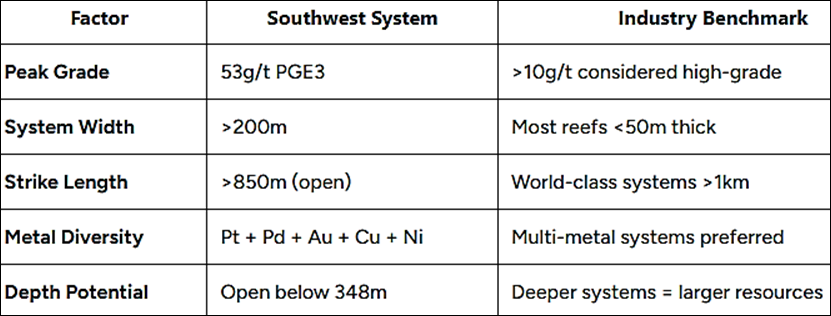
The latest results confirm what appears to be a globally significant platinum group metal (PGM) sulfide system, with mineralisation now defined over an apparent thickness exceeding 200 metres and remaining open at depth beyond 348 metres. Terra Metals has demonstrated remarkable continuity and scale through its systematic exploration programme.
The highlight intercept delivered:
- an extraordinary 31.1g/t PGE3 (1 ounce per ton) over 0.3 metres, representing some of the highest-grade PGM mineralisation reported globally.
- Furthermore, the exceptional discovery sits within broader zones of substantial mineralisation, including 61m @ 1.41g/t PGE3 and 82.4m @ 1.14g/t PGE3, demonstrating both exceptional grades and substantial widths.
The SW6 drilling programme has intersected multiple wide zones of high-grade mineralisation, with all holes returning significant PGM intercepts to end-of-hole. These results showcase the scale and consistency of the mineralised system across the prospect area.
SSWRC031 + SWDD006 (Combined Results):
- 61m @ 1.41g/t PGE3, 0.13% Cu, 0.19% Ni from 172m
- Including 35m @ 1.59g/t PGE3 from 198m,
- Including 1.1m @ 12.67g/t PGE3 from 226.6m,
- Including 0.3m @ 31.1g/t (1 oz/t) PGE3 from 226.6m.
- 82.4m @ 1.14g/t PGE3, 0.11% Cu, 0.11% Ni from 262m to end-of-hole
- Including 25.88m @ 2.25g/t PGE3 from 267.12m.
SSWRC029 + SWDD007 (Combined Results):
- 89m @ 0.96g/t PGE3, 0.09% Cu, 0.14% Ni from 144m
- Including 29.9m @ 1.20g/t PGE3 from 152m,
- Including 9m @ 2.01g/t PGE3 from 152m,
- Including 1m @ 8.76g/t PGE3 from 190m.
The consistency of mineralisation across multiple drill holes, combined with the substantial widths and high grades, confirms the presence of a major magmatic sulfide system. Consequently, these results establish the Southwest prospect as a potentially world-class PGM discovery.
Platinum-Rich Zones Add New Dimension –
A significant development in the latest results is the identification of platinum-rich zones, contrasting with the predominantly palladium-dominant mineralisation previously reported at Southwest. The highest-grade intercept contained 17.8g/t platinum, demonstrating the diversity of the precious metals system.
The platinum enrichment adds an important strategic dimension to Terra Metals’ discovery, as platinum typically commands premium pricing and industrial demand. In addition, the presence of both platinum and palladium-rich zones suggests a complex, multi-phase magmatic system capable of hosting diverse precious metal endowments.
Understanding PGM Sulfide Systems: A Primer for Investors –
PGM (Platinum Group Metal) sulfide systems represent some of the most valuable mineral deposits globally. These systems form when magmas become saturated with sulfur, creating sulfide liquids that concentrate precious metals including platinum, palladium, and gold.
Key characteristics that make these systems valuable:
- High metal grades: PGMs are naturally concentrated in sulfide liquids
- Multiple metals: Systems typically contain platinum, palladium, gold, copper, and nickel
- Industrial demand: PGMs are essential for automotive catalysts, electronics, and hydrogen technology
- Supply constraints: Global PGM production is dominated by a few major deposits
The Southwest discovery exhibits classic features of world-class PGM systems, including thick mineralised zones, high metal grades, and evidence of a large-scale magmatic plumbing system. However, what sets this Terra Metals Ltd platinum group metal discovery apart is the exceptional continuity and scale demonstrated across multiple drill holes.
Magmatic sulfide systems develop when molten rock becomes saturated with sulfur compounds. During this process, sulfide liquids separate from the main magma and concentrate precious metals. The sulfide liquid acts like a metal collector, gathering platinum group elements from large volumes of magma before crystallising into ore deposits.
For instance, the Southwest system appears to represent a vertically connected position within this type of magmatic plumbing system. The consistent mineralogy and metal ratios across different drill holes support this interpretation.
Scale Potential Demonstrated Across 850m Strike: The SW6 prospect sits approximately 850 metres north of the previously announced SW5 discovery, which reported exceptional grades up to 53g/t PGE3 (1.70 oz/t). The separation demonstrates the scale potential of the Southwest system, with high-grade mineralisation occurring across multiple centres within a broader intrusive complex.
System Scale Indicators:
- Mineralised strike length: >850m (and growing)
- Vertical extent: >200m (open at depth)
- Multiple high-grade centres: SW5 and SW6 confirmed
- Consistent mineralogy: Sulfide-rich magmatic system
- Electromagnetic targets: Large conductor plates identified
Chief Geologist Dr. Solomon Buckman noted: “This proximal-distal palladium-platinum zonation is characteristic of large, long-lived layered mafic intrusions and suggests that Southwest occupies a vertically connected position within a magmatic plumbing system”. Furthermore, the expanding scale of mineralisation indicates that Terra Metals Ltd platinum group metal discovery may be part of an even larger system than initially anticipated.
Downhole electromagnetic (EM) surveying has identified a large off-hole conductor (>100m x 150m modelled plate) positioned directly beneath the 31.1g/t PGE3 intercept. The conductor represents a high-priority follow-up target, potentially indicating additional sulfide accumulation at depth.
The conductor’s size and position provide compelling evidence for continued mineralisation below current drilling, supporting the interpretation of a vertically extensive feeder system. Consequently, the electromagnetic target will be prioritised in the upcoming Phase 4 drilling programme.
Terra Metals has announced its largest ever drilling programme, with four drill rigs being mobilised for up to 30,000 metres of diamond and reverse circulation drilling commencing in March 2026. According to the announcement, the programme will focus immediately on expanding the Terra Metals Ltd platinum group metal discovery.
Immediate Priorities:
- Vertical extensions of SW5 and SW6 high-grade discoveries
- Lateral extensions along the 850m mineralised corridor
- Electromagnetic conductor testing beneath SW6
- Resource definition drilling across priority zones
Strategic Objectives:
- Define the full extent of the Southwest sulfide system
- Test for additional mineralised centres along strike
- Establish geometric controls on high-grade zones
- Advance towards maiden resource estimation
The scale of the drilling commitment demonstrates management’s confidence in the system’s potential and their commitment to rapidly advancing the discovery. In addition, this aggressive exploration approach positions the company to capitalise on the momentum from recent exceptional results.
Investment Thesis: World-Class Discovery Potential –
Terra Metals’ Southwest discovery exhibits characteristics consistent with world-class PGM sulfide systems. The combination of exceptional grades (up to 1 oz/t PGE3), substantial widths (>200m mineralised thickness), and system scale (>850m strike length) positions this as a potentially globally significant discovery.
Key Investment Drivers:
Team Maverick.







Australia Calls India a Top-Tier Security Partner, Unveils Landmark Defence and Energy Agreements
Canberra, July 2026 : Australia on Thursday described India as one of its most important s…
Australia Calls India a Top-Tier Security Partner, Unveils Landmark Defence and Energy Agreements
Canberra, July 2026 : Australia on Thursday described India as one of its most …