India AI Impact Summit 2026 Session Highlights Shift from Compute Access to Innovation Capability in AI Ecosystem

“Building AI Readiness: From Compute to Capability” Session Focuses on Converting GPU Access into Scalable, Market-Ready Solution
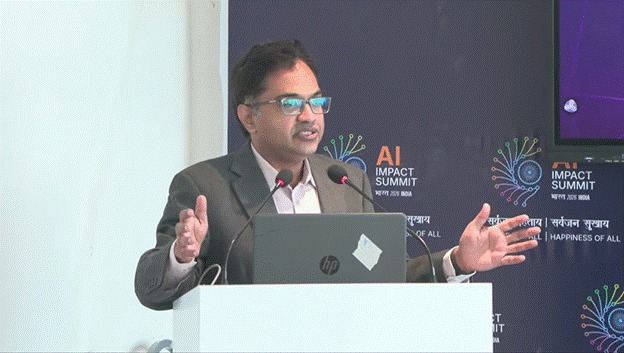
Change Management Alongside Compute Access Crucial to Accelerate AI Adoption in SME: Dr Paneerselvam M, CEO, MeitY Startup Hub
Panel Calls for Informed Investment, Accessible Experimentation and Strong R&D Foundations to Drive AI Competitiveness
As generative AI moves from experimentation to production-scale deployment, the session “Building AI Readiness: From Compute to Capability” at the India AI Impact Summit 2026 focused on a less visible but decisive question: how to convert access to GPUs into real innovation capacity. The discussion reflected a clear shift in the ecosystem, from chasing peak compute performance to designing infrastructure, software environments, and business strategies around specific AI workloads and pathways to market.
For India’s startups and developers using the IndiaAI compute platform, speakers noted that the challenge is no longer availability of hardware alone, but knowing what to build, how to optimize for it, and how to scale sustainably. GPU selection is now tied to memory architecture, interconnect efficiency, cost economics, and deployment models, making AI readiness as much about technical decision-making and organisational change as about raw processing power.
Dr. Panneerselvam M, CEO, MeitY Startup Hub, Ministry of Electronics & Information Technology, emphasised that AI adoption in India requires not only access to compute and capability but also “change management”, particularly for SMEs and legacy businesses navigating a fundamentally different technology adoption cycle. He said, “It is very interesting that, unlike in the past where most software was first adopted by enterprises and then the data percolated into individual usage, we are now seeing a first-of-its-kind change. It is powerful in that way. Having said that, when we discuss the topic of AI readiness—from compute to capability—I would also add one more ‘C’ to it: change management. I think there is a fundamental need for businesses, especially SMEs and startups, to recognize this opportunity because you are almost entering this market as a retail force. However, for legacy businesses in India, where SMEs are largely owner-proprietor or family-driven, the challenge remains unique.”
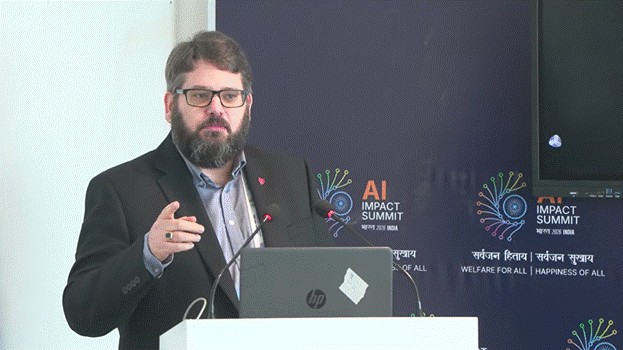
Timothy Robson, AI Business Development Director, EMEAI & APeJ, Datacenter GPU, emphasised the importance of informed investment and accessible experimentation environments in accelerating ecosystem growth. “Before making significant investments, it is critical for organizations to fully understand the technology and their path to market. We are committed to supporting this ecosystem by lowering the barrier to entry; through initiatives like our Dev Cloud and offering free compute hours, we enable developers to test their specific use cases. With a significant total cost of ownership (TCO) advantage, AMD is ensuring that startups have the tools and the economic efficiency they need to scale.
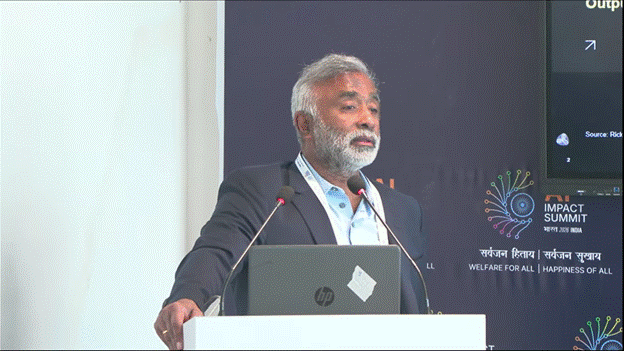
Dr. Thomas Zacharia, Senior Vice President – Strategic Technology Partnerships & Public Policy , AMD, highlighted the central role of research depth and innovation ecosystems in determining global leadership in AI. “I think that if you look at countries that are leading in AI, there is a very strong R&D and innovation foundation that allows them to lead. This is because there are people who are questioning everything to ensure it is validated. It is about continuing to start up innovation labs to take these ideas and start new companies; many of these new technologies may be led by people with new ideas and opportunities, and of course, ultimately, by enterprise and public sector adoption.”
The session underscored a common message that the AI leadership will be shaped not only by access to compute, but by the ability to translate infrastructure into innovation through strong research ecosystems, startup participation, market clarity and organisational readiness. As India scales its sovereign compute capacity and expands access through national platforms, the next phase will depend on how effectively these capabilities are converted into real-world deployment and globally competitive solutions.







Vijender Singh Questions Rahul Gandhi Over Silence on India’s Commonwealth Games Success
New Delhi, Aug 2026 : Olympic medallist boxer Vijender Singh has questioned Congress leade…

Vijender Singh Questions Rahul Gandhi Over Silence on India’s Commonwealth Games Success
New Delhi, Aug 2026 : Olympic medallist boxer Vijender Singh has questioned Congress leader …