
Experts Discuss Role of Open Networks and Digital Public Infrastructure in Scaling AI at India AI Impact Summit 2026

Digital Public Infrastructure Seen as Key to Scaling AI in Healthcare, Agriculture and Public Services
Leaders Call for Affordable, Easy-to-Use and Multilingual AI for Wider Access
Panel Emphasises Need for Inclusive and Replicable AI Models for Global Impact
The session “AI and Open Networks: Creating Impact at Scale” at the India AI Impact Summit 2026 set out a clear proposition: the future of AI will be determined not only by model breakthroughs, but by the digital public infrastructure and open network architectures that allow innovation to reach millions of people. Drawing on examples from healthcare, agriculture, science, and public service delivery, speakers demonstrated how India’s approach, combining consent-based data systems, interoperable platforms and open participation, has created the foundation for AI deployment at a population scale.
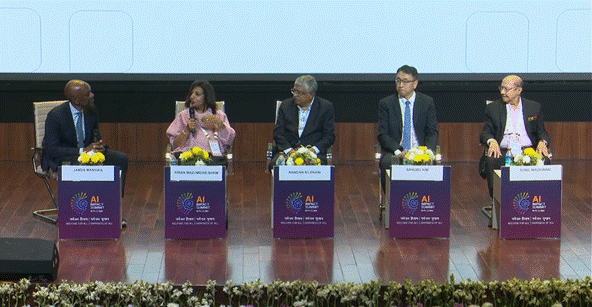
The session featured high-level discussions among Nandan Nilekani, Co-founder and Patron, Networks for Humanity; Kiran Mazumdar-Shaw, Chairperson, Biocon Group; Sangbu Kim, Vice President for Digital & AI, World Bank Group; Sunil Wadhwani, Founder, Wadhwani AI; and James Manyika, President, Research Labs, Technology & Society, Google & Alphabet, on how open networks and digital public infrastructure can enable AI deployment at population scale. From low-cost agricultural advisories and AI-enabled diagnostics to protein research and frontline service tools, the panel examined how reducing inference costs, simplifying user experience through agent-based interfaces and enabling multilingual access can turn AI into a mass-use technology rather than a specialist capability.
Nandan Nilekani, Co-founder and Patron, Networks for Humanity, underscored the importance of open networks in accelerating productive AI diffusion. Highlighting AI as a general-purpose technology, he said the real question is “what is the fastest way of diffusing its use in a productive way for people?” Drawing parallels with UPI’s open architecture, he emphasised that “open networks allow many actors and innovators to build applications at the edge using AI,” adding that “the real power of agents is removing complexity for the user.”
Kiran Mazumdar Shaw, Chairperson, Biocon Group, emphasised the transformative opportunity at the intersection of India’s digital health stack and AI. Highlighting the potential to build a global reference model, she said India can “immediately create a global reference model when it comes to the use of AI with the kind of health data we are connecting.” She added that the ultimate goal is “universal health coverage delivered at scale in a sustainable way.”
Sangbu Kim, Vice President for Digital & AI, World Bank Group, stressed the need for replicable and scalable models across countries. Emphasising global adaptability, he said the focus must be on “what elements can be replicated across governments and countries, and what the critical components really are,” noting that lessons from India are already being extended to multiple regions.
Sunil Wadhwani, Founder, Wadhwani AI, highlighted digital public infrastructure as the backbone of scalable AI deployment in the social sector. Emphasising practicality, he said, “You simply cannot build AI for the social sector without the kind of data and pipelines that DPI provides,” adding that without such infrastructure, large-scale deployment “would never scale to the levels we are seeing today.”
James Manyika, President, Research Labs, Technology & Society, Google & Alphabet, placed the discussion in a broader global innovation context. Highlighting the importance of access, he said, “access to AI is essential to unlock opportunities and expand the innovation capacity for people everywhere,” describing the pace of AI development as “an extraordinary opportunity to solve problems and empower people.”
The session concluded that open networks and DPI together create the institutional and technological foundation required to take AI from pilots to population-scale deployment. By combining low-cost inference, multilingual access and plug-and-play innovation frameworks, countries can build systems that are not only inclusive at home but also replicable across the globe, turning AI into a shared development capability rather than a concentrated advantage.








Amarnath Yatra Resumes After Six-Day Rain Halt, Pilgrims Hail Safety Arrangements and Renew Their Journey of Faith
Jammu, July 2026 : The annual Shri Amarnath Yatra resumed on Saturday after remaining susp…

Amarnath Yatra Resumes After Six-Day Rain Halt, Pilgrims Hail Safety Arrangements and Renew Their Journey of Faith
Jammu, July 2026 : The annual Shri Amarnath Yatra resumed on Saturday after remaining …