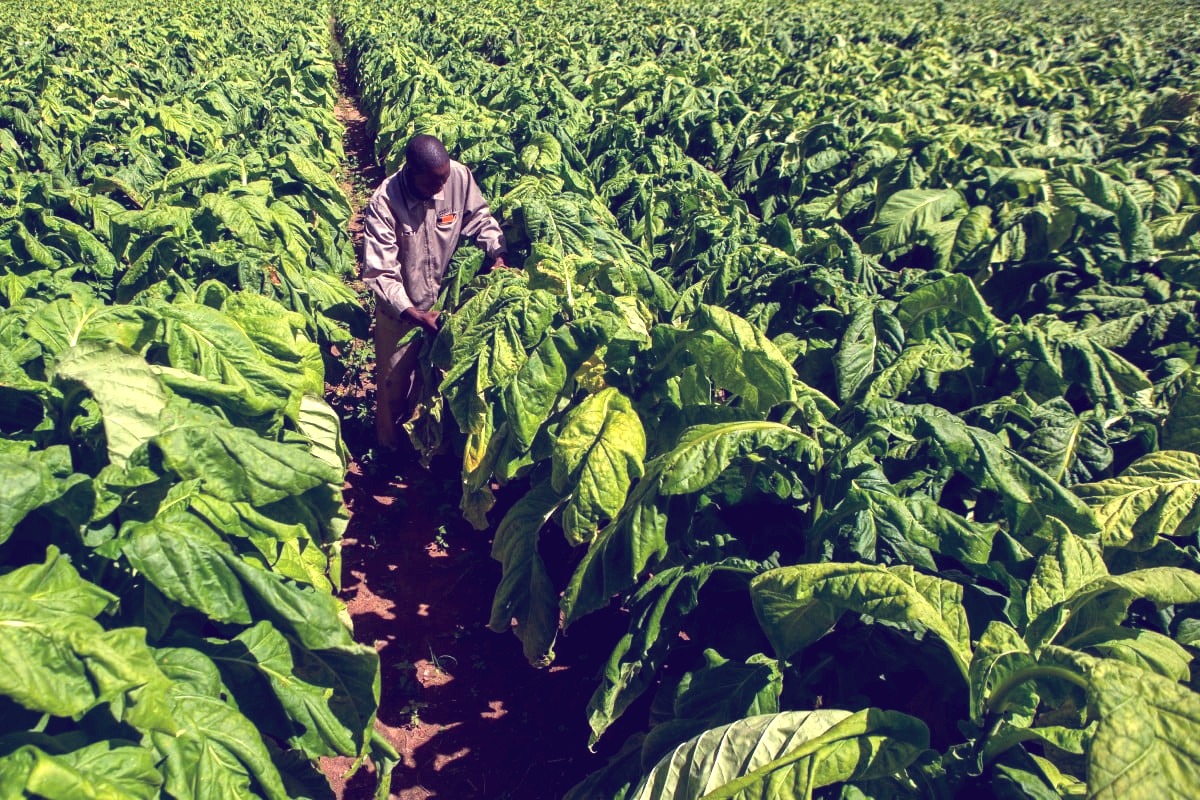
China Helps Zimbabwe Grow US$1.2 Billion Tobacco Crop Amid Debt, Health Concerns.

Harare; February 2026: Driven by Chinese demand, Zimbabwe produced a record 352.7 million kilograms of tobacco which is valued at about US$1.2 billion, in last year’s marketing season. This represents a major turnaround for an industry that, if not for Chinese investment, would have nearly collapsed two decades ago, although it remains a crop of concern for health campaigners.
As Zimbabwe’s largest agricultural export and a primary foreign currency earner, tobacco dominates its trade with Beijing. Last year, China imported US$790 million of the “golden leaf”, accounting for 31% of its total imports from Zimbabwe, according to the Chinese embassy in Harare.
Gorden Moyo, director of the Public Policy and Research Institute of Zimbabwe (PPRIZ), attributes these production levels to Chinese involvement, specifically by Tian Ze Tobacco Company (TZTC).
“It provided financial support through low-interest loans, zero mark-up on inputs and technical assistance to scores of contract farmers”, said Moyo, a former minister of state enterprises. The intervention proved vital after the industry was brought to its knees following the land reforms of the era of former leader Robert Mugabe that led to the exit of white commercial farmers and subsequent targeted Western sanctions.
According to the country’s Tobacco Industry and Marketing Board (TIMB), yields plummeted from 260 million kilograms in 1998 to a record low of 48 million kilograms by 2008 which is within a span of 10 years. As Western financing dried up, China offered to revive Zimbabwe’s tobacco industry as Beijing moved to secure supplies.
A turning point arrived in 2005 when Harare signed a memorandum of understanding with the China National Tobacco Corporation, paving the way for Tian Ze, a subsidiary of the corporation. This state-owned monopoly pioneered a contract farming model that provided smallholder growers with resource, mechanisation, low-interest loans and guaranteed purchases from smallholder growers. The Chinese-led approach reshaped the industry from a few hundred large-scale estates into more than 140,000 small-scale growers.
TIMB CEO Emmanuel Matsvaire last month said Chinese investors had stepped in and transformed the sector by increasing production volumes from a record low of about 40 million kilograms.
“When the Chinese arrived, they provided funding for infrastructure, mechanisation and direct inputs. Prices began to rise; the Chinese demand and appetite for tobacco also improved the prices offered to tobacco growers”, Matsvaire said in a documentary released last month to mark 45 years of China-Zimbabwe relations.
Ethel Hamadziripi, production manager at Tian Ze Tobacco, noted that following land redistribution, local farmers had lacked the means to self-finance. “This is when Tian Ze, facilitated by diplomatic relations, stepped in to begin funding our local farmers”, she said in the documentary while referring to the period when Mugabe’s government compulsorily acquired land from white commercial farmers to redistribute it to landless black Zimbabweans.
The partnership serves both nations: Zimbabwe is Africa’s top producer while China secures a steady supply for its massive domestic market.
Kai Xue, a Beijing-based corporate lawyer who advises on foreign direct investment and cross-border financing, highlighted the scale of the Chinese monopoly, which reported a combined tax and profit contribution of 1.6 trillion yuan (US$232 billion) in 2024. “At that scale, it is easy to see why the Chinese tobacco market sources tobacco from Zimbabwe, Brazil, Argentina and other producers outside China”, Xue said. He added that diversifying the supply also helped manage weather-related risks that could affect production in any single country in a given season.
Despite the growth, critics argue the contract system creates debt traps and public health issues.
Moyo said that while China’s support might have boosted tobacco production in Zimbabwe by offering favourable interest rates and knowledge to contract farmers, “concerns remain about high input costs, low tobacco prices, the danger of losing collateralised property and, more importantly, the escalation of health problems caused by smoking. The company determines the loan conditions while farmers remain rule-takers”, Moyo said. However, he said loans from local banks were unviable because of interest rates ranging between 12% and 17%. “This then forces farmers to surrender themselves to Chinese financing models”.
Tian Ze has said its prices are fair and that it provided interest-free loans for more than a decade. The company reportedly introduced a 04% interest rate in 2023, which remains significantly lower than the rates charged by other lenders.
Artwell Kadungure, director of the Training and Research Support Centre (TARSC) in Harare, confirmed that contract farming was a vital capital source, “yet also there were concerns raised with such arrangements, such as inflated prices of inputs, debt traps and so on”.
Beyond economics, the World Health Organization (WHO) issues regular warnings that the continued expansion of tobacco cultivation undermines global public health efforts to cut the supply and consumption of tobacco products. Zimbabwe’s focus on tobacco production creates difficulties for bringing about the WHO Framework Convention on Tobacco Control, which it ratified in 2014.
Moyo argues that while celebrating the economic implications of heightened tobacco production, it must be noted that China-Zimbabwe tobacco ties, with one a producer and the other a consumer, are a cause for concern for global health.
Team Maverick.







Iran Rejects US Peace Plan, Demands Permanent End to Conflict
Tehran, April 2026: Iran has rejected a US-proposed 15-point peace plan, instead putting f…

Iran Rejects US Peace Plan, Demands Permanent End to Conflict
Tehran, April 2026: Iran has rejected a US-proposed 15-point peace plan, instead putting forward …