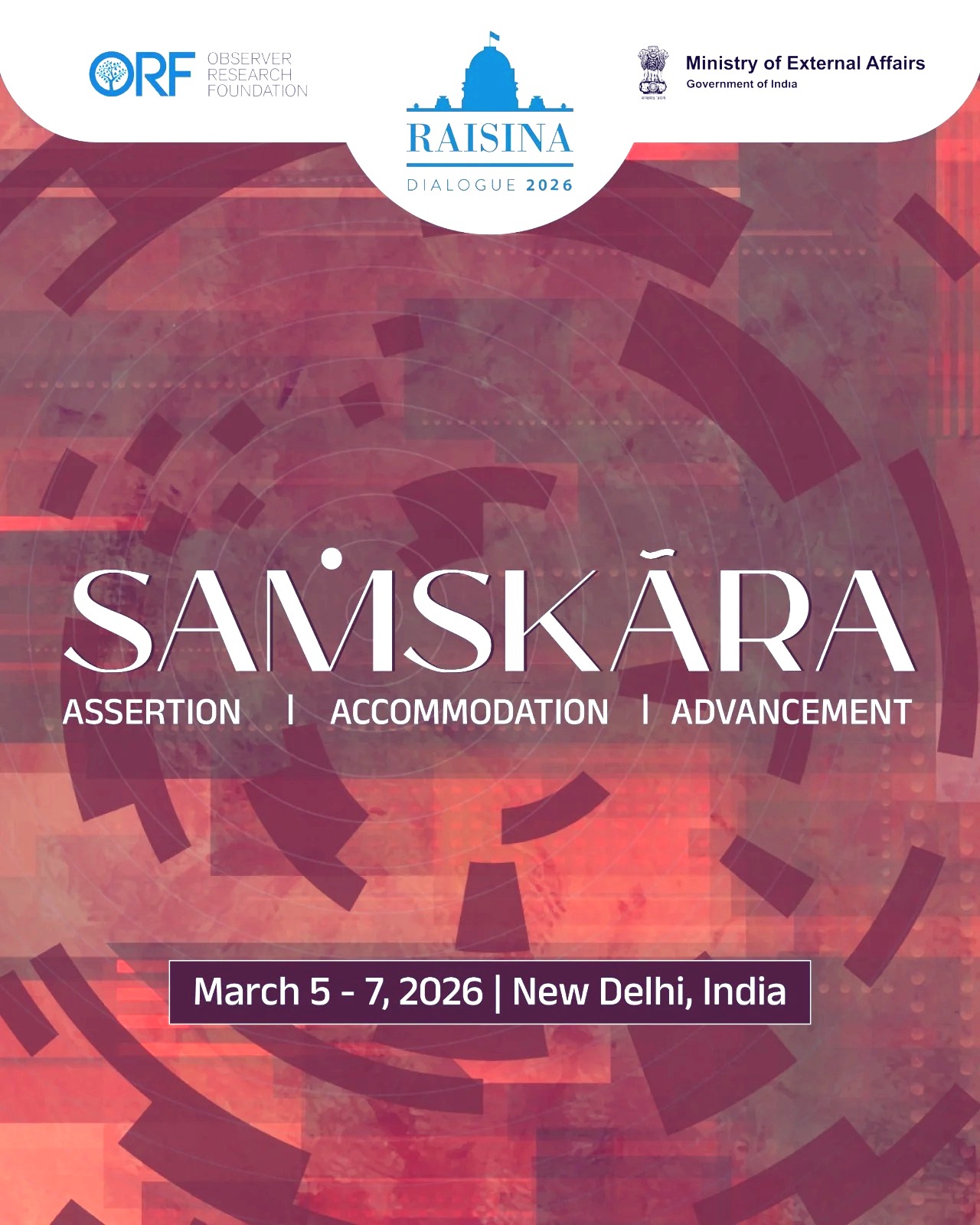
India Hosting Raisina Dialogue From March 3-6, Foreign Leaders To Grace The Programme.

New Delhi; March 2026: India’s premier geopolitical forum – 2026 Raisina Dialogue, will be commemorated at the national capital New Delhi from 05th March 2026 to 07th March 2026.
To be a part of the commemoration, United States Deputy Secretary Of States Christopher Landau is arriving today at New Delhi as per an official release by the US Embassy. According to the Embassy release, Landau will lead the US delegation alongside meeting senior Indian officials to discuss bilateral cooperation on defence, critical minerals, and counternarcotics. It will bolster commercial and economic ties to increase market access for American businesses and advance the shared vision for a free, open, and prosperous Indo-Pacific region.
Furthermore, at the invitation of Prime Minister Narendra Modi, the Finnish President Alexander Stubb is arriving tomorrow (04th March) to attend the Raisina Dialogue. President Alexander Stubb will be the Chief Guest and Keynote Speaker at the 11th Raisina Dialogue, 2026, in New Delhi.
President Alexander Stubb’s visit to India, which is his first after assuming the Presidential Office will include the participation of a high-level delegation of ministers, senior officials, and business leaders,
is aimed at deepening bilateral ties and expanding cooperation between India and Finland across various sectors, MEA said in its release.
In addition to his engagement at the Raisina Dialogue, President Stubb will hold discussions with the Prime Minister, focusing on strengthening bilateral relations and addressing regional and global issues of mutual interest. A key highlight of the visit will be an exchange of views on cooperation in multilateral forums, with an emphasis on deepening people-to-people connections and economic
Partnerships, as reiterated by the Ministry Of External Affairs (MEA) vide a Press Release. Following the discussions, Prime Minister Modi will host a luncheon in honour of President Stubb, the release said.
During his visit, the Finnish President will also meet with President Droupadi Murmu and Vice President CP Radhakrishnan. External Affairs Minister S Jaishankar will also meet President Stubb. After his time in the capital, President Stubb will travel to Mumbai, where he will meet with the Governor and Chief Minister of Maharashtra. He will interact with local business leaders and address students at the
University of Mumbai.
India and Finland share a warm and multifaceted relationship, anchored in shared democratic values. Finland plays an essential role as a partner for India within the European Union and the Nordic region.
President Stubb’s visit follows the recent visit of Finnish Prime Minister Petteri Orpo to India for the AI Impact Summit in February, a testament to both countries’ commitment to enhancing bilateral cooperation and fostering stronger ties.
Raisina Dialogue 2026 –
The Raisina Dialogue is India’s premier conference on geopolitics and geoeconomics, held annually in New Delhi since 2016. Organised by the Observer Research Foundation (ORF) in partnership with the Ministry of External Affairs (MEA), this three-day event convenes global leaders, policymakers, academics, industry experts, and journalists to discuss critical international issues.
Each edition of the Dialogue features vibrant debates and collaboration on topics ranging from shifting geopolitical alliances, climate change, technology, economic security, and evolving global governance systems. This year’s Raisina Dialogue returns with the theme that captures the moment we find ourselves in: Samskara – Assertion, Accommodation, Advancement. Samskara is the inheritance of identity that enables civilisations to assert who they are, accommodate the difference and advance through refinement.
Samskara, in its deepest essence, is a civilisational tool, a statement of continuity. It is the inheritance of meaning that allows societies to assert their truth, accommodate their contradictions, and advance through refinement. Today, nations are asserting sovereignty over borders and bandwidth alike — claiming their right to shape their economic futures, digital destinies, and industrial ambitions.
This era of assertion marks a shift toward greater autonomy, but alongside it comes a quiet current of accommodation. Across continents, new coalitions are emerging: agile, interest-driven, and plurilateral, replacing a multilateralism where consensus has stalled. New norms are being shaped, grounded in shared interests rather than universal agreement. Meanwhile, technology and governance are advancing their reach, bringing services, infrastructure and opportunity to long-underserved regions and communities.
Four conversations define the world in 2025:
(i) Between America and the world, seeking to repair and re-establish dominance;
(ii) between China and the world, in order to end or instrumentalise an economic asymmetry;
(iii) between the US and China, in a search for a new symmetry. But the fourth,
(iv) between the other powers of the world, great and small, is perhaps the most consequential.
It is a conversation about renewal over retreat, one that seeks to restore balance to the world – a conversation about structure, not merely about power.
Thematic Pillars –
Contested Frontiers: Power, Polarity, and Periphery: The global order is unsettled: Power is diffusing, polarities are shifting, and regions once peripheral have staked their claim to centrality. Resources are contested, technologies both miraculous and menacing, and the guardians of order are being outflanked by new actors and new theatres of conflict. New forms of war upend the consensus on how best to defend societies. Global commons — from oceans to orbits, from supply chains to cyberspace — have become global battlefields.
This pillar confronts the persistent shadow of conflict that hovers over the global landscape. Old threats mutate, new ones multiply, and frozen conflicts may burst aflame at any moment. The security order must be recalibrated to confront not only terror and ideology but also the technologies that enable them. Threats no longer lurk at the margins but pulse in civilisational centres, from divided societies to contested cyberspace, from the borders of Europe to the heart of Africa. How we navigate today’s storms will determine the shape and safety of the harbours we eventually find.
Repairing the Commons: New Groups, New Guardians, New Avenues: The global compact that supported the post-war order is fraying. The institutions that gave it life, the UN, the WTO, are struggling to serve a multipolar world. In this vacuum, agility replaces architecture. The world is being rewired, through mineral corridors, maritime linkages, and digital highways. South-South solidarities and new plurilateralisms are displacing old frameworks, creating flexible, interest-driven coalitions to shape global governance where consensus has stalled.
This pillar examines the connective tissue of the emerging order. India’s recalibration from BRICS to IMEC to the UFI trilateral underscores a new strategic grammar. The Global South is no longer a constituency, it is a coalition, a force multiplier for a fairer order. In this fluid landscape, India is not a balancing but a builder, creating new structures for leadership, resilience, and shared growth.
White Whale: The Pursuit of Agenda 2030: In a world diverting resources to security from solidarity, how can development aspirations be met? As 2030 draws ever nearer, ambition must give way to accountability. The Sustainable Development Goals, set in 2015, are facing a crisis. Progress has stalled, funding fatigue is visible, and planetary limits are closing in. The question now is not what was promised, but what can still be delivered.
This pillar asks what will take to recentre development in the global order. Can technology bridge gaps that politics has widened? What does gender equity mean in a digital, post-pandemic economy? What do the world’s young demand beyond rhetoric? Most importantly, can development survive in a world defined by division and self-absorption? If not, what must a post-SDG compact look like one grounded in realism, reciprocity, and responsibility?
The Eleventh Hour: Climate, Conflict, and the Cost of Delay: Across the world, nations are moving from pledges to action and accountability. Countries are putting into place the institutional systemic changes needed to finance and withstand the shock the future may bring. Green finance and investment are moving across borders, but not at the rate needed; governments, despite the uncertainty, are seeking to ensure that the supply chains that determine future prosperity are safeguarded.
In the absence of a worldwide consensus, emerging economies, on the frontline of the transition, must perforce assume leadership. They seek to design resilience, reduce harm, and adapt to what is already inevitable. The challenge is both moral and material: to replace apathy with agency, to turn the cost of delay into a call for action.
Tomorrowland: Towards a Tech-topia: Power today flows through the lines of an algorithm. Code defines identity, data dictates geopolitics, and AI shapes the wealth of nations. Technology is fast outpacing the ability of states to regulate it. We already know technology will shape us – but will we have a chance to shape technology first?
This pillar explores the evolving architecture of digital governance — the clash of regimes, the race for innovation, and the ethics of autonomy. Technology is redefining truth, work, and even personhood. The world must craft oversight that is agile yet anchored, inclusive yet secure. Progress may never be slowed, but it might still be steered to ensure that the machine serves humanity and not the other way around.
Trade in the Time of Tariffs: Recovery, Resilience, Reinvention: Electorates everywhere have demanded sovereignty over their economies. In response, nations are moderating their commitment to globalisation, recommitting to industrial policy, and asserting their right to self-reliance. Yet what could merely be fragmentation has also brought forth innovation. Nations are diversifying their partnerships and rethinking value creation beyond the traditional hierarchies. Constraint is breeding creativity.
This pillar studies the evolving map of global commerce. The old hierarchies of trade are dissolving, replaced by dynamic partnerships that balance competition with cooperation, sovereignty with interdependence, self-reliance and shared growth. Progress, as ever, is born not in ease but in effort — not despite adversity, but because of it
Team Maverick.



Taiwan Reaffirms South China Sea Claims After Philippines Submits Scarborough Shoal Chart to UN
Taipei, Aug 2026 : Taiwan on Sunday reaffirmed its sovereignty claims over islands in the …

Taiwan Reaffirms South China Sea Claims After Philippines Submits Scarborough Shoal Chart to UN
Taipei, Aug 2026 : Taiwan on Sunday reaffirmed its sovereignty claims over islands in …