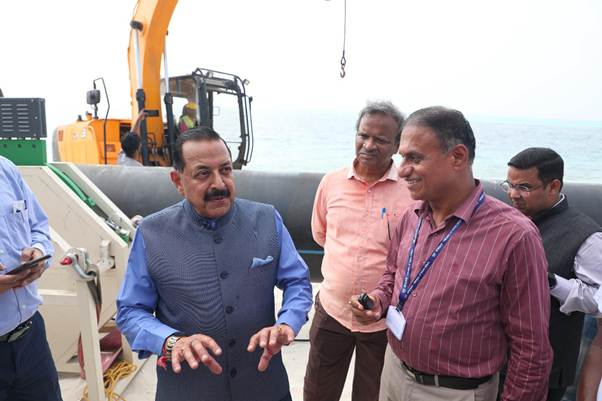
Dr. Jitendra Singh inspects upcoming ‘Ocean Thermal Energy Conversion’ (OTEC) Project in Lakshadweep, first of its kind in the world

The project to provide simultaneous Sustainable Water as well as Energy Supply
The Minister Bats for Ocean Energy to address electricity requirements of Island Territories, through self-reliant clean sources
OTEC Project in Lakshadweep Aims to bring ease of living with ecological compatibility
Union Minister for Earth Sciences and Science & Technology Dr. Jitendra Singh on Friday reviewed the progress of an Ocean Thermal Energy Conversion (OTEC) project during a visit to Kavaratti in Lakshadweep, as the government moves to strengthen freshwater availability and renewable energy use in island territories.
The Minister inspected the ongoing work at the OTEC-based desalination facility, a project designed to convert seawater into potable water by using the temperature difference between warm surface water and cold deep-sea water to generate energy. The energy produced is used to run desalination systems, aimed at providing a stable and sustainable supply of drinking water to the island community.
Officials said the project seeks to address long-standing freshwater challenges in Lakshadweep, where limited groundwater, salinity intrusion and dependence on seasonal rainfall have constrained reliable water supply.
During the visit, Dr. Jitendra Singh reviewed the physical and technical progress of the plant and examined key components such as the seawater intake system, the deep-sea cold-water pipeline, the turbine-generator unit and the desalination modules. He also interacted with scientists, engineers and project personnel involved in the implementation and reviewed timelines for commissioning along with environmental safeguards. Officials also briefed him on plans for an offshore OTEC demonstration project under the Deep Ocean Mission.
According to project officials, infrastructure development in Lakshadweep faces logistical and engineering challenges due to the region’s seabed conditions, which include coral formations, rocky strata and trenches. Work is also limited by narrow operational windows during monsoon months and rough sea conditions, requiring specialised design and installation approaches.
The OTEC-based system is designed to function as a continuous renewable energy source, unlike solar or wind power which depend on weather conditions. Officials said this could eventually reduce the dependence on diesel-powered desalination units, lowering fuel transportation costs and cutting emissions while ensuring uninterrupted water supply for the islands.
Globally, India is the first in the world to develop OTEC facilities, including projects in Japan and the United States. With the commissioning of the Kavaratti plant, India aims to join this group while exploring the technology’s potential for other tropical island regions and coastal areas.
During the visit, Dr. Jitendra Singh said island regions face distinct challenges related to water availability and energy security, and integrating ocean-based renewable energy with desalination could provide a long-term solution for sustainable development in such locations.
Officials said the project is part of broader efforts to promote ocean-based technologies under the government’s Blue Economy framework and to strengthen infrastructure, energy security and climate resilience in island territories.





Iranian Warship IRIS Lavan Docks in Kochi After Technical Fault Amid Rising Regional Tensions
Kochi, March 2026: An Iranian naval vessel, IRIS Lavan, docked at the port city of Kochi a…

Iranian Warship IRIS Lavan Docks in Kochi After Technical Fault Amid Rising Regional Tensions
Kochi, March 2026: An Iranian naval vessel, IRIS Lavan, docked at the port city …