From Traditional Womanhood to Self-Aware Humanity

The lines from a traditional verse — “O God, I do not ask for a necklace of gold; let the world give me respect, that alone is my adornment” — clearly reflect the long-standing aspiration of women for dignity and recognition. To fulfill these expectations, the state government, driven by social awareness, has made efforts through various schemes to help women gain self-respect. A process has begun to provide a clear path for women, who were once confined within the boundaries of the kitchen and childcare, to live confidently as individuals. This article highlights the journey from the suppressed voice expressed in traditional folk songs to the strength women have gained in a democratic system.
When we look at Indian rural life, a woman’s life often appears surrounded by labour, responsibilities, and family expectations. Managing the home, the farm, the family, and relationships, she quietly walked through the path of life. From the outside, her life seemed to represent patience and silent acceptance. However, when we look deeper into folk traditions, a different side of rural women emerges. Particularly in ovya (folk couplets), work songs, and grinding-stone songs, her emotions, experiences, and sense of justice are clearly expressed.
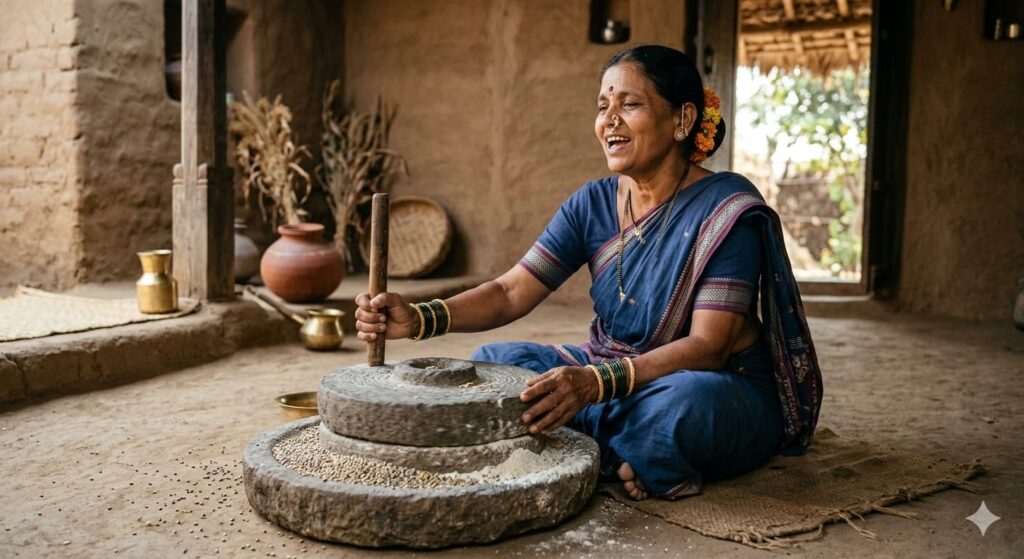
In earlier rural life, a woman’s day would begin before dawn. While completing household tasks, especially grinding grain on the traditional grinding stone, ovya would naturally flow from the women’s lips. The rhythm of the grinding would blend with the rhythm of words, and through that rhythm she would express her feelings.
“I grind jowar on the grinding stone,
but my heart goes back to my mother’s home.”
Through this couplet, the longing for her maternal home and the realities of married life are expressed naturally.
In rural life, a woman’s role was not limited to household work. Women actively participated in farm activities such as weeding, harvesting, and planting seedlings. While working together in the fields, they sang songs through which they shared the emotions of their lives.
“The row of weeding stretches long, the sun beats on the head,
where does a woman find time for rest?”
This couplet reflects the hardship of a woman’s life and her continuous labour.
One important feature of these traditional ovya is that they give expression to a woman’s experiences and thoughts. Often through these verses, women also raised questions about their lives.
“Mother-in-law says work, sister-in-law says do something else,
who will ask what this woman truly feels?”
This verse reflects the circumstances a woman faces while fulfilling responsibilities within the household.
Renowned folk literature scholar Dr. Tarabai Bhavalkar, while studying the ovya of rural women, noted that these verses are not merely for entertainment; they are reflections of women’s inner experiences and emotional worlds. Rural women rarely had the opportunity to speak openly in society, so they expressed their pain, questions, and sense of justice through these ovya.
Although in today’s changing lifestyle the traditions of grinding grain on a stone or singing collectively in the fields have declined, the emotions and experiences preserved in these verses still remain alive in collective memory. These ovya can be considered the oral history of rural women’s lives.
On the occasion of International Women’s Day, when we look at these traditional verses, we realize that the expression of women’s pain and aspirations has existed in our society for generations. These ovya are not merely a part of folk literature but an important cultural heritage that reflects women’s emotions, labour, and dignity.
In modern times, the government has implemented various people-oriented schemes for the holistic empowerment of women, giving them a new direction of self-awareness and self-reliance. Through the Women’s Economic Development Corporation, a movement of self-help groups has been created to economically empower women in both rural and urban areas. These groups have enabled millions of women to access savings facilities, credit support, and opportunities for small enterprises.
Considering women’s health and dignity, schemes such as the Rajmata Jijau Mother-Child Health Scheme, maternity assistance programmes, and various health facilities for safe deliveries in rural areas have been introduced. To promote girls’ education, several educational schemes, scholarships, and residential hostels named after Savitribai Phule have provided many girls with access to education.
For the economic empowerment of rural women, the UMED – Maharashtra State Rural Livelihood Mission is being effectively implemented. Through this mission, women’s self-help groups are being formed, encouraging savings, production, marketing, and small industries. This initiative is not only providing economic independence but also opening opportunities for social leadership among women.
In addition, the Chief Minister’s Ladki Bahin Scheme has become particularly important for women’s financial security. Under this scheme, eligible women receive monthly financial assistance, helping them meet their daily needs. This direct financial support strengthens women’s self-confidence and self-reliance.
Reservation for women in local self-government institutions has also ensured significant participation of women in decision-making processes. As a result, women’s leadership is emerging more strongly in the development of society. Because of these initiatives, today’s woman is no longer limited to the household. She is proving her abilities in politics, science, industry, administration, sports, and education, standing shoulder to shoulder with men. Her work is being recognised and respected in society.
The sense of justice and self-respect that emerged through the traditional ovya is now taking a broader and practical form through various people-oriented government schemes. The woman who once searched for dignity amid silent pain and struggle in folk traditions is today becoming more capable, confident, and self-reliant with the support of these initiatives.
Thus, the journey from traditional womanhood to the self-aware modern woman is not merely the story of an individual’s life; it represents the direction of Maharashtra’s social progress.
The silent voice that once echoed through folk traditions is now transforming into a new era of dignity, rights, and equality. Standing shoulder to shoulder with men in shaping society, the modern woman is becoming stronger, more confident, and self-reliant.
Therefore, on this International Women’s Day, one feels compelled to say:
“Respect a woman’s labour, give wings to her dreams,
Only on the path of equality can society truly progress.”


Bengal to Receive Over ₹1,700 Crore for Rural Roads and Employment Schemes, Says Suvendu Adhikari
New Delhi, June 2026 : Senior West Bengal BJP leader Suvendu Adhikari on Monday announced …
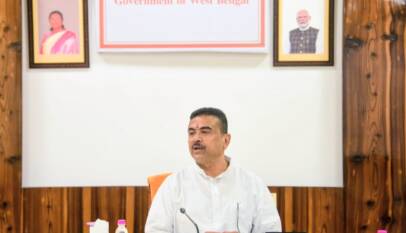
Bengal to Receive Over ₹1,700 Crore for Rural Roads and Employment Schemes, Says Suvendu Adhikari
New Delhi, June 2026 : Senior West Bengal BJP leader Suvendu Adhikari on Monday …